All species › Waders, gulls and terns › Skimmers, noddies, terns and gulls › Black-billed Gull
Black-billed Gull | Chroicocephalus bulleri
Zwartsnavelmeeuw | Gaviota maorí
The Black-billed Gull is the only gull in the world that breeds mainly on the shingle banks of braided rivers, and it occurs only in New Zealand. It is a slight, pale gull with long wings and a strikingly long, slender, jet-black bill — precisely the mark that separates it from the ubiquitous Silver Gull. In Māori it is the Tarāpuka, and it is the living face of the threatened riverbeds of the South Island.
Voice
Over a colony hangs a continuous high chatter: short sharp kak and kree notes given by hundreds of birds at once, together making a shrill clamour that carries far across the river. The alarm at a passing Kelp Gull or harrier is a hard repeated kek-kek-kek, at which the whole colony lifts as a single cloud and mobs the intruder. The voice is thinner and higher than the harsh screeching of a Silver Gull.
No freely licensed recording has been found for this species yet; what to listen for is described below.
Identification
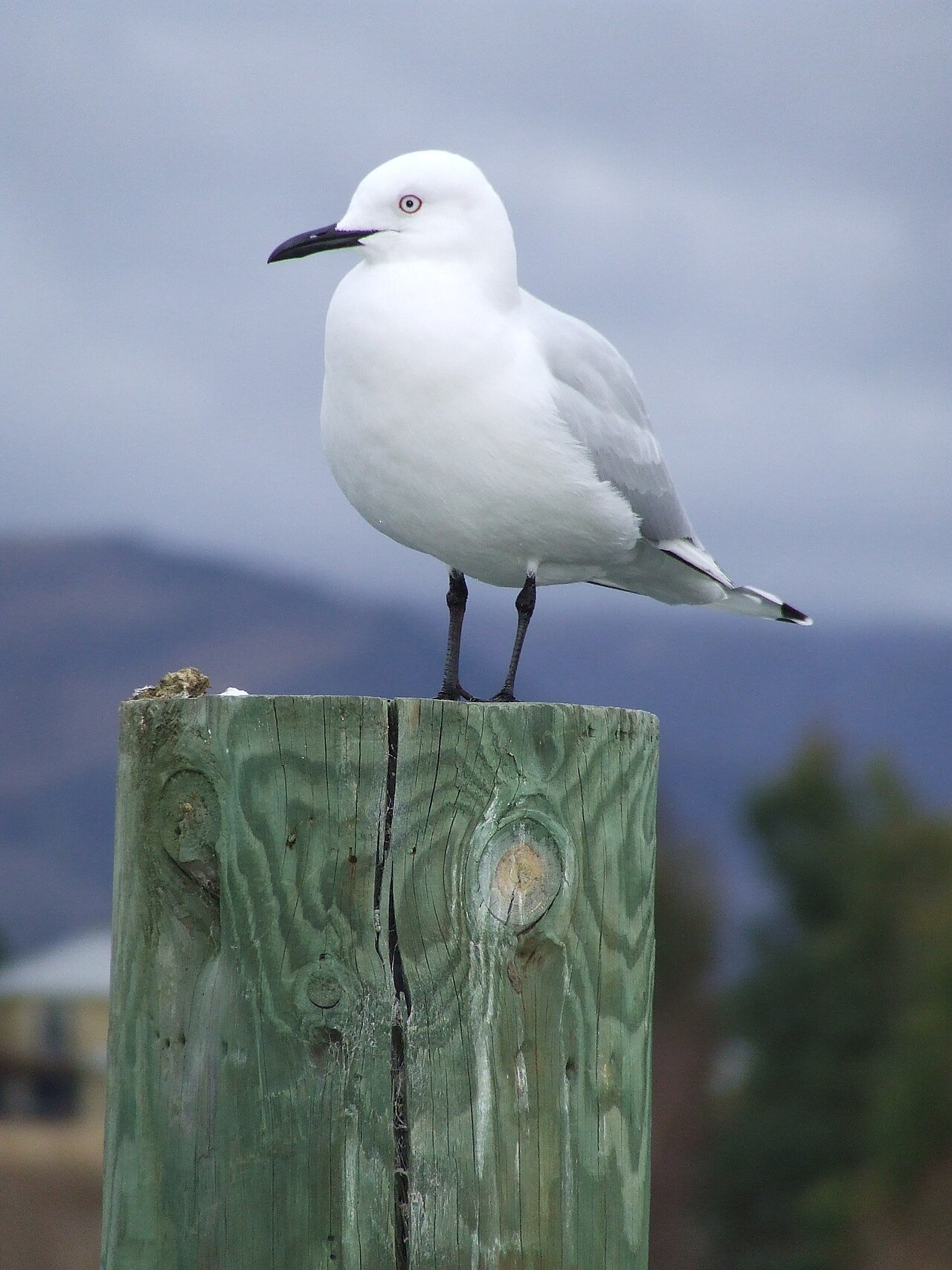
A small, slender gull of about thirty-seven centimetres, with a white head, neck and underparts and a very pale, pearl-grey mantle — lighter than that of any other gull here. The bill is the mark: long, slender, straight, and in the adult entirely black, sometimes with a dark red flush at the base. The legs are black to dark red-black and the eye is white with a thin dark ring. In flight what stands out is how much white there is in the outer wing: the primaries are largely white, with only a narrow black line along the leading edge and tip, where Silver Gull has a broad black tip with white mirrors. Young birds have a flesh-coloured bill with a black tip, brown markings on the wing and a black tail band. It never takes a hood.
Confusion species
Silver Gull (Chroicocephalus novaehollandiae) is the whole problem, standing everywhere in New Zealand and often on the same beaches and lawns. Adults are easy: bright orange-red bill and legs on Silver Gull, entirely black bill and legs on Black-billed Gull, and a clearly paler mantle on the latter. The trap is the juvenile Silver Gull, which has a dark bill and dark legs — then look at the wingtip (largely white with a thin black edge on Black-billed, a broad black tip on Silver), at the bill shape, which is longer and finer here, and at the coarse brown shoulder patches that a young Silver Gull does show. Kelp Gull (Larus dominicanus) is three times the weight and black above. The American vagrants Franklin's Gull (Leucophaeus pipixcan) and Laughing Gull (Leucophaeus atricilla) have dark grey mantles and a black hood in summer, which this species never acquires.
Habitat
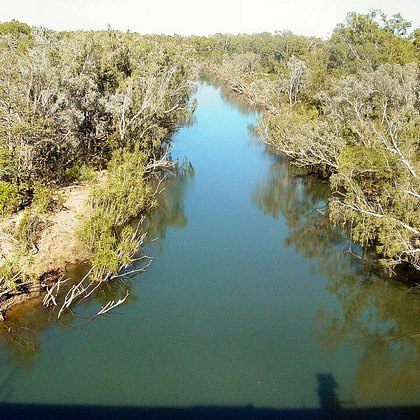
In the breeding season the bare shingle and sand banks of braided rivers, where it packs into dense colonies of hundreds to thousands of pairs on an islet ringed by running water; to a lesser extent also lake shores. It feeds on the surrounding farmland, walking behind the plough for earthworms and leatherjackets, and over the river itself, taking mayflies and caddisflies from the air and off the water surface. Outside the breeding season it moves to estuaries, harbours and the lawns and parks of the coastal cities.
Where the bird is most often found, arranged by main group and formation.



Range and movements
Endemic to New Zealand and breeding nowhere else in the world; in this guide's counts not a single record comes from Australia or Norfolk. The centre of gravity is the South Island, on the braided rivers of Southland, Otago and Canterbury — the Oreti, the Mataura, the Aparima, the Rangitata, the Rakaia and the Waitaki. On the North Island it is far scarcer, with colonies at the Rotorua lakes, in the Bay of Plenty and along the rivers of the Volcanic Plateau. In winter almost the whole population shifts to the coast, and then it stands in Invercargill, Dunedin and Christchurch among the Silver Gulls on the grass.
- Resident
- dark = core range, pale = thinly spread
Where and when to look
To be sure of it, go between October and December to a bridge over a South Island braided river — the Oreti at Invercargill or the Rakaia — and scan the shingle islets: a colony betrays itself from a kilometre away by the continuous chatter and the white cloud that lifts at every disturbance. In winter it is far easier: walk past the gulls on the grass in any South Island city and look for black bills. Keep off the riverbeds in the breeding season; one flush can cost a colony a whole clutch.
Conservation
Near Threatened (NT), and within New Zealand a long-standing worry: the species is often called the most threatened gull in the world, and the South Island colonies have fallen sharply since the 1970s. The causes lie almost entirely on the river itself. Introduced predators — stoats, ferrets, hedgehogs, feral cats and rats — walk into a colony as soon as a shingle island dries out and its side channel silts up. Introduced plants, above all lupin, broom and willow, close over the bare shingle so that no open nesting ground is left and the predators gain cover. Water abstraction and river control shrink the braided system, while spring floods can wash out entire colonies in a night. On top of that come Kelp Gulls and harriers raiding the colonies, and quad bikes and four-wheel drives crushing nests on the riverbed. Management accordingly targets predator trapping around colonies, pushing back lupin and willow, and keeping the riverbeds clear through the breeding season.
Scientific name
Chroicocephalus bulleri | (Hutton, 1871)
Hutton described the species in 1871 as Larus bulleri; because it was later moved to Chroicocephalus, author and year stand in parentheses. The genus Chroicocephalus was introduced by Eyton in 1836 and is formed from Greek khrōikos, 'coloured', and -kephalos, '-headed', after the coloured hood of most species in the genus — a hood that this species and Silver Gull are precisely the ones to lack. The epithet bulleri honours Sir Walter Lawry Buller, the New Zealand lawyer and ornithologist of A History of the Birds of New Zealand. The type locality is in New Zealand; the Māori name Tarāpuka is in general use there.