All species › Pelicans, herons and ibises › Ibises and spoonbills › Australian White Ibis
Australian White Ibis | Threskiornis molucca
Australische witte ibis | Ibis blanco australiano
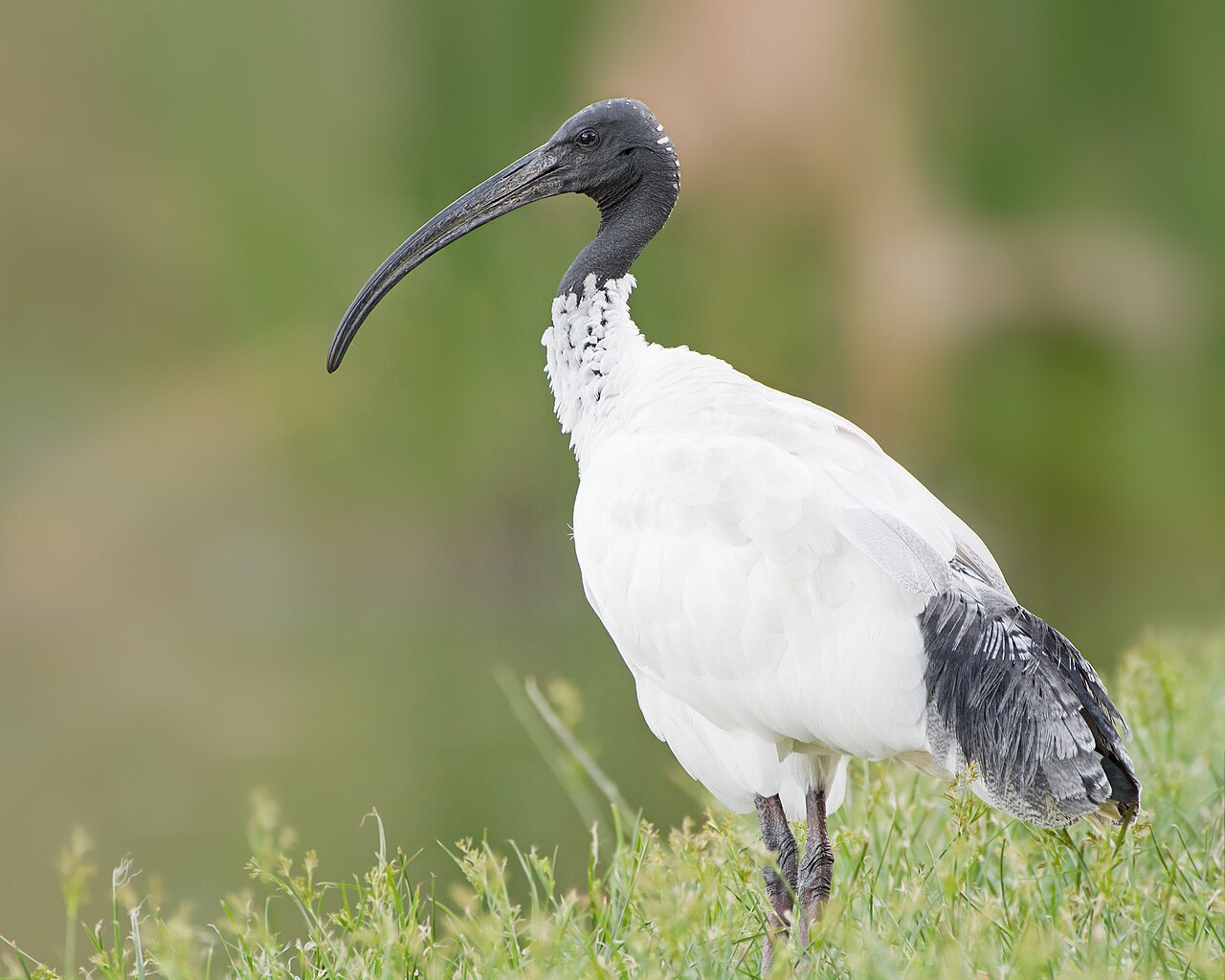
The Australian White Ibis is the big white bird with the bare black head and the long curved bill that has moved in half a century from the inland swamps to the city park. In Sydney and Brisbane it walks the lawns and the picnic tables, and it owes the nickname bin chicken to its habit of working over rubbish bins. In the marshes where it belongs it is going the other way.
Voice
Largely a silent bird; away from a colony it is seldom heard. At the nests and at roosts comes a low, drawn-out, hoarse croak, haa-aa, closer to a groan than a call, with dozens of birds joining in. Beyond that, short hard grunts in disputes over a nest site, and a dull clattering of the bill in greeting. Young birds beg with a shrill, persistent piping.
Recording: James Ray — CC BY-SA 4.0 · Collins St at Botany Rd (near Beaconsfield), Council of the City of Sydney, New South Wales, Australia · xeno-canto
Identification
A large, all-white bird of just over seventy centimetres with a bare black head and neck and a heavy, downcurved black bill. Legs are black, reddening at the thighs when breeding; black tips to the flight feathers form a clear black trailing edge only in flight. Adults carry cream plumes at the base of the neck, and the bare underwing skin turns from dull pink to dark scarlet in the breeding season. The female is smaller and shorter-billed. Young birds have a feathered neck. In flight it stretches neck and legs and soars in a V.
Confusion species
Straw-necked Ibis (Threskiornis spinicollis) shares the same fields but has a glossy black back and wing and yellow straw-like plumes on the neck, and prefers dry grassland to water. Royal Spoonbill (Platalea regia) is as white and has the same bare black head, but its bill is straight and flattened at the tip, and it sweeps sideways through water instead of probing. Glossy Ibis (Plegadis falcinellus) is much smaller and dark.
Habitat
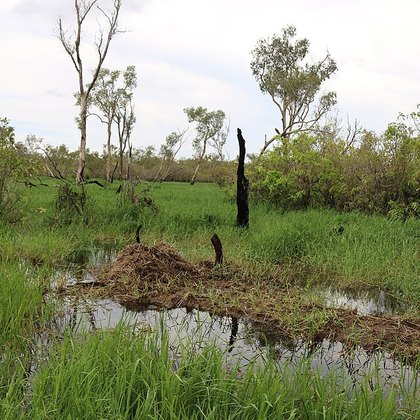
Originally shallow freshwater swamp, reedbed, lagoon, floodplain and melaleuca swamp forest, where it breeds in colonies of thousands and feels through the mud for yabbies and mussels. Beyond that, grazed grassland and cropping country. Since the 1970s, and increasingly, city parks, playing fields, school grounds, sewage ponds and rubbish tips as well, where it lives on waste and human food and roosts on buildings and palms.
Where the bird is most often found, arranged by main group and formation.


Range and movements
Across northern and eastern Australia, from the Kimberley and the Top End to Cape York and south to Victoria and South Australia. It was wholly absent from Western Australia before the 1950s and is still spreading there; it does not occur in Tasmania. Outside Australia it lives in New Guinea, the Moluccas and the Lesser Sundas. It does not migrate in the ordinary sense but follows water: after a good wet season the inland colonies of the Murray-Darling fill, and in dry years the birds shift to the coast and the cities.
- Resident
- dark = core range, pale = thinly spread
Where and when to look
Any east-coast city park produces it inside ten minutes; the effort belongs to the other half of the story. In a wet summer, December to March, find a breeding colony in an inland reedbed or melaleuca swamp — the Macquarie Marshes will do — because thousands of birds together are a wholly different sight from one ibis at a bin. Look there for the scarlet underwing skin, which shows only when breeding.
Conservation
Least Concern (LC), but the category hides two opposite movements. In the east-coast cities it has increased sharply and is locally numerous enough to count as a nuisance at airports, cafés and water supplies. Inland, in the swamps where it belongs, it has declined with the drainage and water extraction of the Murray-Darling: the colonies breed less often and smaller. New South Wales accordingly lists it as a concern inland while it is being moved on in Sydney.
Scientific name
Threskiornis molucca | (Cuvier, 1829)
Cuvier described the bird in 1829 as Ibis molucca; because it was later moved to another genus, author and year stand in parentheses. The genus Threskiornis was introduced by G.R. Gray in 1842, from Greek thrēskos, 'religious', and ornis, 'bird' — after the Sacred Ibis of Egypt, the type species. molucca means 'of the Moluccas', where the described specimen was supposed to have come from; the spelling moluccus also occurs in the literature.