All species › Pelicans, herons and ibises › Ibises and spoonbills › Glossy Ibis
Glossy Ibis | Plegadis falcinellus
Zwarte ibis | Coco oscuro
The Glossy Ibis is the most widely spread ibis in the world and the only dark ibis of Australia and New Zealand: bronze-brown with a green and purple sheen close up, plainly black at any distance. In Australia it wanders after the floods of the inland rivers, and in New Zealand it has settled as a breeding bird this century.

Voice
For an ibis it is quiet, and it is heard mostly in flight, with a low grunting thoo-thoo-thoo-oo coming from a passing party. At the colony there is grunting, croaking and a dull barking note between the nests. Young beg with a hoarse squealing that merges into a continuous rustle across a colony. Outside the breeding season it is seldom heard at all.
Recording: Sonothèque ADVL — CC0 · Genêts, Manche, Normandy, France · xeno-canto
Identification
A slender wader of about half a metre with long legs and a long, evenly downcurved olive-brown bill. In breeding plumage the neck is reddish-brown and the body bronze-brown, with a metallic green and purple sheen over wings and back that shows only in good light; the facial skin is blue-grey with a narrow white border around the eye. Out of the breeding season it is duller and the head and neck are finely streaked white; juveniles are uniform grey-brown without gloss. In flight it holds neck and legs straight out and alternates quick beats with short glides, in lines or loose strings. Against the sky it looks entirely black.
Confusion species
Australian White Ibis (Threskiornis molucca) and Straw-necked Ibis (Threskiornis spinicollis) are both largely white and never a problem in view, but in a mixed flock against the sky it takes work to pick the dark bird out; go then on the smaller, slimmer build. Eastern Curlew (Numenius madagascariensis) also carries a long curved bill, but it is a shorebird in streaked brown with a wholly different flight. Spoonbills fly in the same formation but are white and carry a straight spatulate bill.
Habitat
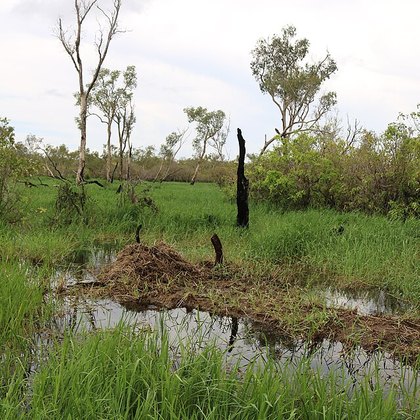
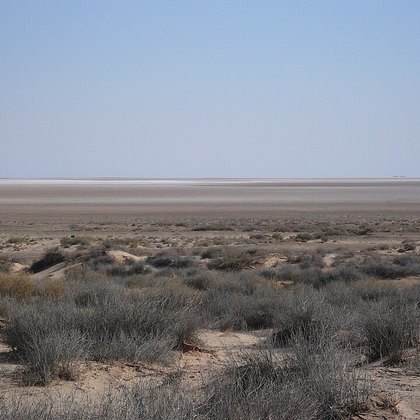
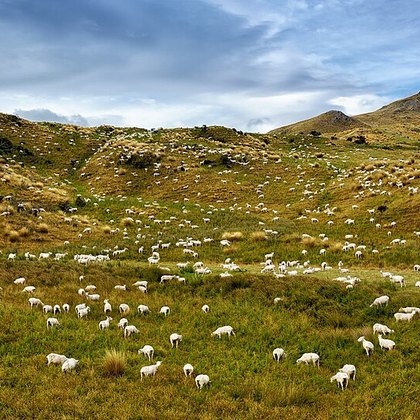
Shallow fresh water with plenty of cover: floodplains, reed and sedge swamps, claypans, wet pasture and rice fields. On the coast it uses estuaries, saltmarsh and the fringe of mangrove. It avoids deep open water and dry plains; what it wants is mud a bill can go into.
Where the bird is most often found, arranged by main group and formation.



Range and movements
The species occurs across four continents. In Australia it is most numerous in the north, and it breeds chiefly in the Murray-Darling Basin, at the Macquarie Marshes in New South Wales and in southern Queensland; Tasmania and southwestern Western Australia see it outside the breeding season only. It ranges far after flooding, so that in a wet year it turns up hundreds of kilometres beyond its usual ground. In New Zealand it has grown since the first record at Washdyke Lagoon in 1902 from vagrant to coloniser: fifty records or more, a first breeding in 2015 at Wainono Lagoon and later at the Wairau Lagoons.
- Resident
- Breeding (summer)
- dark = core range, pale = thinly spread
Where and when to look
Look for it after rain on freshly flooded pasture and along the edges of drying swamps, where it feeds on foot in small parties. Stand with the sun behind you: only then does the bronze and green sheen come out that turns a silhouette into a bird. Work through flocks of white ibis for the single dark bird among them.
Conservation
Least Concern (LC) and numerous worldwide. In Australia it hangs on the flooding of the inland swamps, and water extraction from the Murray-Darling Basin causes colonies to fail in dry years. In New Zealand the movement is the other way: there the species is increasing in numbers and in breeding records.
Scientific name
Plegadis falcinellus | (Linnaeus, 1766)
Linnaeus described the bird in 1766 as Tantalus Falcinellus; because it was later moved to another genus, author and year stand in parentheses. The genus Plegadis was introduced by Kaup in 1829, after Greek plegas, 'sickle', for the curved bill. falcinellus is a Latin diminutive of falx and means 'little sickle'. The type locality is Java and Celebes.