All species › Pelicans, herons and ibises › Ibises and spoonbills › Royal Spoonbill
Royal Spoonbill | Platalea regia
Koningslepelaar | Espátula real
The Royal Spoonbill is the black-billed spoonbill of Australia and New Zealand: a large white bird with a bare black face and a long bill widened at the tip into a spoon, which it sweeps sideways through shallow water as it walks. In the breeding season the male carries a white nuchal crest up to twenty centimetres long. In New Zealand, which it colonised on its own, it is one of the great successes of the last century.

Voice
A quiet bird, heard almost only at the nest: grunts, groans and hisses, and short chew and cho notes between the pair. It also makes non-vocal sounds that carry further than its voice: a dry clapping of the bill, and 'wing-woofing', a dull whooshing of the wings in threat display at the colony. Feeding birds are silent.
No freely licensed recording has been found for this species yet; what to listen for is described below.
Identification
A large, all-white wading bird of seventy-five to eighty centimetres with black legs and a heavy black bill ending in a broad flat spoon; the bare facial skin is black too, with a yellow patch above the eye and a red mark on the forehead when breeding. The breeding male carries long white nape plumes that can reach twenty centimetres and show even in silhouette, plus a creamy-yellow wash on the lower neck and breast and a pink strip on the underwing. The female is smaller with a shorter bill and crest. Young birds lack the crest and the coloured face patches and have black wingtips. In flight it stretches neck and legs and travels in line or in V formation.
Confusion species
Yellow-billed Spoonbill (Platalea flavipes) is the only other spoonbill in the region and one look at the head settles it: there the bill, facial skin and legs are pale yellow instead of black, and the nape crest is absent. Yellow-billed is also slightly larger and keeps almost entirely to fresh water, while Royal also works tidal flats and estuaries. Australian White Ibis (Threskiornis molucca) has the same bare black head and the same white body, but its bill is downcurved and it probes the mud rather than sweeping — on a standing bird at range the bill shape is the only thing that counts.
Habitat
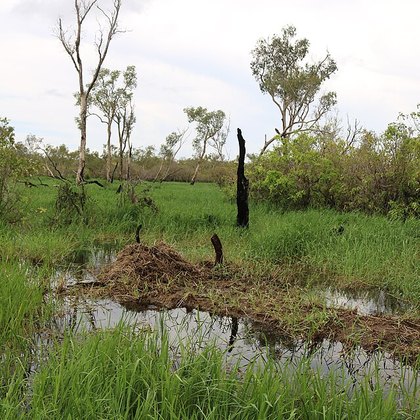
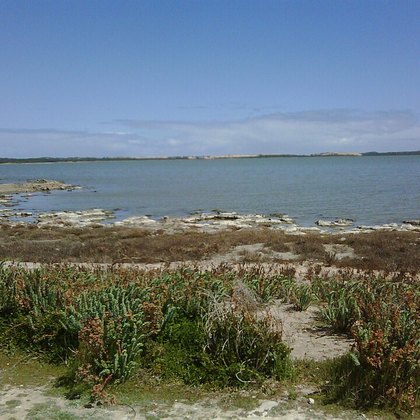
Shallow water, fresh as well as salt: swamps, lagoons, lakes and farm dams, but also estuarine mudflats, saltmarsh, saltfields and sewage ponds. The build of the bill ties it to water less than forty centimetres deep over sand, mud or clay. In New Zealand it nests in kahikatea trees, in reeds, in shrubs and even on rocky coastal headlands; in Australia in colonies in tree crowns over water or in tall reeds, often alongside ibises and herons.
Where the bird is most often found, arranged by main group and formation.



Range and movements
In Australia across the east and north, from the Kimberley through the Top End, Queensland, New South Wales and Victoria to south-eastern South Australia; it is scarce in Tasmania and absent from central Australia and the south-west. On the coast it is sedentary; inland it follows the water. In New Zealand it arrived under its own power: the first record was at Castlepoint in 1861 and the first breeding at the heron colony of Ōkārito in South Westland in 1949. Since then it has spread to both main islands and increased explosively, from fifty-two birds in 1977 through 2,360 in 2012 to 4,593 in 2024. It also turns up on Norfolk Island.
- Resident
- Breeding (summer)
- dark = core range, pale = thinly spread
Where and when to look
Look for it on a mudflat on the falling tide or along the edge of a lagoon, and watch the way it walks: slowly forward with the half-open bill swinging sideways through the water, a motion recognisable at hundreds of metres. In New Zealand visit a known colony between October and February — Ōkārito on the west coast is the oldest — and watch there for the males' nape crest, which is at full length only in those months. With any white wader, check the bill first: straight and spooned is a spoonbill, curved is an ibis.
Conservation
Least Concern (LC) and increasing in both countries. In New Zealand it is nationally rated Naturally Uncommon but increasing: the population has risen almost a hundredfold in some fifty years, and the main concern there is disturbance of the colonies in the breeding season and the spread of coastal recreation. In Australia it depends, like the other colonial waterbirds, on the flooding of the inland swamps, but it falls back on the coast, saltfields and sewage ponds more readily than Yellow-billed Spoonbill, which leaves it less exposed.
Scientific name
Platalea regia | Gould, 1838
Gould described the species in 1838 as Platalea regia, and it has stayed in that genus, so author and year carry no parentheses. The genus Platalea goes back to Linnaeus in 1758 and is the Latin word for spoonbill, related to Greek platys, 'broad, flat'. regia means simply 'royal', after the crest the breeding male wears like a crown. The type locality is the east coast of New South Wales. In Maori the bird is kōtuku ngutupapa, 'the kōtuku with the flat bill', after the White Heron whose colony at Ōkārito it shares.