All species › Waders, gulls and terns › Sandpipers and allies › Bar-tailed Godwit
Bar-tailed Godwit | Limosa lapponica
Rosse grutto | Aguja colipinta
The Bar-tailed Godwit is the most numerous large wader in New Zealand and holds the world record for unbroken flight: Alaska to New Zealand in eight to eleven days, without food, water or a landing. On the flats it is a streaked, long-legged bird with a slightly upturned pink bill with a black tip. Maori call it kuaka, and its arrival in September counts on the North Island as the start of summer.

Voice
At the roost it gives a loud, nasal, sharp kwe-kwe or kirrik, often in chorus from hundreds of birds at once as a flock shifts; it carries across a whole harbour and is the sound every New Zealander associates with the tidal flats. Feeding birds exchange soft, clipped contact notes. Just before the great departure in March the flocks grow restless and noisy, circling high and calling without pause; that is the sound around which farewell gatherings are held in many places.
No freely licensed recording has been found for this species yet; what to listen for is described below.
Identification
A large wader of thirty-seven to forty-one centimetres, the female larger and longer-billed than the male; weight runs from two hundred and seventy-five to six hundred grams depending on how much fat is stored for migration. The bill is long, tapering and clearly slightly upturned, pink with a black tip, which is the best separation from any other large wader here. The legs are dark grey to black and shorter than on Black-tailed Godwit, so that they project only just beyond the tail in flight. Non-breeding plumage is streaked brown with a pale belly; in breeding plumage, seen mostly on males just before departure, head, neck and underparts turn brick-red. In flight: no white wingbar, a finely barred tail, and on the Siberian birds a white wedge up the back.
Confusion species
Black-tailed Godwit (Limosa limosa) is the main one: longer in the leg, with a dead-straight bill, an even grey rather than streaked non-breeding plumage, and in flight a broad white wingbar and a black tail band, both of which Bar-tailed Godwit lacks. Hudsonian Godwit (Limosa haemastica) also shows a white wingbar and a black tail, plus a black underwing; here it sits almost always among Bar-tailed Godwits, so always work a large flock for wing pattern. Asian Dowitcher (Limnodromus semipalmatus) often stands in the same flock and is told by its dead-straight, wholly black bill without a pink base. Far Eastern Curlew (Numenius madagascariensis) and Eurasian Whimbrel (Numenius phaeopus) have decurved bills and are ruled out on that; Great Knot (Calidris tenuirostris) is shorter in neck, leg and bill.
Habitat
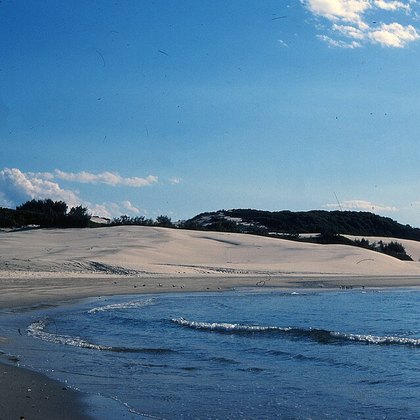
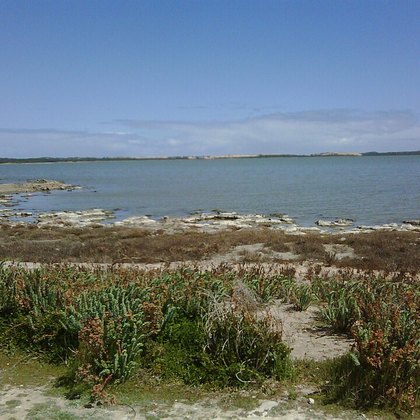
Broad intertidal flats of mud and sand in harbours, estuaries and sheltered bays, where it spreads out at low water and probes for worms, bivalves and crabs. At high water it gathers in dense flocks on shellbanks, sandspits, samphire saltmarsh and the bunds of saltworks, often shoulder to shoulder with thousands of other birds. Sandy beaches it uses for roosting, and inland ground hardly at all.
Where the bird is most often found, arranged by main group and formation.


Range and movements
The most numerous large wader in the region. About seventy-five thousand birds arrive in New Zealand each year, virtually all of the Alaskan subspecies baueri, with Kaipara Harbour, Manukau Harbour and the Firth of Thames the largest sites; the first birds come in during early September and departure north begins in early March. In Australia it is found along the entire coast, with the largest numbers in the northwest, where the Siberian subspecies menzbieri winters, and along the east coast, where birds of the Alaskan subspecies predominate. On Norfolk Island it appears annually in small numbers. A share of the young birds simply stay here for their first summers.
- Resident
- Breeding (summer)
- dark = core range, pale = thinly spread
Where and when to look
In New Zealand, go to the Miranda roost on the Firth of Thames or to Manukau Harbour on a rising tide between October and February; the tide pushes the birds towards you and you have them at tens of metres. Look first at the bill — long, tapering, upturned and pink with a black tip — and then at the legs, which are shorter than on a Black-tailed Godwit. After that work every bird for wing pattern in flight: that is how the rare Hudsonian Godwit and the Asian Dowitcher get found in this region. Come back in late March for the departure of the kuaka.
Conservation
Near Threatened (NT) globally, and rated as declining in New Zealand, with a loss of nearly two per cent a year. The pinch lies on the flyway: on the northward return the birds depend entirely on the tidal flats of the Yellow Sea, a large part of which has been reclaimed for ports, industry and aquaculture. Beyond that, climate change is altering the tundra they breed on and the weather systems they time their unbroken flights to. Within Australia and New Zealand the main issue is disturbance at high-tide roosts by dogs, vehicles and walkers: a flock that has to take off again and again does not make it across the ocean.
Scientific name
Limosa lapponica | (Linnaeus, 1758)
Linnaeus described the bird in 1758 as Scolopax lapponica, with Lapland as the type locality; because of the later move to another genus, author and year stand in parentheses. The epithet lapponica means 'of Lapland'. The genus name Limosa comes from Latin limus, 'mud'. In Maori it is kuaka, and the proverb asks: who has ever seen the nest of the kuaka? That question went unanswered for centuries, because the bird nests on the arctic tundra of Alaska, twelve thousand kilometres away — and in October 2022 a young bird flew that very route in one go: thirteen thousand five hundred and sixty kilometres from Alaska to Ansons Bay in Tasmania, eleven days without landing.