All species › Waders, gulls and terns › Sandpipers and allies › Hudsonian Godwit
Hudsonian Godwit | Limosa haemastica
Rode grutto | Aguja hudsoniana
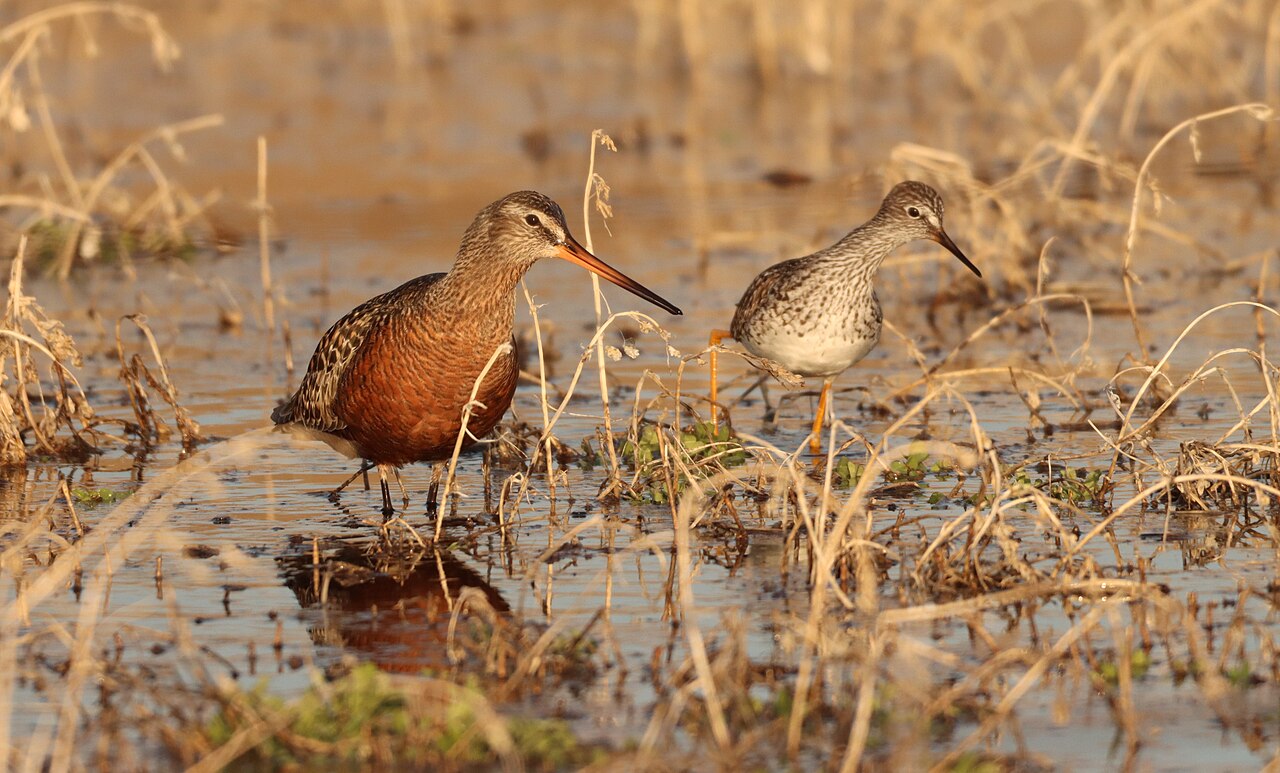
The Hudsonian Godwit is the godwit of the wrong hemisphere: a North American breeder that ought to migrate to Tierra del Fuego and Chiloe and ends up in Australia and New Zealand by mistake. It looks like a Black-tailed Godwit with a white wingbar and a black tail, but the moment it lifts a wing the matter is settled, because the underwing is jet black, which no other godwit in the world has. In breeding plumage the underparts are deep chestnut-red with fine black and white barring.
Voice
At the roost it is almost always silent, and most observers in this region never hear it. Where it does call, the note is a high, short, slightly squeaky too-wit or ke-wit, higher and thinner than the nasal three-syllable calling of Black-tailed Godwit and far less carrying than what a Bar-tailed Godwit produces at a roost. The exuberant display calling belongs to the tundra of Alaska and Hudson Bay and falls outside this map window.
No freely licensed recording has been found for this species yet; what to listen for is described below.
Identification
A large wader of thirty-seven to forty-two centimetres, a wingspan of about seventy-four centimetres and around three hundred grams, the female heavier than the male. The bill is long, straight to slightly upturned, pink at the base and black at the tip; the legs are long and dark grey to black. In non-breeding plumage it is evenly grey-brown and unremarkable; in breeding plumage the underparts are deep chestnut-red with fine black and white barring over belly and flanks and the upperparts are dark with white spotting. The decisive mark is the underwing: coverts and axillaries are black, showing as a dark flash on every wingbeat. Beyond that: white rump, black tail and a narrow white wingbar.
Confusion species
Black-tailed Godwit (Limosa limosa) is the dangerous one, for it too has a white wingbar, a white rump and a black tail band: the difference lies solely in the underwing, wholly white on Black-tailed Godwit and black here, and in the width of the wingbar, which is broader on Black-tailed Godwit. Bar-tailed Godwit (Limosa lapponica), the species it hides among in this region, lacks both the wingbar and the black tail and shows instead a finely barred tail and a white wedge up the back. Asian Dowitcher (Limnodromus semipalmatus) has a wholly black, blunt bill and no wingbar. Every claim here should rest on a photograph of the spread underwing; a settled bird in non-breeding plumage cannot be named with certainty.
Habitat
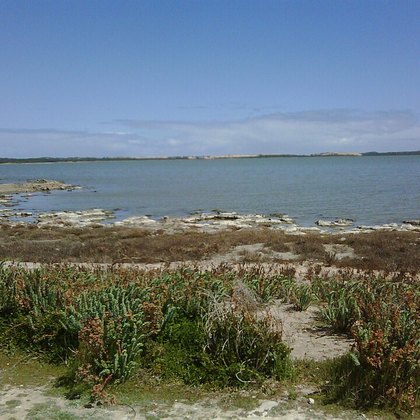
In this region it keeps to wherever its hosts are: intertidal mud and sandflats of estuaries and bays, the ponds and bunds of saltworks, shallow coastal lagoons and samphire saltmarsh. It feeds as a godwit does, wading to belly depth and putting the whole bill under water after worms and shellfish. Inland freshwater pools it rarely uses here, though a long-staying bird may end up on a wastewater pond or a flooded paddock.
Where the bird is most often found, arranged by main group and formation.


Range and movements
Within the map window it is a rare but almost annual visitor. In Australia there are records from Queensland, New South Wales, Victoria, Tasmania, South Australia and Western Australia, nearly always one bird at a time and nearly always among Bar-tailed Godwits at a large roost; some birds stay for months at the same site and draw many observers. In New Zealand it is usually a matter of fewer than three birds a year, in estuaries and coastal wetlands and likewise in godwit company; the first record was at Lake Ellesmere in 1902. The breeding grounds lie in western Alaska, the Mackenzie Delta and around Hudson Bay, and so far outside this map window.
- Resident
- Breeding (summer)
- Winter
- dark = core range, pale = thinly spread
Where and when to look
From November to February go to a large roost holding Bar-tailed Godwits — Werribee, the Coorong, the Hunter estuary or the Firth of Thames — and look not for colour but for shape and pattern in flight. Wait for the flock to shift: one black underwing among a thousand pale ones shows up like a shadow. A bird beginning to moult in February and turning chestnut on the breast is the easiest of all, since no Bar-tailed Godwit in this region colours that deeply. Submit the record with images to the national rarities committee.
Conservation
Vulnerable (VU). The species breeds in three separate areas of arctic North America and winters almost entirely in two areas of southern South America, and it is exactly that concentration that makes it vulnerable: whatever goes wrong at one of the few staging or wintering sites hits a large share of the world population at once. Loss and disturbance of coastal wetlands in North and South America, and change on the arctic breeding grounds, are the main factors. For Australia and New Zealand it is a matter of a few birds a year and poses no management question of its own, but each record is a useful addition to what is known of this species' wanderings.
Scientific name
Limosa haemastica | (Linnaeus, 1758)
Linnaeus described the bird in 1758 as Scolopax haemastica; because of the later move to another genus, author and year stand in parentheses. The type locality was later fixed at Hudson Bay. The epithet haemastica is built on Greek haima, 'blood', and means something like 'blood-coloured', after the deep chestnut underparts of breeding plumage. The genus name Limosa comes from Latin limus, 'mud'. The English name refers to Hudson Bay.