All species › Waders, gulls and terns › Sandpipers and allies › Black-tailed Godwit
Black-tailed Godwit | Limosa limosa
Grutto | Aguja colinegra
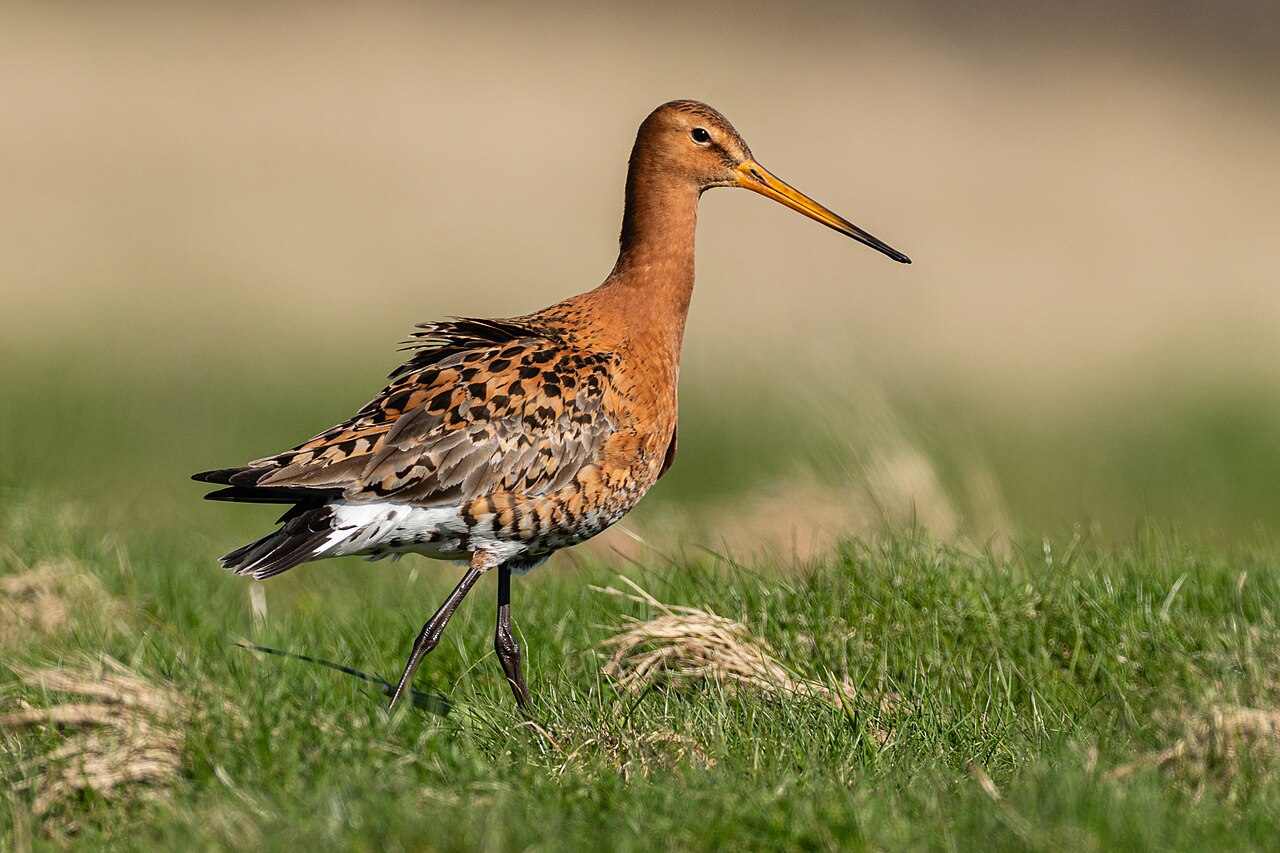
The Black-tailed Godwit is the slimmest and most elegant of the three godwits of this region: a long-legged, straight-billed wader that can stand in thousands on the northern Australian flats. Sitting, it looks grey and unremarkable; in flight it is unmistakable, for a broad white stripe runs the length of the wing and the tail ends in a clean black band above a white rump. The birds that come here belong to the smallest subspecies and breed in Siberia, Mongolia and northeastern China.
Voice
On passage and at the roost it gives a loud, nasal, three-syllable wicka-wick or wetta-wetta, usually as a party lifts or shifts; it is harder and sharper than the yelping note of Asian Dowitcher. Disturbance turns it into a fast, repeated short alarm. The clamorous display calling for which the species is known in Europe belongs to the breeding grounds and falls outside the map window of this guide.
No freely licensed recording has been found for this species yet; what to listen for is described below.
Identification
A large, slender wader of forty to forty-four centimetres, a wingspan of sixty-three to seventy-five centimetres and two to three hundred grams. The bill is long, straight or at most very faintly upturned, with a pink to orange base and a black tip; the legs are long, black, and project well beyond the tail in flight. In non-breeding plumage it is evenly grey-brown with a pale supercilium and no streaking above; in breeding plumage, rarely seen here in full, the head, neck and breast go cinnamon-red. The flight pattern settles everything: a broad, sharply defined white stripe along the whole wing, a white rump, a black terminal band on the white tail, and an entirely white underwing.
Confusion species
Bar-tailed Godwit (Limosa lapponica) is the species it stands beside daily: shorter in the leg, with a clearly upturned bill, a streaked rather than plain plumage, and in flight no white wingbar and no black tail band; instead it shows a finely barred tail and a white wedge up the back. Hudsonian Godwit (Limosa haemastica), a rare visitor here, looks much like Black-tailed Godwit in flight with its white wingbar and black tail, but its underwing is black instead of white — that is the one truly conclusive mark, and its white wingbar is narrower besides. Asian Dowitcher (Limnodromus semipalmatus) has a dead-straight, wholly black bill without a pink base and lacks the white wingbar. The curlews all have decurved bills and are ruled out on that.
Habitat
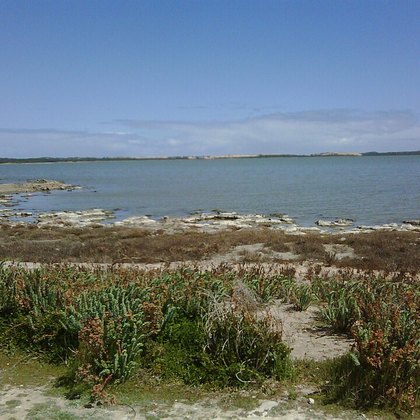
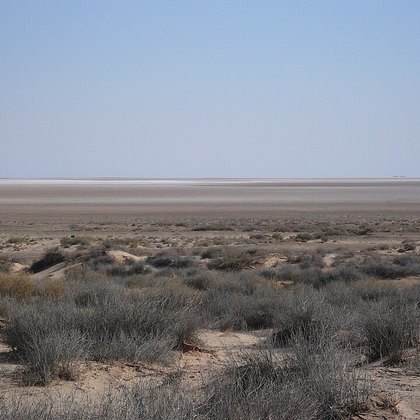
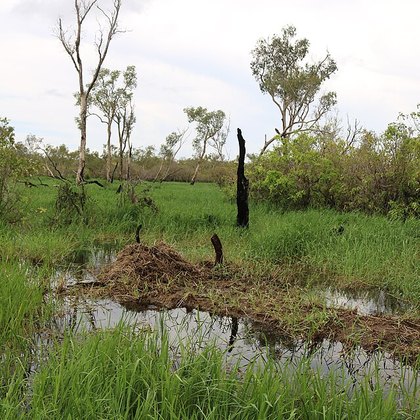
Intertidal ground above all: mud and sandflats in estuaries, bays and lagoons, with samphire saltmarsh and saltworks as high-tide roosts. Unlike most waders of this flyway it also takes readily to inland water: shallow fresh and brackish swamps, the edges of drying lakes and claypans, flooded grassland and wastewater ponds, far from the coast. It wades deeper than most other species while doing so, often up to the belly, and puts the whole bill under water.
Where the bird is most often found, arranged by main group and formation.


Range and movements
Within the map window it is a non-breeding visitor mainly to the north coast of Australia: the largest numbers stand between Darwin and Weipa, in Arnhem Land and around the Gulf of Carpentaria, with further important sites in the Kimberley and scattered flocks along the east and south coasts into Tasmania. It occurs in every state, inland as well when the wetlands fill. In all, about forty-two thousand nine hundred mature birds winter in Australia, out of some hundred and sixty thousand on the whole East Asian-Australasian flyway. In New Zealand it is a matter of one or two birds a year and rarely more than ten, usually in estuaries among Bar-tailed Godwits or Pied Stilts; the first was at Miranda in 1952.
- Resident
- Breeding (summer)
- dark = core range, pale = thinly spread
Where and when to look
Look for it at a north-coast roost in the summer months and wait for the flock to lift: the white wingbar carries a long way and separates it at once from any Bar-tailed Godwit. Then check the underwing once more, because that is what rules out a Hudsonian Godwit. In Australia also work the inland wetlands that have filled after rain, since parties often turn up there that were missed on the coast.
Conservation
Near Threatened (NT) globally and, since 2024, listed as endangered on the Australian federal list. The decline comes from the loss of staging grounds around the Yellow Sea, where it must lay on fat during migration: reclamation for ports and aquaculture, intensification of farming on the saltmarshes, and dams that hold back the sediment the flats are built from. Within Australia the issues are mainly disturbance at roosts and the loss of shallow inland wetlands to water extraction. Because a quarter of the flyway population winters here, Australian management counts heavily.
Scientific name
Limosa limosa | (Linnaeus, 1758)
Linnaeus described the bird in 1758 as Scolopax limosa, with Sweden as the type locality; because of the later move to another genus, author and year stand in parentheses. Both the genus name Limosa and the identical epithet come from Latin limus, 'mud', and so mean 'muddy', a reference to the flats it lives on. The birds of this region belong to the subspecies melanuroides, the smallest and darkest of the three, whose name means 'with a blackish tail'.