All species › Waders, gulls and terns › Sandpipers and allies › Eurasian Curlew
Eurasian Curlew | Numenius arquata
Wulp | Zarapito real
In Australia the Eurasian Curlew is a genuine rarity: a large, brown-streaked wader with a long decurved bill that turns up now and then among the Far Eastern Curlews of the northern flats. It is almost as large as that species and has an equally long bill, so it hides easily in a flock. The best sign comes only when the flock lifts, because then a white wedge lights up from the rump of the Eurasian Curlew and runs up the back.
Voice
The call is the famous, plaintively rising coor-lee that hangs over every wet meadow and saltmarsh in Europe, loud, far-carrying and melancholy in tone. On disturbance there is a fast repeated, alarmed kwee-kwee-kwee. The voice is barely separable from that of Far Eastern Curlew and so is no help in Australia; the turning, bubbling song belongs to the Eurasian breeding grounds and is not to be heard here.
No freely licensed recording has been found for this species yet; what to listen for is described below.
Identification
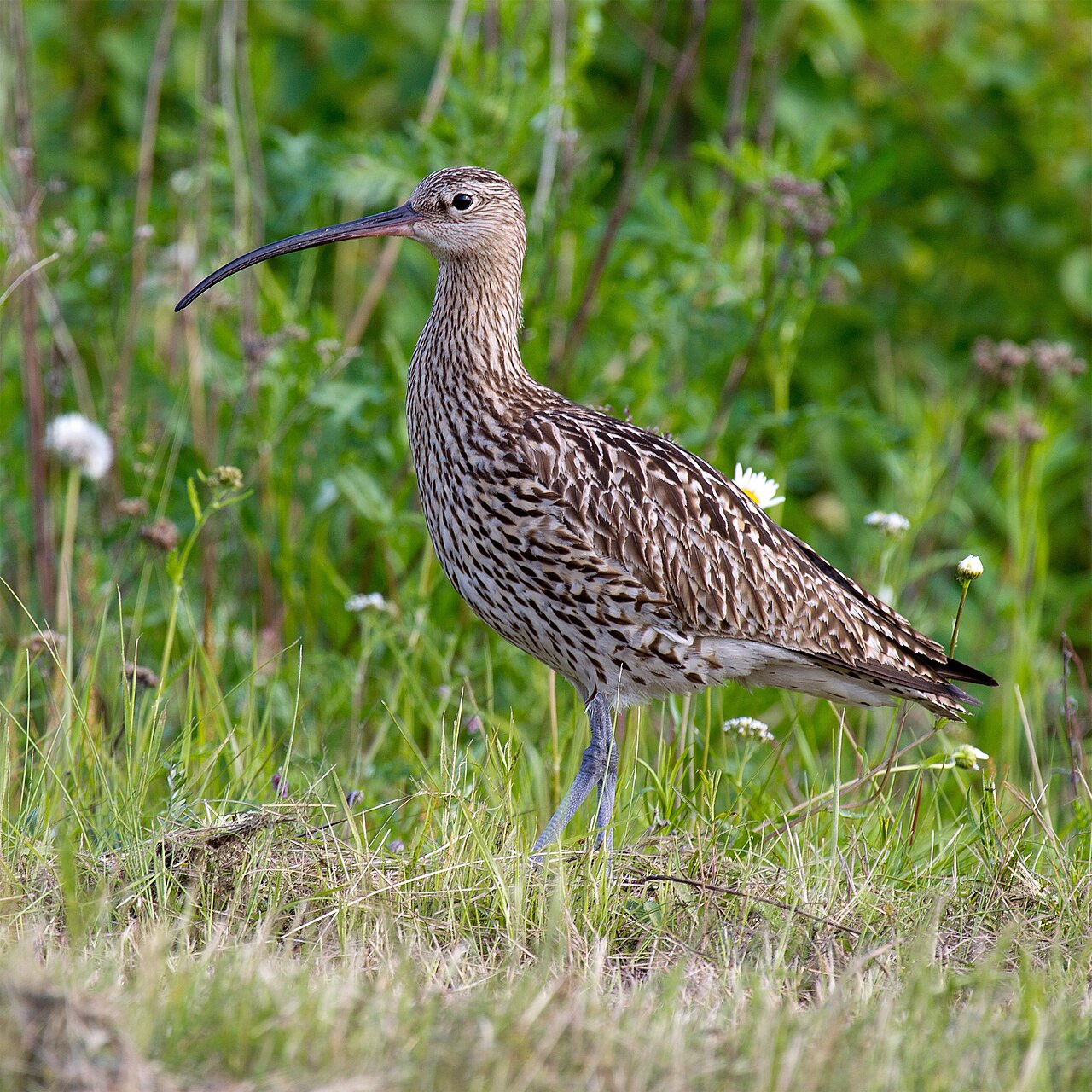
A large, long-legged wader of fifty to sixty centimetres, a wingspan of eighty-nine to a hundred and six centimetres, and a wide weight range of four hundred and ten to well over thirteen hundred grams. The bill is long and curved down in an even arc, longest in the adult female, dark with a flesh-coloured base to the lower mandible. The legs are long and blue-grey. The plumage is streaked brown with a white belly on which the streaking thins out, and the head is evenly streaked without crown stripes. The decisive mark shows only in flight: a sharply defined white wedge running from the rump up the back, and an almost white, barely marked underwing.
Confusion species
Far Eastern Curlew (Numenius madagascariensis) is always the first thought in this region and is the hard one: as large or larger, with an equally long curved bill and the same streaked plumage. The difference lies in flight and in the colour of the rear body: on Far Eastern Curlew the rump is plain brown, there is no white wedge, the underwing is plain brown, and the belly is densely streaked rather than white. Eurasian Whimbrel (Numenius phaeopus) is clearly smaller, has a far shorter bill with a kink rather than an even arc, and carries crown stripes; the subspecies here also lacks the white wedge. Little Curlew (Numenius minutus) is smaller again and much shorter-billed. Every claimed Eurasian Curlew in Australia should be supported with photographs of the back and the underwing.
Habitat
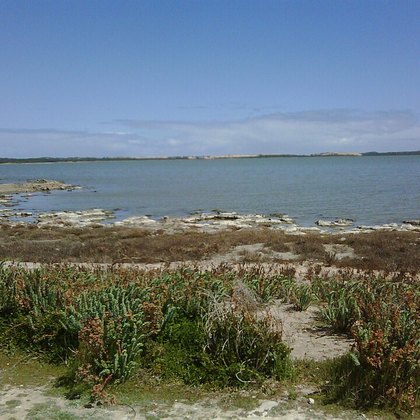
Where it turns up here, it is on intertidal mud in sheltered bays and estuaries, usually in the company of Far Eastern Curlews, whimbrels and godwits. At high water it follows that flock to samphire saltmarsh, saltworks and sandbars. In Europe it also feeds on grassland and arable, and it will do so here on occasion, but in this region it is in practice a bird of the tidal flats.
Where the bird is most often found, arranged by main group and formation.

Range and movements
Within the map window it is a rare vagrant, with a few dozen accepted records spread across roughly half of the last ten years, almost all in Australia. The centre of gravity is the northwest coast, around Broome and Eighty Mile Beach, and on along the north coast to Darwin and the Gulf of Carpentaria; scattered records exist from the east and south coasts. Birds that end up here belong to the eastern subspecies orientalis and are almost always overshooting migrants that should have stopped in Southeast Asia. In New Zealand and on Norfolk Island it is rarer still.
- Resident
- dark = core range, pale = thinly spread
Where and when to look
To find it, work through every large curlew at a roost on Roebuck Bay or Eighty Mile Beach in the summer months and wait for the flock to lift; that one second in which the back becomes visible settles everything. Photograph the bird from behind rather than side on: the white wedge and the pale underwing are what a records committee wants to see, while a profile of head and bill is never conclusive. Bear in mind too that a worn Far Eastern Curlew can show a paler belly, and do not be led astray by it.
Conservation
Near Threatened (NT) globally, and that status arises almost entirely from what happens outside this map window. In western Europe the species has collapsed: between 1996 and 2016 England and Scotland lost more than half, Wales more than eighty per cent and Ireland more than ninety per cent, largely through the conversion of damp grassland to arable and forestry, so that nests no longer come off. For Australia the species poses no management question of its own, since it involves a few dozen birds; what counts here is that the flats it strays onto are the same ones Far Eastern Curlew depends on, and those are under heavy pressure.
Scientific name
Numenius arquata | (Linnaeus, 1758)
Linnaeus described the bird in 1758 as Scolopax arquata, with Sweden as the type locality; because of the later move to another genus, author and year stand in parentheses. The epithet arquata comes from medieval Latin arquatus, 'bow-shaped', after the curve of the bill — the same idea that sits in the genus name, for Numenius goes back to Greek noumenios, 'new moon'. The English name curlew, like French courlis, imitates the call.