All species › Waders, gulls and terns › Sandpipers and allies › Far Eastern Curlew
Far Eastern Curlew | Numenius madagascariensis
Siberische wulp | Zarapito siberiano
The Far Eastern Curlew is the largest shorebird in the world: a heavy, evenly brown-streaked bird of well over sixty centimetres with a sickle bill that in the female reaches almost twenty centimetres. Three-quarters of the world population winters in Australia, which is exactly why Australia is also where its decline is most visible. In thirty years the species has gone from unthreatened to endangered.
Voice
The call is a loud, plaintive, rising cuuur-lee that carries across a whole bay and is usually the first thing you notice about a party; it is given both in flight and on the ground. Disturbance at a roost turns it into a fast, repeated, alarmed keer-keer-keer on which the whole flock lifts. The tone is mournful and drawn out, where Eurasian Whimbrel gives a cheerful, even rattling whistle — that difference alone separates the two.
No freely licensed recording has been found for this species yet; what to listen for is described below.
Identification
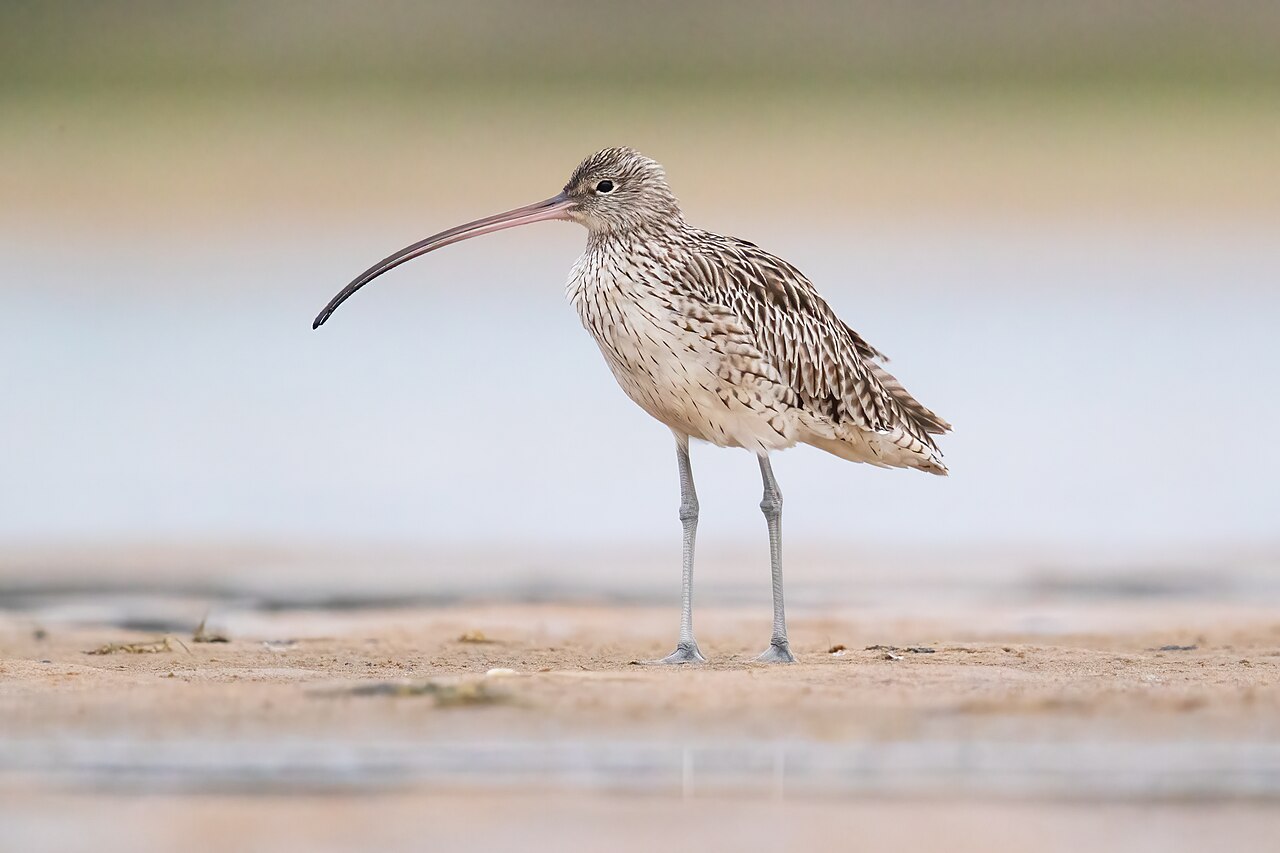
A very large, long-legged wader of sixty to sixty-six centimetres, a wingspan of about a hundred and ten centimetres and around nine hundred grams. Everything about it is long: the neck, the legs and above all the bill, which measures thirteen to twenty centimetres, curves down in an even arc and averages a hundred and eighty-five millimetres in the female against clearly less in the male; the base of the lower mandible is flesh-coloured, the rest dark. The legs are long and blue-grey. The plumage is streaked brown throughout, belly included, with no white anywhere, and the head is evenly streaked without crown stripes. In flight what stands out is what is missing: no white wedge up the back, no pale rump, and a plain brown underwing.
Confusion species
Eurasian Whimbrel (Numenius phaeopus) is the main alternative and often stands in the same flock: much smaller, with a bill of only eight to nine centimetres that reads as a kink rather than an arc, and with a striped crown — a pale central line between two dark bands — that Far Eastern Curlew entirely lacks. Eurasian Curlew (Numenius arquata), a vagrant here, is almost as large and has an equally long curved bill, and that is the hard comparison of this trio: watch the flight, because Eurasian Curlew shows a conspicuous white wedge from the rump up the back and an almost white underwing, while Far Eastern Curlew stays brown everywhere. Little Curlew (Numenius minutus) is barely half the size and usually sits on dry grassland. The godwits have straight or slightly upturned bills.
Habitat
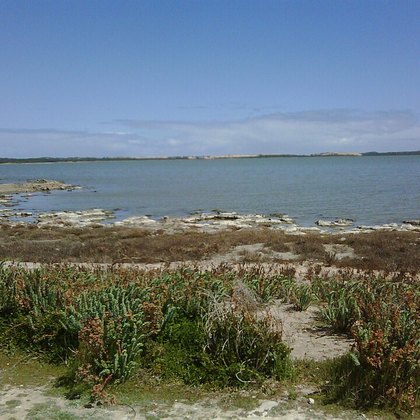
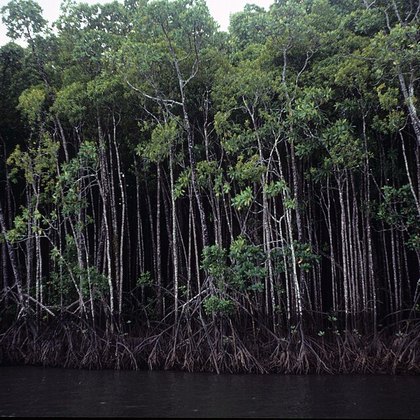
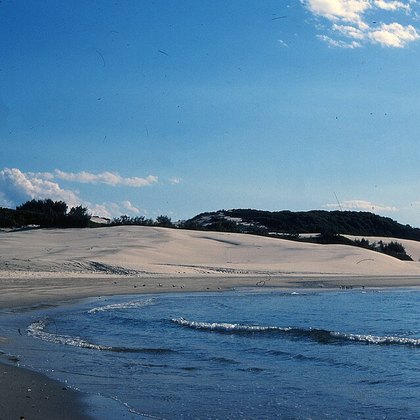
Intertidal mud and sandflats on sheltered coasts, often with beds of seagrass: estuaries, mangrove bays, harbours and lagoons. There it hunts slowly and deliberately for small crabs and molluscs, drawing them out of their burrows with the long bill. At high water it moves to samphire saltmarsh, sandbars, saltworks and the open parts of mangrove country. Inland it appears rarely.
Where the bird is most often found, arranged by main group and formation.

Range and movements
Widespread along the coast of northeastern and southern Australia, Tasmania included, with scattered sites elsewhere on the coast; it occurs in every state but almost never inland. The main concentrations are in Moreton Bay near Brisbane, in the bays of New South Wales and Victoria, and along the north coast. Birds leave the breeding grounds from mid-July to late September, arrive mainly in August, reach the east coast in numbers from September to November, and depart again from late February into March. In New Zealand only small numbers occur, with Manukau Harbour and the Firth of Thames as regular sites; on Norfolk Island it is a rarity.
- Resident
- dark = core range, pale = thinly spread
Where and when to look
Go to a large roost in Moreton Bay, the Hunter estuary or Western Port on a rising tide and find the bird that stands head and shoulders above the godwits; the silhouette alone is enough. Keep well back and stay put: this is the shyest wader on the Australian coast, and a flock put up three times in a tide burns the fat it needs for the flight to Siberia. Report your counts to a shorebird team, because the trend for this species is derived almost entirely from Australian counts.
Conservation
Endangered (EN) globally and one step higher in Australia, listed as critically endangered federally since 2015. The sequence speaks for itself: until 2009 it counted as of least concern, in 2010 it became vulnerable and in 2015 endangered. The world population is now put at twenty to thirty-five thousand mature birds. The cause lies halfway along the flyway: more than sixty-five per cent of the tidal flat around the Yellow Sea has been reclaimed or lost, and without that staging ground the birds do not reach the breeding grounds in Siberia. On top of that come the loss of flats in Australia to port expansion and urban growth, disturbance at roosts by dogs, vehicles and walkers, and in time the drowning of the flats under sea level rise. Because three-quarters of the world population winters here, protecting Australian roosts is not a local but a global measure.
Scientific name
Numenius madagascariensis | (Linnaeus, 1766)
Linnaeus described the bird in 1766 as Scolopax madagascariensis, after the account Brisson had given six years earlier; because of the later move to another genus, author and year stand in parentheses. The epithet is a mistake that has stuck: Brisson believed his specimen came from Madagascar, but the type locality is Makassar on Sulawesi, and the species has never been recorded on Madagascar. The genus name Numenius goes back to Greek noumenios, 'new moon', after the crescent shape of the bill. The English name points, rightly, to the breeding grounds in the far east of Siberia.