All species › Cuckoos › Cuckoos › Black-eared Cuckoo
Black-eared Cuckoo | Chalcites osculans
Zwartoorkoekoek | Cuclillo orejinegro
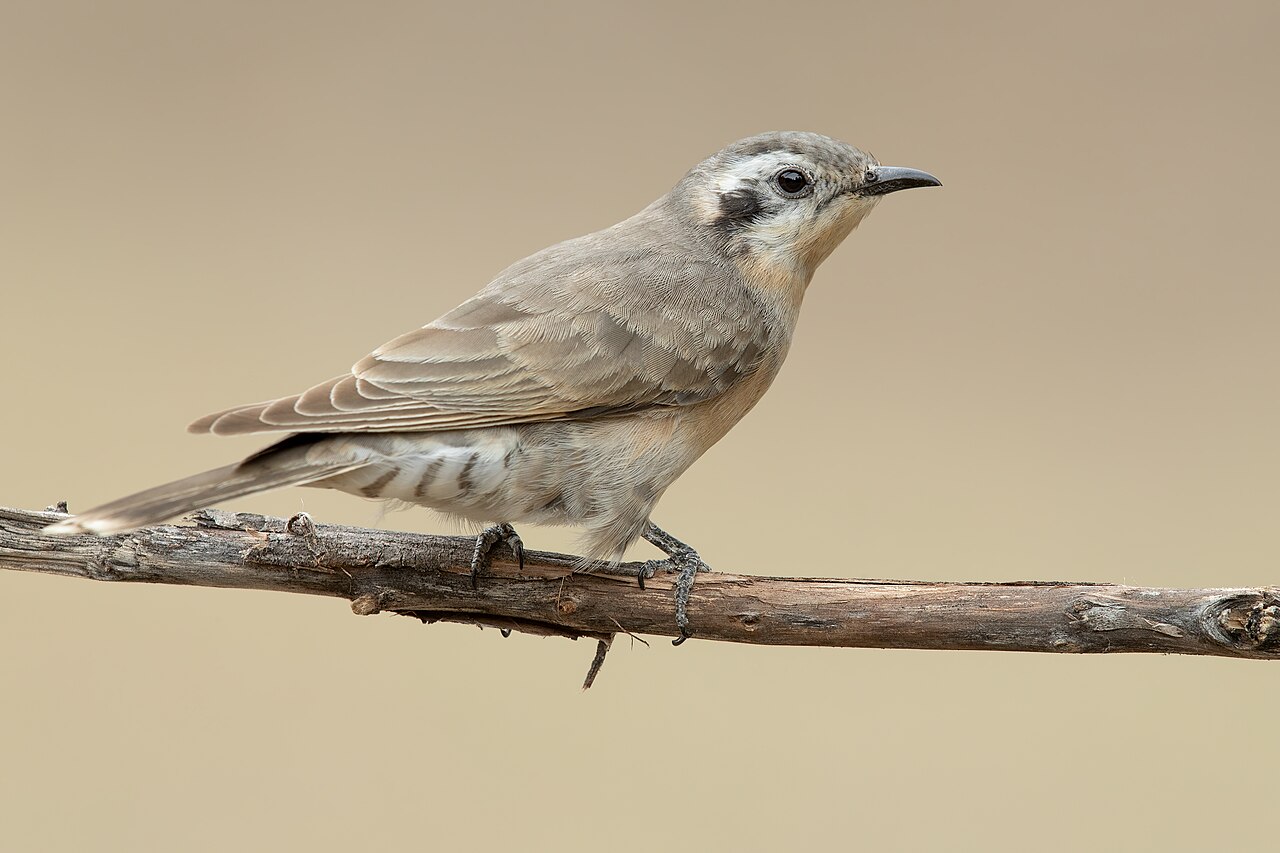
The largest and at the same time the plainest of the Australian bronze cuckoos: grey-brown above with at most a faint olive-bronze wash, and plain creamy buff below without a single bar. What fixes it is the head — a broad, jet-black line from the bill past the ear to the neck, under a white eyebrow that widens towards the back. It belongs to the dry interior and lays its egg with Speckled Warbler and Redthroat.
Voice
A piercing, drawn-out and slightly descending whistle, repeated at regular intervals: feeeeuw, lower and more mournful than in the other bronze cuckoos, sometimes extended to pee-o-weer. In display a short pee-o-wit is given. In quiet mulga country that single note carries remarkably far.
No freely licensed recording has been found for this species yet; what to listen for is described below.
Identification
Nineteen to twenty-one centimetres and around thirty grams, noticeably larger and heavier-set than the other bronze cuckoos. The upperparts are grey-brown with an olive-bronze gloss only in good light — it lacks the obvious metallic colour of its relatives. The underparts are plain cream to salmon without any barring, which is unique in this genus; only the tail feathers are marked. The face is creamy white with a white eyebrow that broadens towards the neck, and below it the broad black ear-stripe that gives the bird its name. The rump is pale. Young birds are as adults but paler.
Confusion species
The real risk is a young Horsfield's Bronze Cuckoo (Chalcites basalis), which also shows little barring: that bird is smaller (17–18 cm), has rufous at the base of the tail feathers and a narrower brown rather than broad black eyeline, and its call is a higher, more sharply falling whistle. Shining Bronze Cuckoo (Chalcites lucidus) is ruled out at once by the broad, unbroken green bars on white underparts and the absence of eyebrow and eyestripe, and is in any case a bird of damper forest. Little Bronze Cuckoo (Chalcites minutillus) is the smallest of the four, the male with a red eye-ring, with rufous in the undertail and fine barring on the flanks, and lives in northern mangrove and monsoon forest — country this species precisely avoids. The host is a key here too: only this cuckoo lays with Speckled Warbler (Pyrrholaemus sagittatus) and Redthroat (Pyrrholaemus brunneus).
Habitat
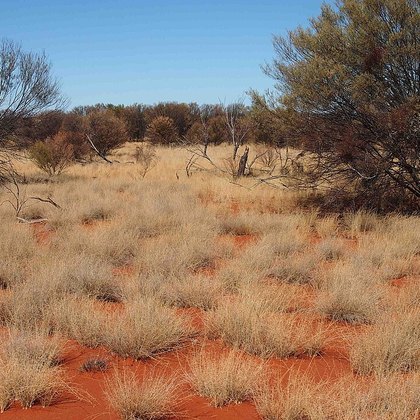
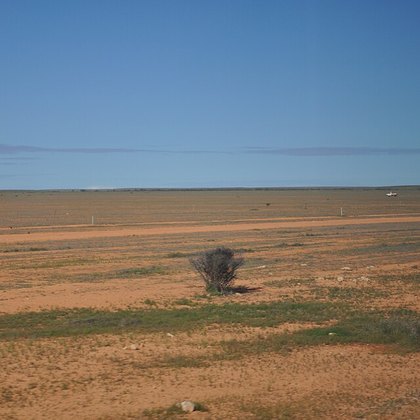
Drier inland country: open woodland and shrubland of mulga and mallee, saltbush and bluebush plains, and above all the denser vegetation along ephemeral creeks, where the hosts build their domed nests low in the shrubs. It hunts by dropping from a low perch onto caterpillars on the ground.
Where the bird is most often found, arranged by main group and formation.


Range and movements
Widespread across mainland Australia, but pointedly away from the wet forested coast: the humid east coast and the south-west of Western Australia are avoided. The centre of gravity lies inland of the Great Dividing Range in Victoria, New South Wales and Queensland and on through the dry interior. On islands and in Tasmania it occurs only as a vagrant. Some birds stay in the south all year, others move to tropical northern Australia and beyond in winter.
- Resident
- Breeding (summer)
- Passage
- dark = core range, pale = thinly spread
Where and when to look
Look for it in late winter and early spring along a creek line in mulga country and let your ears do the work: that one long, mournful whistle, with counted pauses between, is unmistakable in such quiet landscape. Then check low bare branches from which it watches the ground. Plain creamy underparts plus a black ear-stripe is a combination nothing else here matches.
Conservation
Least Concern (LC), and rated secure in every state where it occurs; it is absent from Tasmania. It is nowhere numerous and ranges widely, which makes it hard to count. Its fate hangs on that of its hosts: Speckled Warbler and Redthroat suffer from the loss of the shrub layer to grazing, and in time that pulls at this cuckoo as well.
Scientific name
Chalcites osculans | Gould, 1847
Gould described the species in 1847 in the Proceedings of the Zoological Society of London, already in the genus Chalcites, with New South Wales as the type locality; author and year therefore carry no parentheses. The epithet osculans is Latin for 'kissing', used in nineteenth-century taxonomy for a form standing so close to another group that it seems to touch it. Chalcites (Lesson, 1830) comes from Greek khalkos, 'bronze' — a name that fits this dullest member of the genus least well of all.