All species › Cuckoos › Cuckoos › Oriental Cuckoo
Oriental Cuckoo | Cuculus optatus
Boskoekoek | Cuco de horsfield
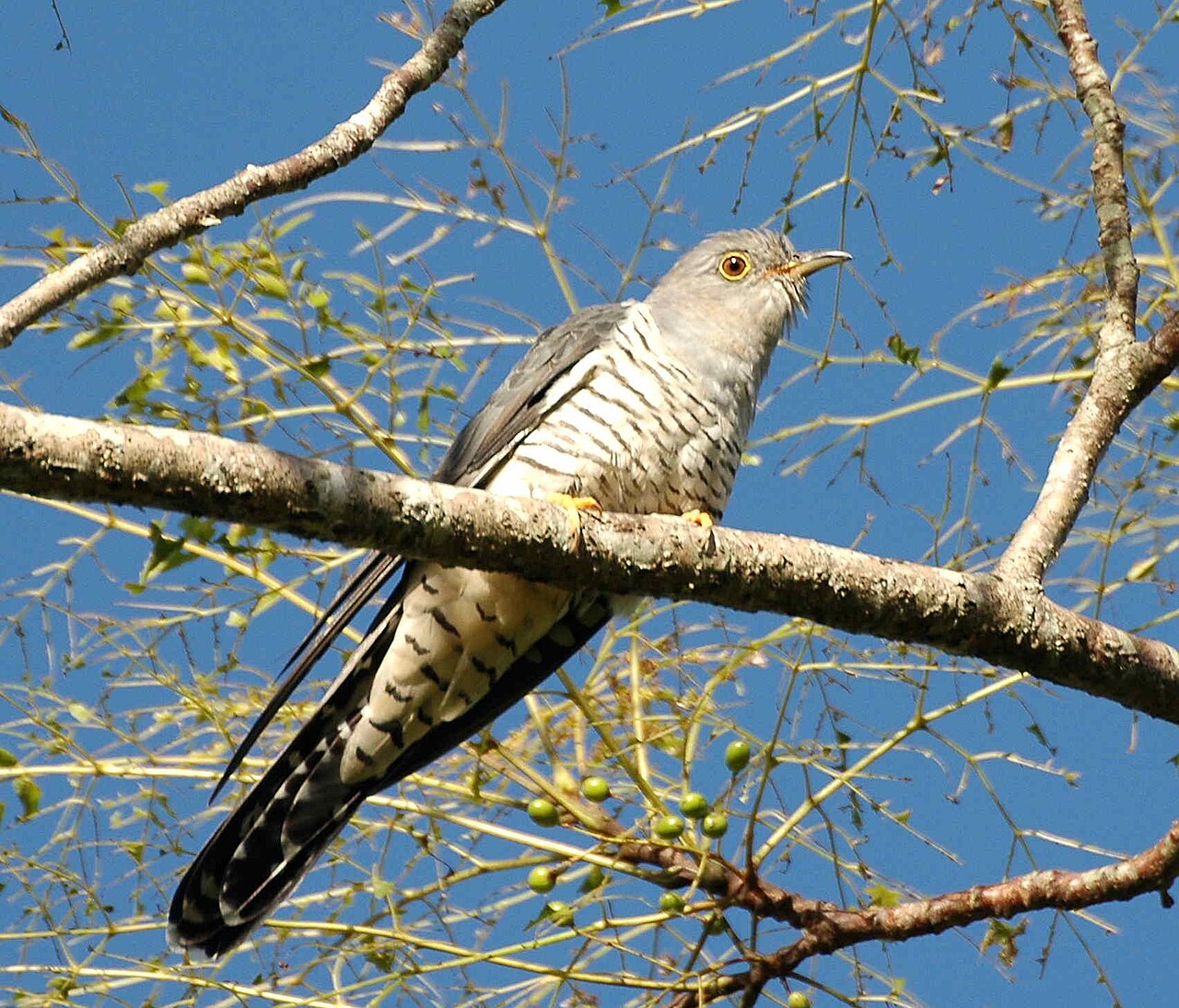
The Oriental Cuckoo is the one cuckoo in this book that breeds nowhere near it: a Siberian bird that spends the southern summer in the forests of tropical Australia. It is slim and hawk-like, grey above and white below with heavy black barring, and flies fast and straight like a small falcon. Silent and hidden in the canopy — a species you have to see, because hearing it here is not an option.
Voice
In Australia it is almost always silent; outside the breeding season this cuckoo hardly calls at all, and for the observer that is the hardest fact about the species. On the Siberian breeding grounds the male gives a series of low paired notes, poo-poo … poo-poo, both notes stressed equally and faintly hoopoe-like at a distance; the female answers with a deep bubbling trill. Do not count on hearing any of it here.
No freely licensed recording has been found for this species yet; what to listen for is described below.
Identification
A slim, medium-large cuckoo of 28 to 34 centimetres, about the size of a blackbird but with a far longer tail. The adult has a grey head, throat and upperparts and white underparts with broad, crisp black bars; the eye-ring and feet are yellow and the undertail is barred. Females and young birds come in two morphs: a grey one like the male, and a rufous one heavily barred dark throughout. In flight look for pointed wings, a long tail and a fast, direct line — the silhouette of a small raptor.
Confusion species
Pallid Cuckoo (Heteroscenes pallidus) is the first to rule out: about the same length, but paler and plain grey, with a dark eye-stripe and white spots on the upper tail coverts, and without the heavy barring below. Fan-tailed Cuckoo (Cacomantis flabelliformis) is much smaller and buff below rather than barred. The four bronze cuckoos of the genus Chalcites are far smaller and metallic green. The real pitfall is not a cuckoo at all but a small hawk of the genus Accipiter: that bird has short rounded wings, a flap-and-glide flight and yellow eyes, while the Oriental Cuckoo has pointed wings and drives straight on with a level beat.
Habitat
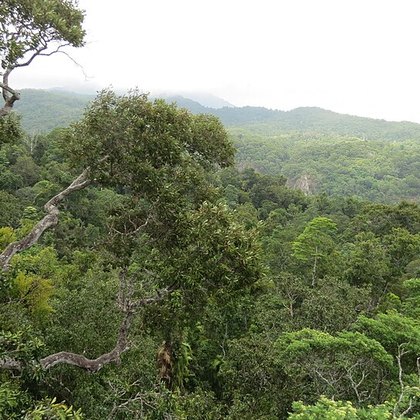
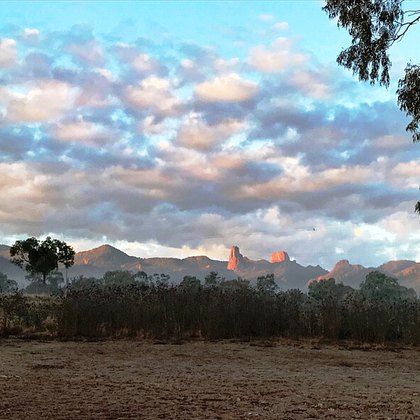
The canopy of monsoon forest, vine thicket, rainforest, gallery forest along creeks and eucalypt woodland. It stays largely inside the foliage, which is what makes it hard to see. From a perch in the canopy it sallies out after prey — mainly caterpillars, beetles, stick insects and cicadas. It does not breed here: in Siberia it parasitises leaf warblers of the genus Phylloscopus, the Olive-backed Pipit and the Asian Stubtail, none of which occur in Australia.
Where the bird is most often found, arranged by main group and formation.


Range and movements
Coastal and subcoastal northern Australia, from the Pilbara across the Kimberley and Top End to Cape York, inland to the Great Dividing Range and on into New South Wales; also Groote Eylandt and Lord Howe Island. It is a non-breeding summer migrant: arriving in November and December, leaving in April and May, then returning to the north Eurasian taiga. In New Zealand it is a rare vagrant: about thirty-six records since the 1970s, sixteen of them since 2000, always between October and April; the last well-documented bird was at Lake Mapourika in Westland in November 2021.
- Resident
- dark = core range, pale = thinly spread
Where and when to look
Here the rule for every other cuckoo is reversed: look, do not listen. Between December and March walk the edge of a patch of monsoon forest or vine thicket in the Top End or on Cape York and scan the canopy for a hawk-like bird that sits still for a long time and then sallies after a caterpillar. Heavily barred white underparts, a yellow eye-ring and that slow, patient perching are the combination; the rufous morph gives itself away by the same barring.
Conservation
Least Concern (LC). The species has a vast world range across northern Eurasia and a large population, and in Australia it is only a visitor, so its fate is settled mainly in the Siberian taiga and along the migration route. For the Australian part of its year what counts is keeping monsoon forest and vine thicket — small, fragmented forest types that suffer badly from stock, weeds and hot fire.
Scientific name
Cuculus optatus | Gould, 1845
Gould described the species in 1845 as Cuculus optatus, and it has stayed in that genus, so author and year carry no parentheses. There is a neat reversal in that: the bird breeds in Siberia, but was named from a wintering specimen taken in Australia — the lectotype comes from Port Essington on the Cobourg Peninsula in the Northern Territory. optatus is Latin for 'wished for, longed for', from optare, 'to choose or wish'. Cuculus is the classical Latin word for a cuckoo, formed after the call. The bird was long treated as a subspecies of Cuculus saturatus; since Christidis and Boles (2008) it stands as a full species. The Spanish name recalls Horsfield, from the synonym Cuculus horsfieldi.