All species › Cuckoos › Cuckoos › Pacific Koel
Pacific Koel | Eudynamys orientalis
Indische koël | Koel occidental
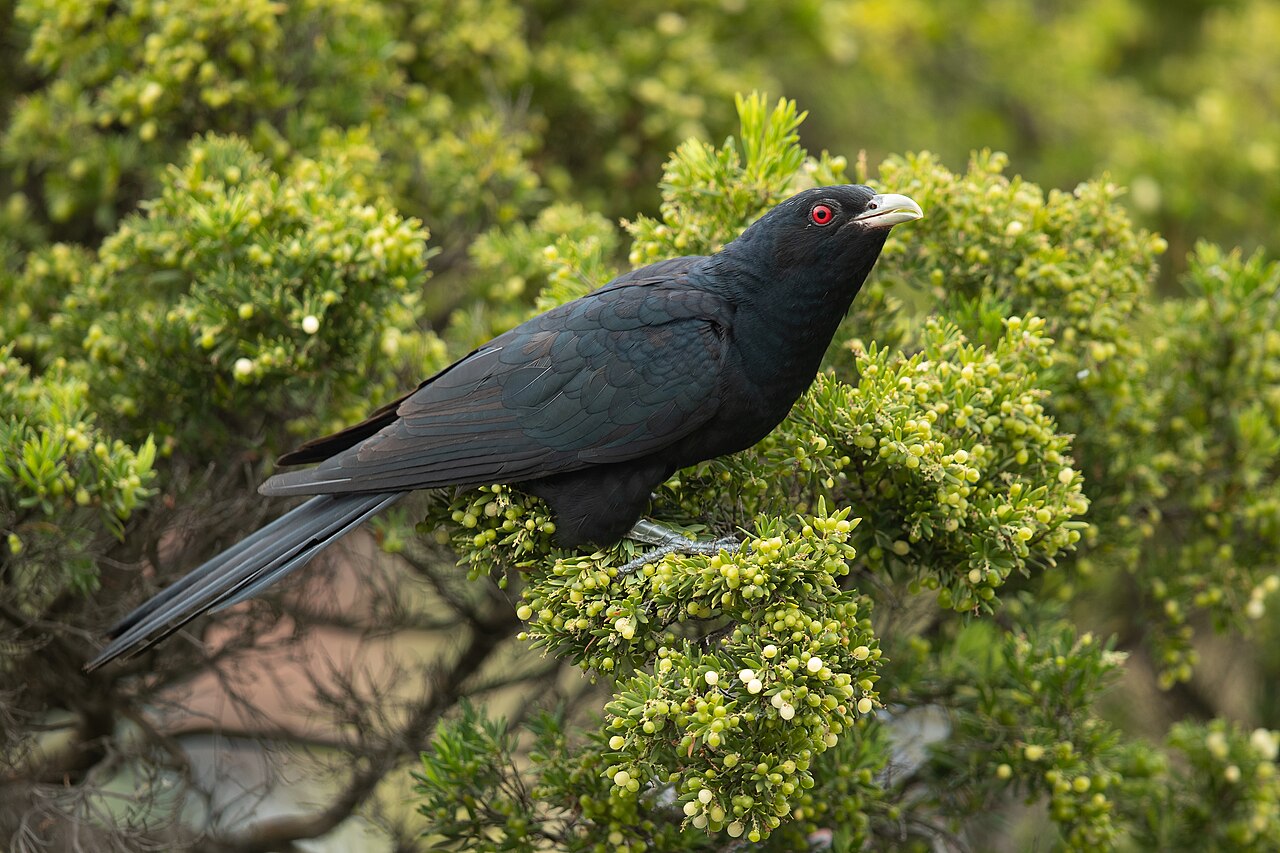
The Pacific Koel is the voice of the Australian early summer: a large slim cuckoo that arrives from New Guinea in October and from that moment sends its rising koo-el ringing through the suburbs day and night. The male is glossy jet black with a blood-red eye, the female brown and spotted white, and both leave their egg with a honeyeater in the top of the garden.
Voice
The sound is better known than the bird. The male repeats a loud rising whistle endlessly, koo-el, often from the dead of night right through to morning, each delivery a half-tone higher as he warms up. The female answers with a quick penetrating series of keek-keek-keek-keek on one pitch. Near a host's nest both voices break into a loud, hellish shriek.
No freely licensed recording has been found for this species yet; what to listen for is described below.
Identification
A large cuckoo of 39 to 46 cm with a long tail, a short thick pale grey bill and a straight, almost sparrowhawk-like flight on quick beats. The male is wholly glossy black with blue and green sheen and a bright red eye — a black bird that is plainly not a crow, being slimmer, longer-tailed and without the heavy bill. The female is glossy brown above spotted with white, with a black crown, cream underparts finely barred black, and a banded tail. Juveniles resemble the female but are warmer brown with a dark eye.
Confusion species
The female is the difficult one: brown, spotted and barred, and so much like Long-tailed Koel (Urodynamis taitensis), the closest relative in this region — but that bird is all but confined to New Zealand and has hardly ever been recorded in Australia, so range settles it; close to, taitensis shows lengthwise streaking below instead of fine barring, and a longer, more wedge-shaped tail. Channel-billed Cuckoo (Scythrops novaehollandiae) arrives in the same season and parasitises partly the same hosts, but at nearly sixty centimetres is far larger and carries an enormous pale down-curved bill. The black male is regularly taken for an Australian Raven (Corvus coronoides): that bird is bulkier, has a white eye and a much heavier bill.
Habitat
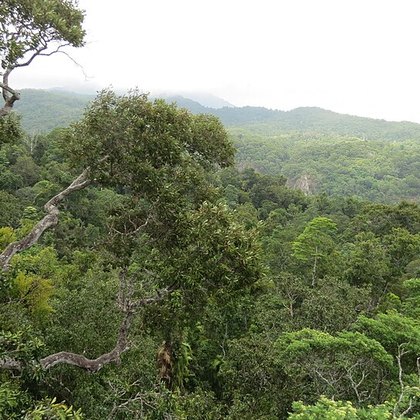
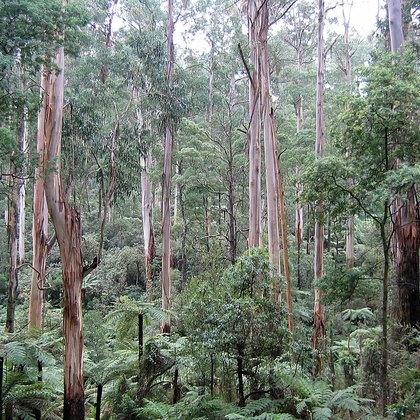
Tall timber carrying fruit: rainforest, monsoon forest and vine thicket, wet eucalypt forest and riverine woodland along creeks, but equally the older suburbs of Brisbane and Sydney, where figs, palms and camphor laurels set a richly laid table. It feeds almost entirely in the canopy and rarely comes to the ground.
Where the bird is most often found, arranged by main group and formation.



Range and movements
A breeding visitor to northern and eastern Australia, from the Kimberley across the Top End and Cape York and south along the east coast, in normal years to about Nowra in New South Wales; the southern limit has moved in recent decades and the species now regularly reaches the Melbourne area. Outside the breeding season virtually all birds leave the map window for New Guinea and the Indonesian islands. Arrival late September to early October, departure around March.
- Breeding (summer)
- dark = core range, pale = thinly spread
Where and when to look
Look for it in October and November in the crown of a fruiting fig or camphor laurel in an older suburb, and follow the racket: a screaming Red Wattlebird or Australasian Figbird chasing something almost always points out a koel. The calling male usually sits high and still in the densest foliage, a few metres to one side of where the sound seems to come from.
Conservation
Least Concern: the range covers half of South-East Asia and Australasia, and in Australia the species has in fact gained from fruiting trees planted in gardens and streets, which supply both food and hosts in abundance. The southward spread along the east coast is the visible result. Some headwind comes from control of camphor laurel as a weed and from complaints about the night calling, but neither threatens the population.
Scientific name
Eudynamys orientalis | (Linnaeus, 1766)
Linnaeus described the species in 1766 as Cuculus orientalis, after an earlier French account; because it later moved to another genus, author and year stand in parentheses. Vigors and Horsfield introduced Eudynamys in 1827, from Greek eu, 'good, true', and dunamis, 'power'. orientalis means 'eastern'. The type locality is Ambon in the Moluccas; Australian birds belong to the subspecies cyanocephalus in the east and south-east and subcyanocephalus in the north. The name koel is onomatopoeic, taken from Hindi and formed on the call itself.