All species › Cuckoos › Cuckoos › Pallid Cuckoo
Pallid Cuckoo | Heteroscenes pallidus
Vale koekoek | Cuco pálido
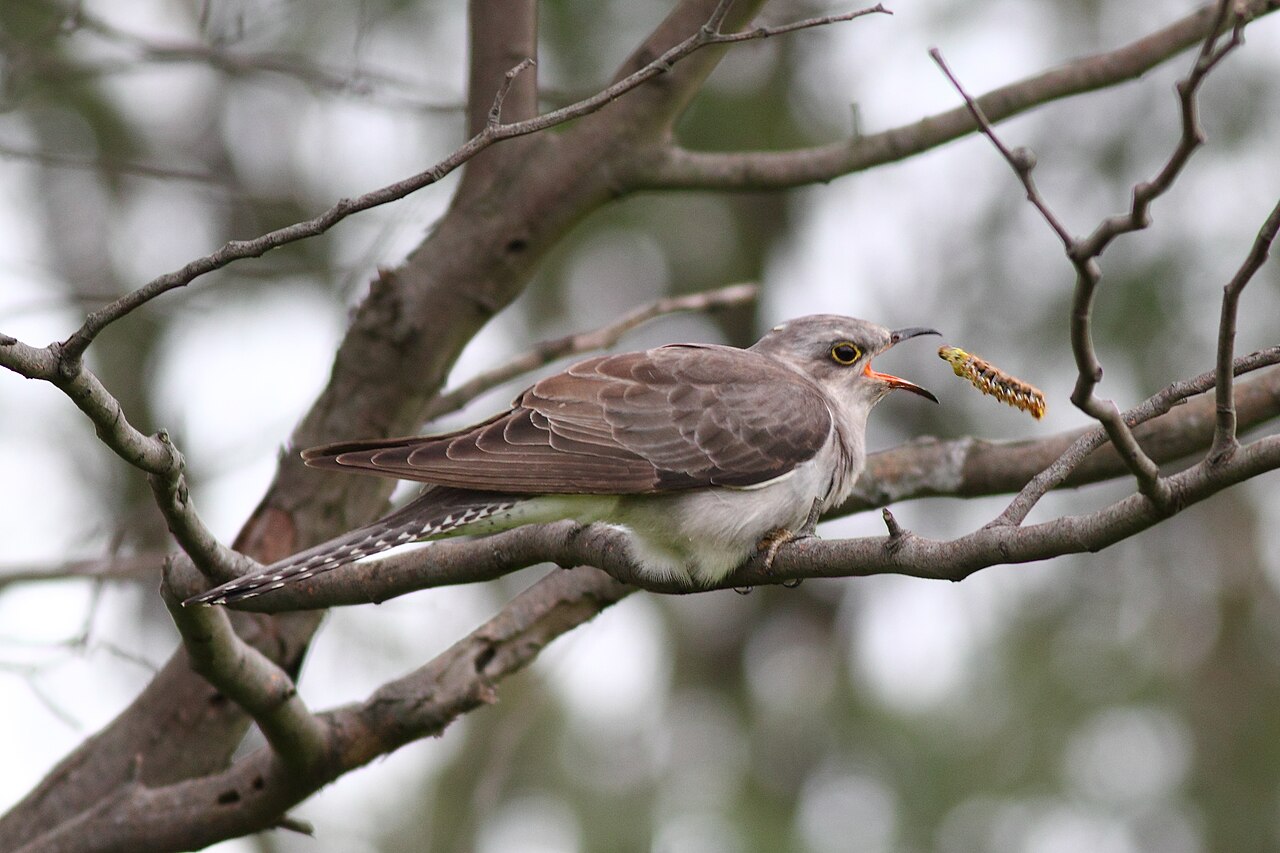
The most widely distributed cuckoo in Australia and at the same time the palest: a slender, plain grey bird of thirty centimetres, darker on back and wings, with a yellow eye-ring, a dark eyestripe and a white spot on the nape. Anyone who hears a whistle climbing the scale step by step through an Australian spring, and going on and on, has this bird.
Voice
A loud, rising series of clear whistles that creeps up like a scale: too-too-too-too-too, eight to ten notes, each half a step higher, quickening towards the end and then starting again almost at once. The male keeps it up for hours, at night too, which has earned it the Australian nickname 'brain-fever bird'. The female answers with a hoarse ascending call.
No freely licensed recording has been found for this species yet; what to listen for is described below.
Identification
Twenty-eight to thirty-three centimetres, so more than twice the length of the bronze cuckoos, slim-bodied with pointed wings and a long tail. The male is plain grey, darker on back and wings, with a brown, slightly decurved bill, a conspicuous yellow eye-ring, a dark line through the eye and a white spot on the nape; the undertail is boldly barred black and white and is the best mark on a bird passing overhead. The female is usually warmer, with rufous mottling on darker upperparts. Young birds are mottled brown and buff above with white nape spots, and grey-brown streaked below — a quite different picture from the adult.
Confusion species
Oriental Cuckoo (Cuculus optatus), a summer visitor from Asia to northern Australia, matches this species closely in build and size but is darker grey and carries obvious black-and-white barring across the lower breast and belly, where Pallid Cuckoo is plain pale grey; it also lacks the white nape spot. A rufous female Pallid Cuckoo is the hardest case and can suggest a hepatic Oriental Cuckoo — check the nape spot and the unbarred belly. Fan-tailed Cuckoo (Cacomantis flabelliformis) is smaller (24–28 cm), with warm orange-buff rather than grey underparts and a mournful descending trill instead of a rising scale. Sahul Brush Cuckoo (Cacomantis variolosus) is smaller again, with a grey rather than yellow eye-ring. In practice the voice decides: that rising ladder has no second in Australia.
Habitat
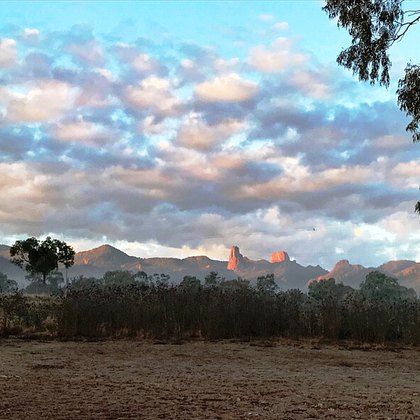
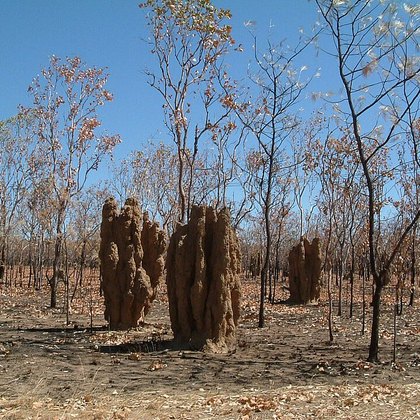
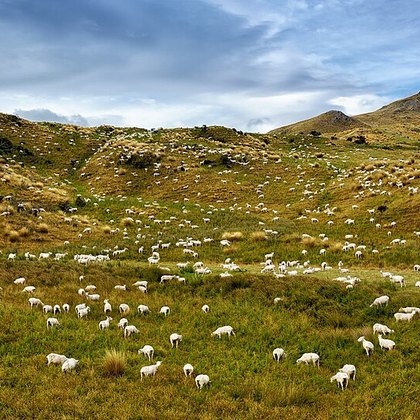
Almost any open forest and woodland, from eucalypt forest and mallee to eucalypt savanna, and beyond that cleared and settled open country, pasture, cropland and orchards with scattered trees. It hunts from a clear low perch and drops to the ground after caterpillars — especially hairy ones, which most birds leave alone.
Where the bird is most often found, arranged by main group and formation.

Range and movements
The most widely distributed cuckoo in Australia: present across the whole continent, Tasmania included, with a clear shift through the year. In the south it is chiefly a spring and summer bird that moves north after breeding; in the tropical north it is more numerous in winter. That keeps it inside the map window all year, but rarely in the same place. In New Zealand it is a vagrant with nine accepted records, the last in February 2021 at Otakeho in south Taranaki.
- Resident
- Breeding (summer)
- Winter
- Passage
- dark = core range, pale = thinly spread
Where and when to look
Drive a farm road with scattered eucalypts in August or September and turn the engine off: the rising scale carries from a distance and leads you straight to a bird perched bolt upright on a post, a wire or a dead branch. Then look at the tail from below; the bold black-and-white barring reads even against the light. In flight it suggests a small hawk or a falcon rather than a cuckoo.
Conservation
Least Concern (LC), rated secure federally and in every Australian state and territory. It is one of the few cuckoos that gains rather than loses from half-open farmed country: paddocks with tree lines supply exactly the lookout perches and the hosts it needs. Laying chiefly with common birds such as Willie Wagtail and Hooded Robin also leaves it less exposed than the specialised bronze cuckoos.
Scientific name
Heteroscenes pallidus | (Latham, 1801)
Latham described the species in 1801 in the supplement to his Index Ornithologicus — but as Columba pallida, because on the evidence of a drawing he took the bird for a pigeon; the type locality is taken as New South Wales. The epithet pallidus is Latin for 'pale'. The genus Heteroscenes is built on Greek heteros, 'other', and skēnē, 'tent, dwelling', and is explained as 'living in another's house' — a name hardly bettered for a brood parasite.