All species › Cuckoos › Cuckoos › Channel-billed Cuckoo
Channel-billed Cuckoo | Scythrops novaehollandiae
Reuzenkoekoek | Cuco tucán
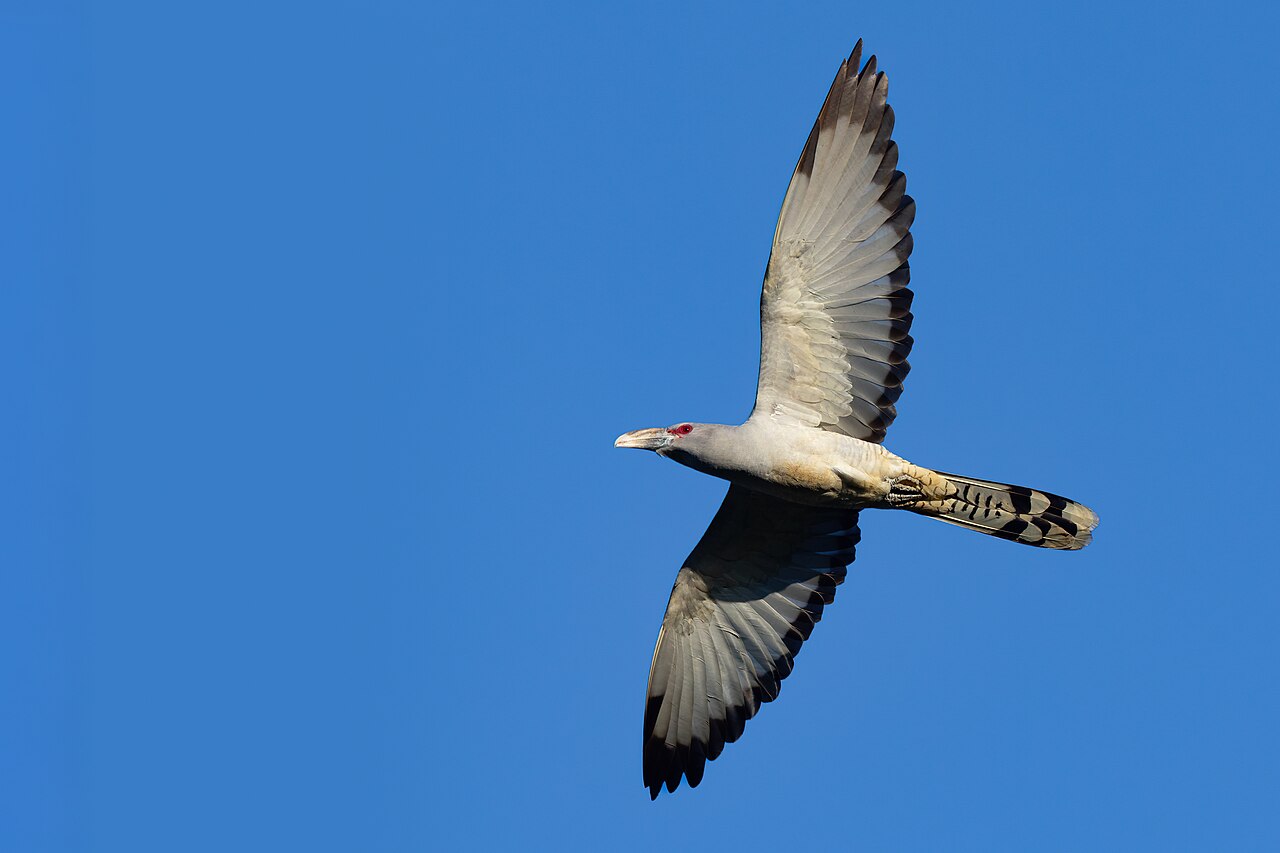
The Channel-billed Cuckoo is the largest cuckoo in the world and at the same time the largest brood parasite there is: a grey bird of nearly sixty centimetres with an enormous pale down-curved bill that suggests a toucan, and a bare red ring around the eye. It arrives with the first thunderstorms of early summer, which has earned it the names storm bird and rain bird in eastern Australia.
Voice
A deafening, raucous din that keeps whole streets awake at night. The call is a loud kawk, followed by a faster and weaker awk-awk-awk-awk that dies away, given from a high branch and just as often in flight. A pair passing overhead calls to one another without a break, and the sound is usually the first sign that the species is back.
No freely licensed recording has been found for this species yet; what to listen for is described below.
Identification
Unmistakable for size and bill: 58 to 65 cm, with a massive pale bill, grey at the base and running out to a straw-coloured tip, carrying a groove along the upper mandible. The plumage is pale grey on head and underparts and darker grey on back and wings, with black wingtips and a barred, white-tipped tail. A conspicuous patch of bare red skin surrounds the eye. In flight the cross-shaped silhouette stands out — long pointed wings, long tail — which at range suggests a bird of prey. Females have a slightly smaller bill and more barring below; juveniles are buff-toned with a pink bill.
Confusion species
Little scope for error when the bird is seen well, since nothing else in the region combines this size with such a bill. In flight against the sky it is harder: the cross-shaped silhouette with its long tail suggests a large raptor, but the slow even beats and the absence of soaring rule that out. Pacific Koel (Eudynamys orientalis) arrives in the same season and works partly the same country, but at forty centimetres is much smaller, the male all black and the female brown and spotted, and both have a short bill. A passing Channel-billed Cuckoo is almost always chased by crows, ravens or Pied Currawongs — that uproar is a more reliable pointer than the silhouette.
Habitat
Tall open forest and eucalypt woodland, riverine woodland along creeks and fig-bearing monsoon forest in the north, and in the east increasingly the parks, streets and gardens of the coastal cities, where figs and camphor laurels fruit and where its hosts are numerous. It stays almost entirely in the canopy and sits quietly in dense foliage by day.
Where the bird is most often found, arranged by main group and formation.


Range and movements
A breeding visitor to northern and eastern Australia, from the Kimberley across the Top End and Cape York and south along the east coast, densest in Queensland and New South Wales and reaching Victoria in good years. The birds arrive between August and October from New Guinea and the Indonesian islands and leave again in February and March. It reaches New Zealand only as an extremely rare vagrant.
- Resident
- Breeding (summer)
- dark = core range, pale = thinly spread
Where and when to look
In October and November listen over a suburb or a river valley for the hoarse kawk and then look up: the chances are you will see a large grey bird under attack from a furious party of ravens or currawongs. By day it sits motionless in a dense fig; look there for the pale bill among the leaves, because it is the only light surface that shows.
Conservation
Least Concern, and regarded as secure throughout its Australian range. The species has gained from figs and other fruit trees planted in gardens and streets, which supply food and at the same time make its hosts — Australian Raven, Torresian Crow, Pied Currawong and Australian Magpie — numerous in built-up areas. Its numbers swing with the monsoon and with the fruit crop, but there is no structural threat within this map window.
Scientific name
Scythrops novaehollandiae | Latham, 1790
Latham described the species in 1790 and erected the genus in the same work, so author and year carry no parentheses. Scythrops comes from Greek skuthros, 'sullen, angry', and ops, 'face', after the bare rough red skin around eye and lore that gives the bird a grim expression; novaehollandiae means 'of New Holland', the old name for Australia. The type locality is New South Wales. The English name channel-billed refers to the groove in the upper mandible.