All species › Tubenoses › Petrels, shearwaters and diving petrels › Blue Petrel
Blue Petrel | Halobaena caerulea
Blauwe stormvogel | Halobaena caerulea
The Blue Petrel is the blue-grey tubenose of the subantarctic ocean that makes you look twice: at range it is a prion, with the same blue-grey back and the same open black M across the wings, but it has a black cap running down below the eye and a square tail with a snow-white tip. That white tail tip is the one feature that always works at sea. It is the only species in its genus.

Voice
At sea it is silent. At the colony the sound comes from inside the burrow at night and from birds circling over the tussock slope: cooing and cackling series much like those of prions, a rattling kek-kek-kek-kek alternating with a softer, dove-like coo. Walk past a colony by day and you hear nothing.
No freely licensed recording has been found for this species yet; what to listen for is described below.
Identification
Twenty-nine centimetres and about two hundred grams, a quarter heavier than most prions and with a larger, blockier head. The upperparts are blue-grey with an open black M running from wingtip to wingtip, broken across the lower back. Forehead and throat are white, but the blackish cap extends below the eye and carries on as a partial collar onto the side of the breast. Underparts and underwing are white, the bill black, the legs blue. The tail is square-cut with a clear white tip. The flight is faster and more angular than a prion's, with higher arcs above the swell — more the picture of a small gadfly petrel than of a whalebird.
Confusion species
All six prions in this guide resemble it closely: Fairy Prion (Pachyptila turtur), Fulmar Prion (Pachyptila crassirostris), Slender-billed Prion (Pachyptila belcheri), Antarctic Prion (Pachyptila desolata), Salvin's Prion (Pachyptila salvini) and Broad-billed Prion (Pachyptila vittata). All six have a grey tail with a black tip; the Blue Petrel is the only one with a white tail tip. It is also bigger and heavier, its cap is darker and runs below the eye, and it lacks the pale-browed face of Slender-billed Prion. The name misleads: despite the word 'petrel', Halobaena does not sit taxonomically with the true petrels (Pterodroma, Procellaria) but right beside the whalebirds — it is the sister genus of Pachyptila, and the blue-grey plumage with its M-band is exactly what that relationship shows.
Habitat
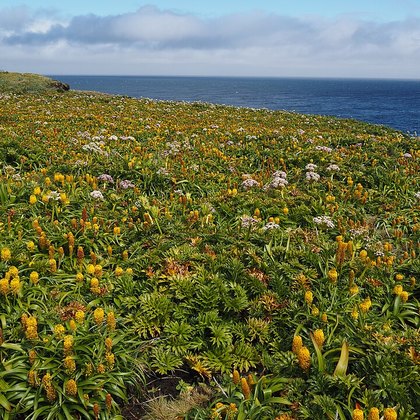
Cold, productive ocean water around and south of the Antarctic Convergence, where it takes krill, small squid and fish larvae from the surface, mostly at night. It breeds in self-dug burrows in peat under tussock on subantarctic islands, usually on slopes with a clear run to the sea, and comes and goes only in darkness.
Where the bird is most often found, arranged by main group and formation.


Range and movements
Within this guide's map window it breeds only on Macquarie Island, with fewer than a thousand pairs; the large colonies on Kerguelen, Crozet, Prince Edward and South Georgia lie outside it. In the waters south of Australia and New Zealand it is a non-breeding visitor rarely seen from a boat but turning up every year as a beach wreck: on New Zealand beaches usually ten to a hundred dead birds a year, with a clear peak from July to October, and in Australia mainly on the Victorian, Tasmanian and South Australian coasts after winter storms.
- Resident
- dark = core range, pale = thinly spread
Where and when to look
On any prion-like bird, look at the tail tip before the bill: white means Blue Petrel, and it holds up even against the light. Living birds are best seen on a subantarctic island voyage or on a deep southern pelagic in winter. From the coast, walking a beach transect after a sustained south-westerly blow in August or September is the more realistic way to get the species in the hand.
Conservation
Least Concern (LC): the world population runs into the millions and its centre of gravity lies on uninhabited islands. Where predators did arrive the story differs. On Macquarie Island cats and rats kept the colony small and rabbits dug the slopes to pieces; only after the great eradication campaign that declared the island pest-free in 2014 could burrow numbers rise again. At sea it is little affected by longline fisheries, but plastic in the stomach and the warming of krill-rich water count as growing concerns.
Scientific name
Halobaena caerulea | (Gmelin, 1789)
Gmelin described the species in 1789 as Procellaria caerulea; because the genus has since changed, author and year are bracketed. caerulea is Latin for 'blue', after the plumage. The genus Halobaena was introduced by Bonaparte in 1856, from Greek hals 'sea' and bainō 'to walk', hence 'sea-walker'. The type locality is given no more precisely than 'Southern Ocean'.