All species › Tubenoses › Petrels, shearwaters and diving petrels › Southern Fulmar
Southern Fulmar | Fulmarus glacialoides
Grijze stormvogel | Fulmar sureño
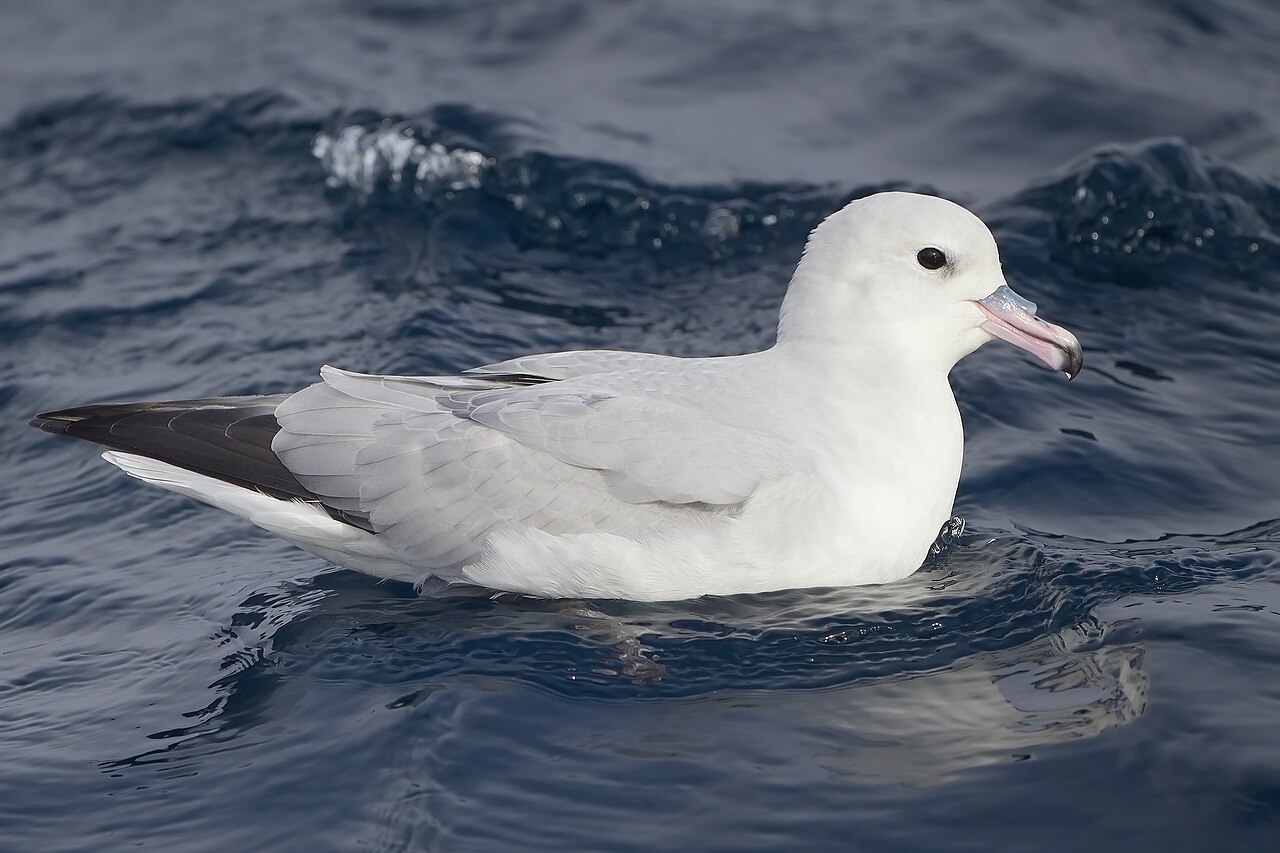
The Southern Fulmar is the pale, heavily built tubenose of the pack ice: white head and underparts, silver-grey mantle, and a pink bill with a black tip. It flies on long stiff wings with much gliding and soaring, which makes it suggest a small albatross rather than a petrel. In this map window it is a winter visitor from the south.
Voice
At sea it is almost always silent, though a growling cackle can break out in a squabble over fish waste. At the nest on the cliff ledge it is noisy: loud cackling and rattling calls and a repeated kew-kew-kew with which pairs greet each other and see off intruders. Like all fulmars it spits a foul-smelling stomach oil when threatened.
No freely licensed recording has been found for this species yet; what to listen for is described below.
Identification
Forty-five to fifty centimetres with a wingspan over a metre, so clearly larger than most petrels here. The head is white, the neck and mantle silver-grey shading to darker grey on the back and upperwing. The wingtips are black with conspicuous rectangular white flashes in them, which light up at range like the wing patches of a skua. Underwing and tail are white, the legs pink. The bill is pink with a black hooked tip and bluish nasal tubes, the best mark at close range. The flight is stiff and soaring, with long glides on rigidly held wings.
Confusion species
White-headed Petrel (Pterodroma lessonii) is the hardest: also a pale bird with a white head, but with a dark eye patch, a grey M across the upperwing, a wholly dark underwing and a short black bill — and it flies in the high, swooping arcs of a gadfly petrel instead of soaring stiffly. Cape Petrel (Daption capense) is smaller and chequered black and white. The prions and Blue Petrel (Halobaena caerulea) are half the length and blue-grey rather than silver-white. A pale young Black-browed Albatross is twice the size with a far longer wing. No second Fulmarus occurs in the north of this region, so a big pale tubenose with a pink black-tipped bill south of Tasmania or Stewart Island is almost always this species.
Habitat
Cold Antarctic and subantarctic water, often at the edge of the pack ice and over the continental shelf, where it takes krill, small fish and squid from the surface and readily joins ships and whale carcasses. It breeds colonially on narrow cliff ledges up to two hundred metres above the sea.
Where the bird is most often found, arranged by main group and formation.


Range and movements
It does not breed within this guide's map window: the colonies lie on the Antarctic coast and on the islands of the Scotia arc, with the Balleny Islands south of New Zealand the nearest of all. In guide waters it is a regular winter visitor, mainly from May to December, in the cold sea south of New Zealand and Australia. Small numbers wash up on New Zealand beaches most years, with spikes in bad ones — over six hundred birds in 1975. In Australia it is mainly a bird of the waters off Tasmania, Victoria and South Australia, with rare beach records further north.
- Winter
- dark = core range, pale = thinly spread
Where and when to look
Take a winter pelagic well to the south, or better still a voyage to the subantarctic islands or the Ross Sea: there it stands out as the palest large bird behind the boat. From land, a seawatch in a southerly gale between June and September is the best chance; watch for the white flashes in the black wingtip, which carry even in poor light. Walk the beach after storms, because it is the dead birds that show the pink black-tipped bill at close range.
Conservation
Least Concern (LC): the range is enormous and the population is put at over four million birds, with about a million pairs on the South Sandwich Islands alone. The colonies sit on inaccessible cliff ledges free of introduced predators. The heaviest losses come from the weather: in bad years extreme weather costs roughly forty per cent of eggs and a quarter of chicks. The longer-term uncertainty is climate change, which shifts the position of the sea ice and with it the krill supply.
Scientific name
Fulmarus glacialoides | (Smith, 1840)
The Scottish zoologist Andrew Smith described the species in 1840 as Procellaria glacialoides; because the genus has since changed, author and year are bracketed. Fulmarus goes back to Old Norse fúl már, 'foul gull', after the stinking stomach oil these birds spit. glacialoides means 'resembling glacialis', that is the Northern Fulmar, named by Linnaeus in 1761. The type locality is given no more precisely than 'Cape seas', the waters off the Cape of Good Hope.