All species › Passerines › Honeyeaters › Brown Honeyeater
Brown Honeyeater | Lichmera indistincta
Balinese honingeter | Mielero pardo
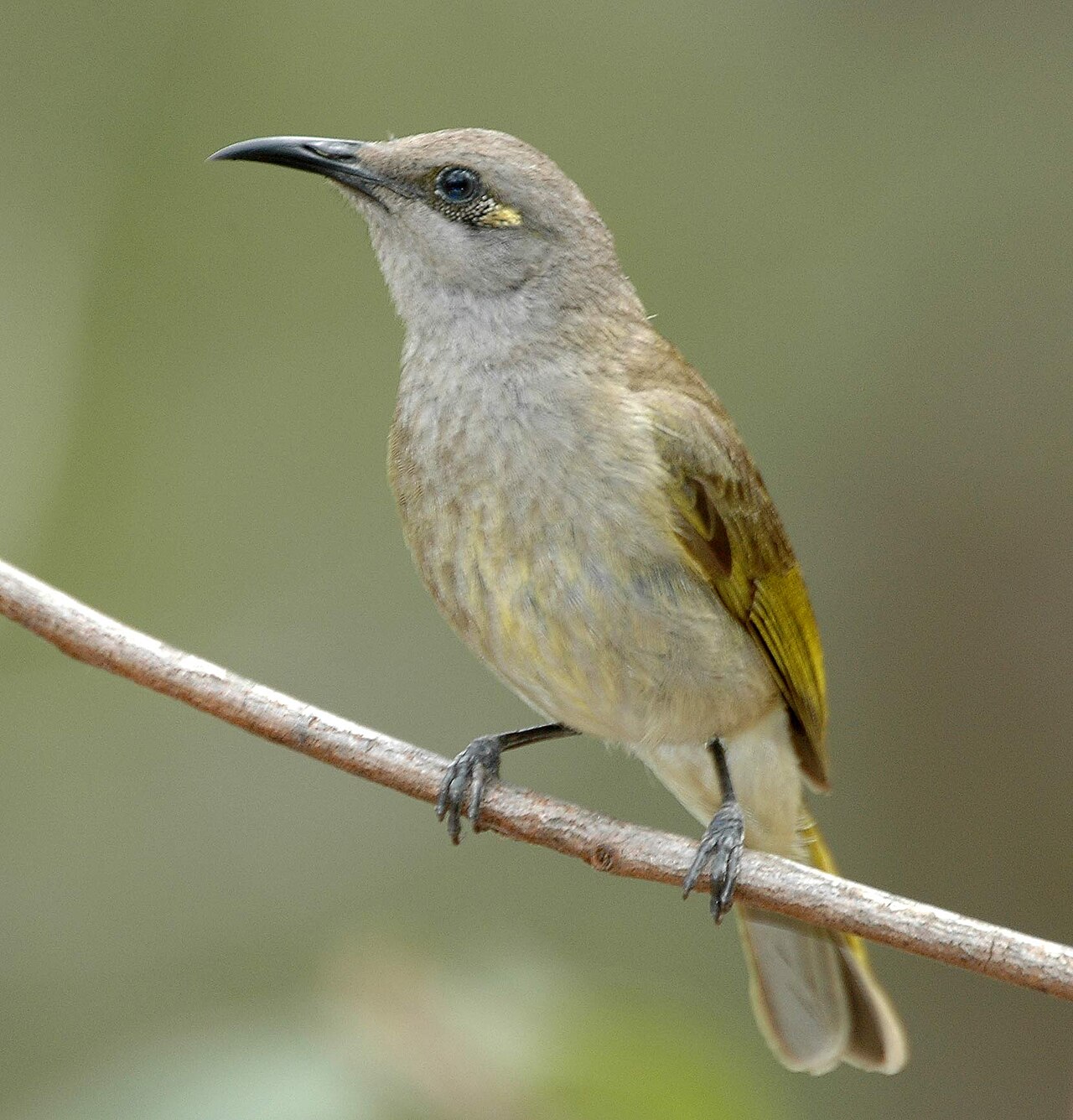
The Brown Honeyeater is the least conspicuous honeyeater in Australia and at the same time the family's finest singer: a small, plain grey-brown bird with no more marking than a yellow spot behind the eye, singing at a volume you do not expect at this size. It is also the only honeyeater that reaches beyond Wallace's Line as far as Bali — which is what the Dutch name balinese honingeter records.
Voice
This is where the species earns its reputation. The song is clear, loud and musical, a rolling series often written as sweet-sweet-quarty-quarty, and for a bird of eleven grams it carries far. Australian observers have repeatedly called it the best songster among the honeyeaters, and some go further and place it among the finest songbirds on the continent. The male sings above all when defending his territory, at length and from a fixed perch. Alongside this come short, sharp alarm notes.
Recording: Eddy Smith — CC BY-NC-SA 4.0 · Cattana Wetlands (near Smithfield), Cairns Regional, Queensland, Australia · xeno-canto
Identification
A small honeyeater of twelve to sixteen centimetres, plain grey-brown to olive-brown above and pale grey below, without streaking or mask. Two things give it away: a small triangular yellow spot just behind the eye, and the dull yellow to olive-yellow panels in the closed wing and the tail, which catch the low light of early morning and late afternoon. The bill is black, long, slender and slightly decurved — a tool for deep tubular flowers. The eye is dark brown, the legs grey. The sexes are alike; young birds are yellower in tone and do not yet show a clear ear spot.
Confusion species
The likeliest confusion is with Dusky Myzomela (Myzomela obscura), which carries the same plain brown but is darker, has a shorter and straighter bill and lacks the yellow ear spot altogether. Young Scarlet Myzomelas (Myzomela sanguinolenta) and young Red-headed Myzomelas (Myzomela erythrocephala) are likewise brown and colourless, but smaller and finer-billed, and they too have no yellow spot. In the tropical north, Brown-backed Honeyeater (Ramsayornis modestus) and Bar-breasted Honeyeater (Ramsayornis fasciatus) are added: those are white below with brown scaling or barring rather than plain grey. Rufous-throated Honeyeater (Conopophila rufogularis) has a rusty throat patch. If doubt remains, let the bird sing — the loud, musical song cannot be confused with any of these.
Habitat
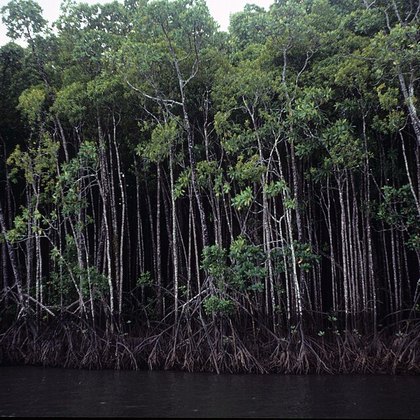
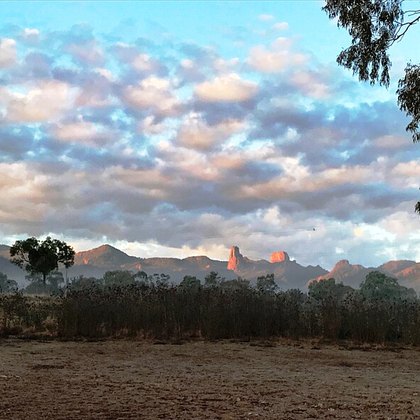
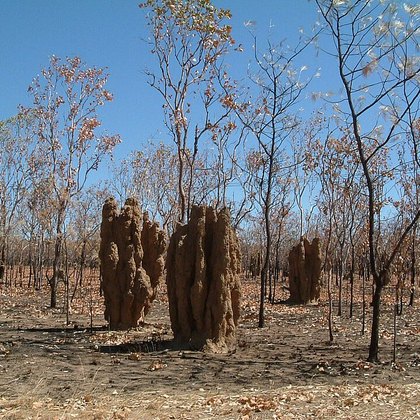
Almost any wooded place near water: mangrove and the vegetation behind it, dry eucalypt forest and woodland, mallee (low, multi-stemmed eucalypt scrub of dry southern Australia), heath, riverine timber along creeks, eucalypt savanna and, not least, gardens, parks and street plantings, where flowering grevilleas and bottlebrushes hold it. It is nomadic and follows the flowering season of its food plants, so it can be common in an area for months and then vanish. Food is nectar from mistletoe, mangrove and eucalypt, supplemented with insects — beetles, flies, ants and wasps — gleaned from foliage. The nest is a small, deep cup of grass and soft bark, hidden in a shrub or tree up to about five metres; it uses the same nesting territory year after year.
Where the bird is most often found, arranged by main group and formation.


Range and movements
Widespread across western, northern and eastern Australia, and beyond it across New Guinea and neighbouring islands into the Lesser Sundas. Uniquely among honeyeaters it penetrates west of Wallace's Line and occurs on Bali. In Australia it is common in the west, the north and Queensland and reaches eastern New South Wales; Victoria and Tasmania fall outside the range, and in South Australia it is rare. It does not occur in New Zealand.
- Resident
- dark = core range, pale = thinly spread
Where and when to look
Find it by ear, not by eye: in a garden or a strip of mangrove, a loud rolling song coming out of an unremarkable bush is almost certainly this bird. When you get it in view, note the small yellow spot behind the eye and the long, slightly decurved bill; those two together rule out the myzomelas. In Western Australia and around Darwin it is one of the commonest garden birds, and a flowering grevillea in a front garden is often the best place of all.
Conservation
Least Concern (LC) and common over nearly the whole range; it does very well in urban plantings of flowering native shrubs, so that gardens have locally even gained it ground. The exception lies in the Western Australian Wheatbelt, where decline has been recorded following the large-scale clearing of native vegetation for cropping. At the scale of the species that is a regional phenomenon and does not reverse the general picture.
Scientific name
Lichmera indistincta | (Vigors & Horsfield, 1827)
Nicholas Vigors and Thomas Horsfield described the species in 1827 as Meliphaga indistincta; the parentheses around their names record the later move. Jean Cabanis introduced the genus Lichmera in 1851, from Greek likhmērēs, 'licking with the tongue' — a reference to the brush tongue with which honeyeaters take up nectar. The epithet indistincta is Latin for 'indistinct' or 'unmarked', and it is an honest description: the bird has almost no pattern. The English name Brown Honeyeater and the Spanish mielero pardo follow the same colourlessness. The Dutch name balinese honingeter instead takes the oddest fact about the species: that it alone among honeyeaters reaches Bali, and so occurs west of Wallace's Line.