All species › Passerines › Honeyeaters › Yellow-tufted Honeyeater
Yellow-tufted Honeyeater | Lichenostomus melanops
Geelpluimhoningeter | Mielero orejigualdo
The Yellow-tufted Honeyeater is the showier of the two species still carrying the old name Lichenostomus: a lively, noisy bird of the dry eucalypt forests of eastern Australia, with a bright yellow crown and throat, a glossy black mask and a golden tuft pointing back from the eye. It lives in colonies, defends flowering trees fiercely against anything that passes, and in the field is less an observation than an event.

Voice
A persistent, irritable bird that uses many short, hard notes rather than a flowing song. The ordinary repertoire is a set of single calls rendered as tsup, shup, jik or chow, brief and emphatic and repeated from the canopy. Alongside these there is a softer chattering between birds of the same colony, and a sharp, rattling alarm the moment a raptor or another honeyeater enters the territory. A colony in full swing can be heard from a long way off.
No freely licensed recording has been found for this species yet; what to listen for is described below.
Identification
A medium-sized honeyeater of seventeen to twenty-three centimetres, olive-brown to olive-green on back and wings and yellowish grey below. The head carries the pattern: bright yellow forehead, crown and throat, between them a glossy black mask running from the bill base through the eye and across the ear coverts, and at the end of that mask a short, vivid yellow ear tuft. Bill and gape are black, the eye dark brown, the legs grey-brown. The sexes are alike, though the male is a little larger. Young birds are duller, with a greenish wash over the yellow. Of the four subspecies, cassidix — the Helmeted Honeyeater of Yellingbo — is the largest and brightest.
Confusion species
This is the heart of the old Lichenostomus problem, where a run of very similar olive-green honeyeaters has to be kept apart. Yellow-faced Honeyeater (Caligavis chrysops) is smaller, has no black mask and no yellow crown but a single narrow yellow stripe starting above the bill base and ending in a white point below the eye, and migrates north in large flocks in autumn. Purple-gaped Honeyeater (Lichenostomus cratitius) is the only other species still bearing the name Lichenostomus: it lacks the yellow crown and throat and shows instead a purple strip of bare skin along the gape, and lives in mallee far to the west. Bridled Honeyeater (Bolemoreus frenatus) and Eungella Honeyeater (Bolemoreus hindwoodi) are duller and hold small upland ranges in Queensland, the latter only around the Eungella plateau. Yellow-throated Honeyeater (Nesoptilotis flavicollis) of Tasmania and White-eared Honeyeater (Nesoptilotis leucotis) of the mainland have a black head with a large white ear patch instead of yellow. The Ptilotula honeyeaters are smaller, plainer and lack both the black mask and the yellow crown.
Habitat
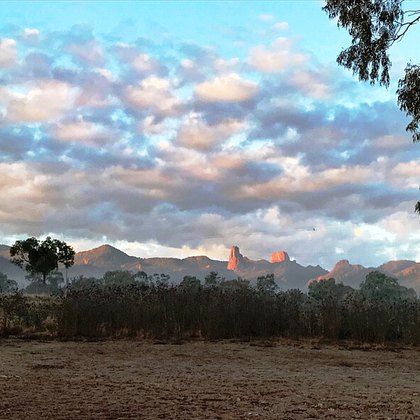
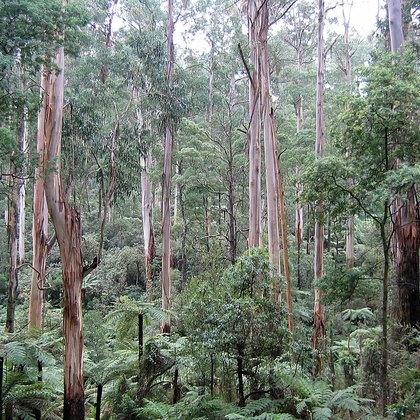
Dry, open eucalypt forest and woodland with a shrub layer beneath, often close to running or standing water, and beyond that wetter eucalypt forest, mallee, brigalow and, locally, gardens holding large eucalypts. It eats arthropods, lerp and honeydew and nectar from eucalypt blossom, with a little fruit. Outside the breeding season it forages in parties of up to ten, which occupy a flowering tree together and drive other honeyeaters out of it with a great deal of noise. It breeds colonially in monogamous pairs with helpers; the female incubates, both parents and the helpers feed, and two to three broods are raised in a season.
Where the bird is most often found, arranged by main group and formation.


Range and movements
Eastern and south-eastern mainland Australia, from the Tropic of Capricorn in Queensland south through eastern New South Wales to south-western Victoria and south-eastern South Australia. The range broadly follows the forest country on and behind the Great Dividing Range and reaches inland into the drier woodlands. Within it, the subspecies cassidix occupies no more than a handful of narrow strips of streamside and swamp forest at Yellingbo, east of Melbourne. The species is absent from Tasmania and does not occur in New Zealand.
- Resident
- Winter
- dark = core range, pale = thinly spread
Where and when to look
Go by sound and by commotion: where in dry eucalypt forest a flowering tree is held by a noisy party of honeyeaters chasing everything off, this is the first candidate. Then look at the head and not at the back, because the back is the same olive-green in nearly every species of this group. Yellow forehead plus black mask plus yellow ear tuft is the decisive trio; if the yellow forehead is missing, you are on another species. A creek or a drinking place in dry forest is the best spot to wait.
Conservation
The species as a whole is Least Concern (LC) and secure over most of its range. The exception is the subspecies cassidix, the Helmeted Honeyeater, listed as endangered nationally and critically endangered in Victoria: it holds on in a few narrow strips of forest at Yellingbo and survives only through intensive habitat restoration, captive breeding and reintroduction. Habitat loss is the main cause, compounded by displacement by aggressive species, in particular Bell Miner (Manorina melanophrys), which establishes colonies in exactly the kind of damp edge forest cassidix depends on. Vegetation restoration at Yellingbo has produced results.
Scientific name
Lichenostomus melanops | (Latham, 1801)
John Latham described the species in 1801 as Turdus melanops — initially, that is, as a thrush; the parentheses around his name record the later move. Jean Cabanis introduced the genus Lichenostomus in 1851, built from Greek leichēn, 'lichen' or 'callous', and stoma, 'mouth', for the warty, callous gape of these birds. When a molecular study in 2011 showed the genus to consist of several unrelated branches, only two species were left in it: this one and Purple-gaped Honeyeater. The epithet melanops is Greek for 'black face'. The English name Yellow-tufted Honeyeater and the Dutch geelpluimhoningeter take the ear tuft, and the Spanish mielero orejigualdo does the same. The subspecies name cassidix goes back to Latin cassis, 'helmet', and lives on in the name Helmeted Honeyeater.