All species › Passerines › Honeyeaters › Yellow-throated Miner
Yellow-throated Miner | Manorina flavigula
Witstuithoningeter | Mielero goligualdo
The Yellow-throated Miner is the miner of dry Australia: a grey, noisy, colonial honeyeater with a black mask, a yellow bill and yellow legs, which drives every other bird out of its trees. Where the Noisy Miner holds the wet east coast, this species takes on almost the whole of the dry interior. The white rump is the only feature that works at a distance — and it is also the feature on which, in the mallee, the fate of an endangered relative turns.

Voice
A clear, piping pwee-pwee-pwee, of the same kind as the Noisy Miner's but higher and thinner in tone. Alongside it comes a wide register of harsh, scraping cries and continuous chatter, and in danger an alarm chorus in which the whole colony joins at once: ten to thirty birds that keep calling around a raptor, a snake or a cat until it leaves. The sound carries far across open woodland and usually betrays the colony well before the birds are seen.
No freely licensed recording has been found for this species yet; what to listen for is described below.
Identification
Eighteen to twenty-three centimetres: a stocky, long-tailed honeyeater, grey from crown to tail and pale grey below, with fine scalloping on the breast. The face carries a black mask, above it an olive-yellow forehead and behind it a patch of bare yellow skin; bill, legs and feet are bright yellow. The throat is pale and usually washed yellow. Decisive is the rump: white to off-white and clearly set off against the grey back, a panel that lights up in flight. The tail is dark with white tips, and the wings show an olive-yellow gloss on the flight feathers.
Confusion species
The Noisy Miner (Manorina melanocephala) is larger, has a black crown and a grey rump with no contrast against the back; in the east of the range the two species meet, and there the rump is the only difference that can be read quickly. The Black-eared Miner (Manorina melanotis) of the mallee is the hardest case: it has a brown rump that does not differ from the back, a grey rather than white throat, and a heavier mask with less silver-grey flecking. Because the two produce hybrids where they meet, birds intermediate in every one of these characters occur, and there a single feature is never enough. The Bell Miner (Manorina melanophrys) is smaller, olive-green and tied to moist gullies.
Habitat
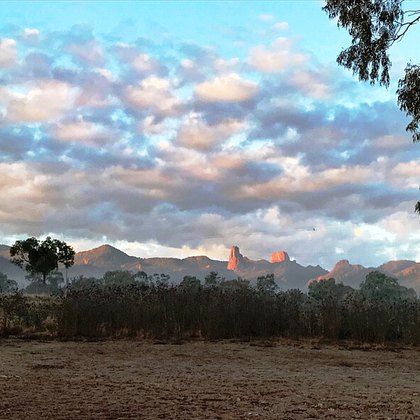
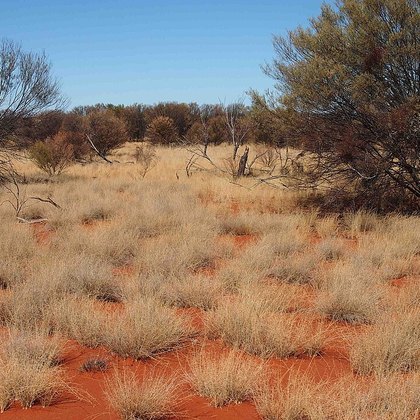
Dry eucalypt forest and woodland, mallee, mulga and other acacia scrub, casuarina and callitris woodland, and the narrow tree belts along inland creeks. It has a marked preference for edges, young regrowth, roadsides and cleared patches, and avoids dense, old, continuous forest. It therefore profits greatly from clearing: every new road and every stripped paddock yields it habitat. Parks, farmyards and the edges of inland towns belong to its range as well.
Where the bird is most often found, arranged by main group and formation.



Range and movements
Across almost the whole Australian mainland, except the country east of the Great Dividing Range, Cape York, Arnhem Land and the western Gulf of Carpentaria, and the very driest core of the interior. Five subspecies have been described, one of them on Melville Island. Resident, in colonies of a few to nearly fifty birds that stay on the same ground all year; the colony is divided into smaller parties that breed together and raise young together. In the south-east the range has expanded over the last century, following the clearing.
- Resident
- dark = core range, pale = thinly spread
Where and when to look
Flush a party of miners and look at nothing but the rump: white means this species, plain grey or brown means one of the other two. Do this with extra care in the mallee of the Murray region, and note throat colour and the amount of silver-grey in the mask as well — there pure birds, pure Black-eared Miners and everything in between occur together, and such records count in management.
Conservation
Not threatened and numerous over nearly the whole continent; the species has grown with clearing rather than being pushed back by it. That is precisely where the problem lies. Research shows that the Yellow-throated Miner establishes itself as a dominant competitor in fragmented landscapes and drives out smaller woodland birds, so that the bird communities of widely different areas come to resemble one another more and more. In addition it moves into the mallee along cleared ground and hybridises there with the endangered Black-eared Miner (Manorina melanotis), eroding that species' genetic integrity.
Scientific name
Manorina flavigula | (Gould, 1840)
John Gould described the bird in 1840 as Myzantha flavigula; because the species was later moved to another genus, author and year stand in parentheses. The type locality is the Namoi River in New South Wales. Louis Pierre Vieillot introduced the genus Manorina in 1818, from Greek manos (thin, sparse) and rhis, rhinos (nostril), after the narrow nostril opening. flavigula is Latin for 'yellow-throated', from flavus (yellow) and gula (throat). The English group name 'miner' has nothing to do with mining but is a nineteenth-century respelling of 'myna', after a superficial likeness to the Asian mynas. The Dutch name takes hold of the white rump, the feature that separates it from the other miners.