All species › Waders, gulls and terns › Sandpipers and allies › Buff-breasted Sandpiper
Buff-breasted Sandpiper | Calidris subruficollis
Blonde ruiter | Correlimos canelo
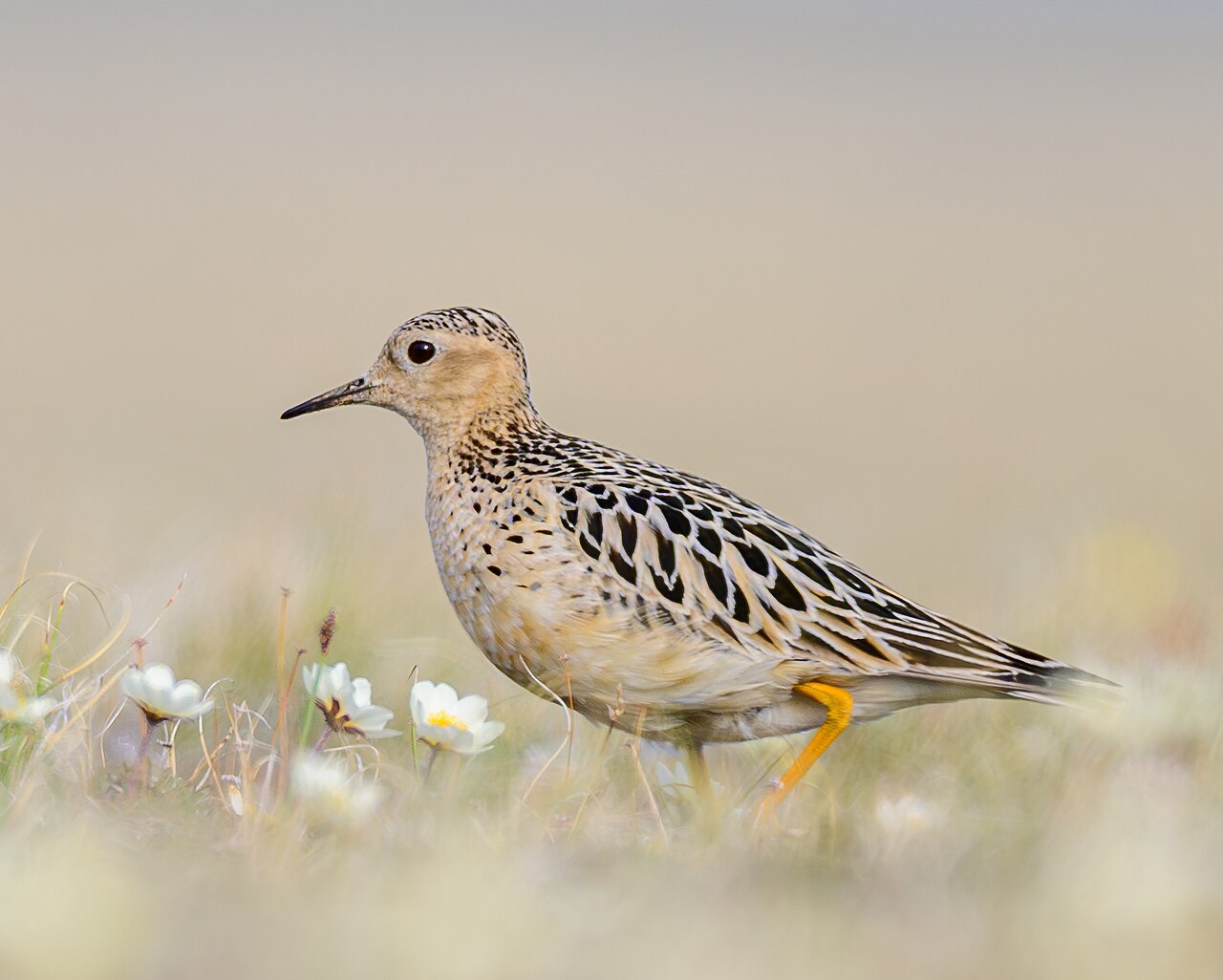
The Buff-breasted Sandpiper breaks the mould of the stints and sandpipers: not a grey-and-white bird of the tide line but an evenly warm ochre bird with a small round head, a large dark eye that seems to float on that plain face, and long yellow legs. It walks on short grass rather than mud, moving with the short bursts and sudden stops of a plover. In this map window it is an outright vagrant: a handful of Australian records and a single New Zealand one.
Voice
A silent bird. Away from the breeding grounds it gives at most a soft, clipped greet as it flushes, sometimes preceded by a low, barely audible prreet. On the arctic display grounds there is a ticking, clicking sound during the wing display, but nobody who sees the bird here will hear it. Anyone who finds this species in Australia or New Zealand finds it by eye, not by ear.
Recording: Paul Kelly — CC BY-NC-SA 4.0 · Tacumshin Lake (East End), County Wexford, Ireland · xeno-canto
Identification
A medium-sized wader of eighteen to twenty centimetres, slim but with a strikingly small, round head on a fairly long neck. The whole face, neck and breast are an even warm ochre to apricot, with a slightly paler throat and no streaking or breast band; against that, the large, round, dark eye stands out as if stuck on a blank cheek. The crown is finely streaked dark. The upperparts are blackish-brown with broad pale feather fringes, giving a scaly pattern. The bill is short, straight and dark. The legs are long and bright yellow to ochre. In flight the decisive feature is the pure white underwing, cutting sharply against the ochre underparts, which the male shows off deliberately at the lek by raising one or both wings. There is no wingbar and no white rump.
Confusion species
Juvenile Ruff (Calidris pugnax) is the main and genuinely difficult one: it too is ochre on the breast with a scaly back and yellow legs. Separate it on size and build — Ruff is larger, longer in neck, leg and bill, and shows two white ovals at the sides of the rump in flight, which Buff-breasted Sandpiper entirely lacks; its underwing is greyish, not white. Sharp-tailed Sandpiper (Calidris acuminata) has a rufous cap and a clearly streaked breast rather than a plain ochre one. Little Curlew (Numenius minutus) shares the short-grass habitat but has a decurved bill and dark legs. Pacific Golden Plover (Pluvialis fulva) is larger, heavier-billed, spangled gold-brown and shows a grey underwing.
Habitat
Short grass is the keyword: grazed paddocks, airfield verges, playing fields, the dry upper edge of saltmarsh and samphire (low, succulent saltmarsh shrubland on tidal mud), and the drying margins of inland lakes. It largely avoids tidal flats, and where it does appear on them it stands on the dry, vegetated upper edge rather than in wet mud. It feeds walking and picking from the ground and from low vegetation, usually alone or among golden plovers.
Where the bird is most often found, arranged by main group and formation.

Range and movements
A New World vagrant. It breeds on the arctic tundra of North America and the extreme northeastern tip of Siberia and winters almost entirely on the grasslands of southern South America, with Samborombón Bay in Argentina as its core; migration runs up the middle of North America. Within this map window it is therefore far off course: at least eight Australian records, spread across the coast and the interior, and exactly one from New Zealand — a bird at Waionui Inlet on the southern side of Kaipara Harbour in March 2014, the country's first. The chance of a sighting falls in the southern summer, between October and April.
- Breeding (summer)
- dark = core range, pale = thinly spread
Where and when to look
Do not look for it among the waders on the flats but on short grass: a grazed paddock beside an estuary, an airfield edge, a playing field where golden plovers are standing. The image to work on is a medium-sized, evenly ochre bird with a small head and a large dark eye, running a few paces and then freezing. If in doubt, let it fly: the pure white underwing against the ochre belly is a feature no other wader here shows in that way. Always report a find to the rarities committee, because every record counts.
Conservation
Vulnerable (VU). The world population is a fraction of what it was around 1900: the species was shot in enormous numbers for the market on migration through North America in the nineteenth century and has never recovered. Present pressure comes from the conversion of the pampas grasslands it winters on into cropland, from pesticide use on those fields, and from the loss of suitable stopovers in the Great Plains. On the breeding grounds a changing climate is altering the tundra and shifting the display grounds. For Australia and New Zealand that mainly means the chance of a vagrant is shrinking rather than growing.
Scientific name
Calidris subruficollis | (Vieillot, 1819)
Vieillot described the species in 1819 as Tringa subruficollis, with Paraguay as the type locality — a wintering area, then, far from the arctic breeding grounds; because of the later move, author and year stand in parentheses. The epithet is formed from Latin subrufus, 'reddish', and -collis, 'necked', after the ochre neck and breast. For a long time it stood in its own genus Tryngites, but genetic work returned it to Calidris. The Dutch name calls it the 'blond' bird; the word it pairs that with, 'ruiter', suggests a kinship with the Tringa shanks that does not exist.