All species › Waders, gulls and terns › Sandpipers and allies › Great Knot
Great Knot | Calidris tenuirostris
Grote kanoet | Correlimos grande
The Great Knot is the largest of all the calidrid sandpipers and close to a trademark bird of the Australian tidal flats: a big, long-billed grey wader that stands in flocks of tens of thousands in the north-west. In a good year Eighty Mile Beach in Western Australia holds close to half the world population, and that very crowding is what makes the species vulnerable.
Voice
Usually silent. In flight there is a low, soft two-note whistle, nyut-nyut, more often heard as a whole flock lifts than from a single bird. At the roost there is at most a restless murmur.
No freely licensed recording has been found for this species yet; what to listen for is described below.
Identification
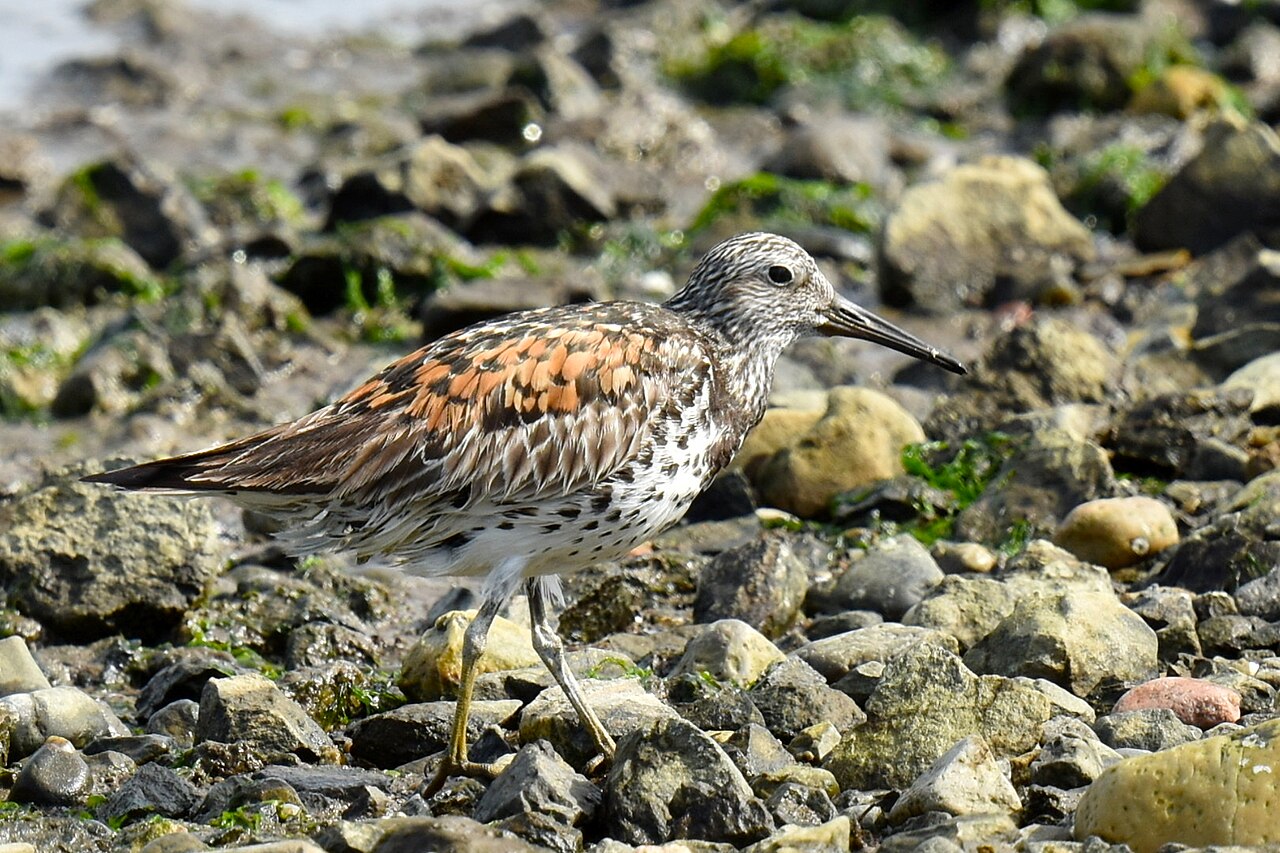
Twenty-six to twenty-eight centimetres: larger and longer-bodied than any other sandpiper here. The bill is black, straight, slender and clearly longer than the head, with a barely perceptible droop at the tip. The legs are short and dark grey-green. In non-breeding plumage the upperparts are grey with pale feather edges that give a scalloped look; neck and breast are heavily streaked and that streaking runs out into coarse black spots on breast and flanks — far more contrasting than on any relative. Rump and uppertail coverts are whitish and stand out in flight. In breeding plumage the scapulars carry a rufous patch and a black-spotted band crosses the breast.
Confusion species
Red Knot (Calidris canutus) is the only real candidate for confusion, and the two often stand side by side in one flock. Set them together: the Great Knot is some three centimetres longer, taller on the leg and longer in the neck, and its bill clearly exceeds the length of the head and tapers finer towards the tip, where the Red Knot has a short, evenly thick bill of about head length. Then look at the underparts: heavy black spotting on breast and flanks against an evenly pale grey, at most finely streaked breast. And as the flock lifts, look at the rump: whitish on Great Knot, grey and barred on Red Knot. Bar-tailed Godwit (Limosa lapponica) is much larger with a long, slightly upturned bill; Curlew Sandpiper (Calidris ferruginea) is smaller, with a curved bill and longer black legs.
Habitat
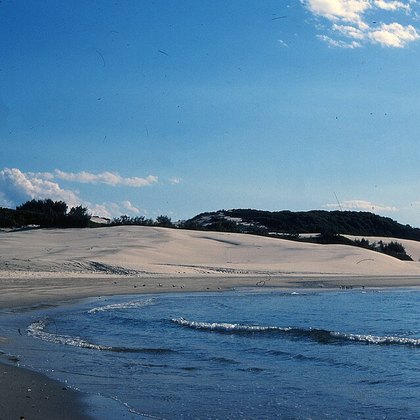
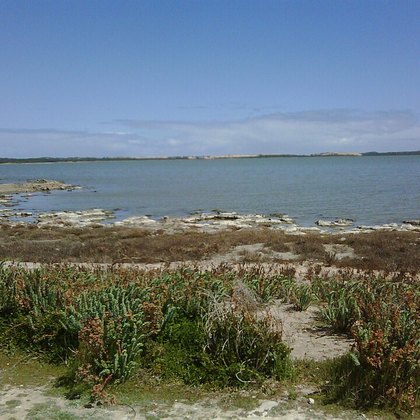
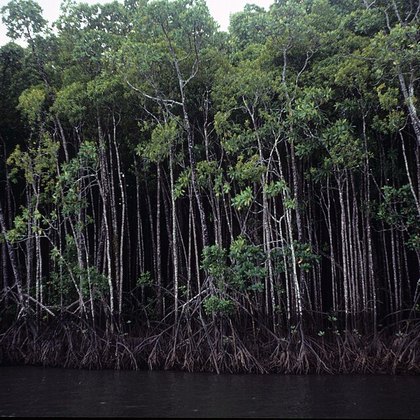
Intertidal mud and sandflats of sheltered coasts — bays, harbours and estuaries — where it takes bivalves from the soft surface layer. At high tide it gathers on sandy beaches, shellbanks, samphire flats and the fringe of mangroves, often in dense flocks that darken the beach.
Where the bird is most often found, arranged by main group and formation.

Range and movements
Around the whole Australian coast, but the weight of numbers lies overwhelmingly in the north and north-west. Complete counts on Eighty Mile Beach have reached about a hundred and sixty-nine thousand birds, a little under half the estimated world population; Roebuck Bay at Broome, the Gulf of Carpentaria and the flats around Darwin are the other major sites. In the south-east it is a scarce bird. In New Zealand it is a rare vagrant with a few dozen records in all, mostly on Kaipara and Manukau Harbours or Farewell Spit. Birds arrive from August and September and leave in March and April for the mountain tundra of north-eastern Siberia; some immatures stay through the winter in northern Australia.
- Resident
- dark = core range, pale = thinly spread
Where and when to look
Go to a roost at Roebuck Bay or Eighty Mile Beach on a rising tide and wait for the flat to drown: the flocks are then pushed up the beach shoulder to shoulder. Search the mass for the largest birds with the longest bills and the most heavily spotted flanks. A camera helps: on a photograph the bill-to-head ratio can be measured at leisure afterwards.
Conservation
Endangered (EN) globally, and listed as Critically Endangered under Australia's national environment law. The cause lies almost wholly along the flyway: the tidal flats of the Yellow Sea, where virtually every bird refuels on both legs of the journey, have been reclaimed on a large scale, and after the Saemangeum estuary in South Korea was walled off in 2006 tens of thousands of Great Knots disappeared from that site within a few years. Because nearly the whole world population concentrates at a handful of Australian sites, every disturbance and every loss at those sites also weighs heavily.
Scientific name
Calidris tenuirostris | (Horsfield, 1821)
Horsfield described the species in 1821 as Totanus tenuirostris; the move into Calidris puts author and year in parentheses. The epithet comes from Latin tenuis, 'thin' or 'slender', and rostrum, 'bill' — exactly the character that separates it from Red Knot. The genus Calidris goes back to Greek kalidris, Aristotle's word for grey waterside birds. The type locality is Java, where Horsfield worked as a naturalist. The Dutch name places it beside the knot, the old name of the Red Knot.