All species › Waders, gulls and terns › Sandpipers and allies › Subantarctic Snipe
Subantarctic Snipe | Coenocorypha aucklandica
Aucklandsnip | Agachadiza de las auckland
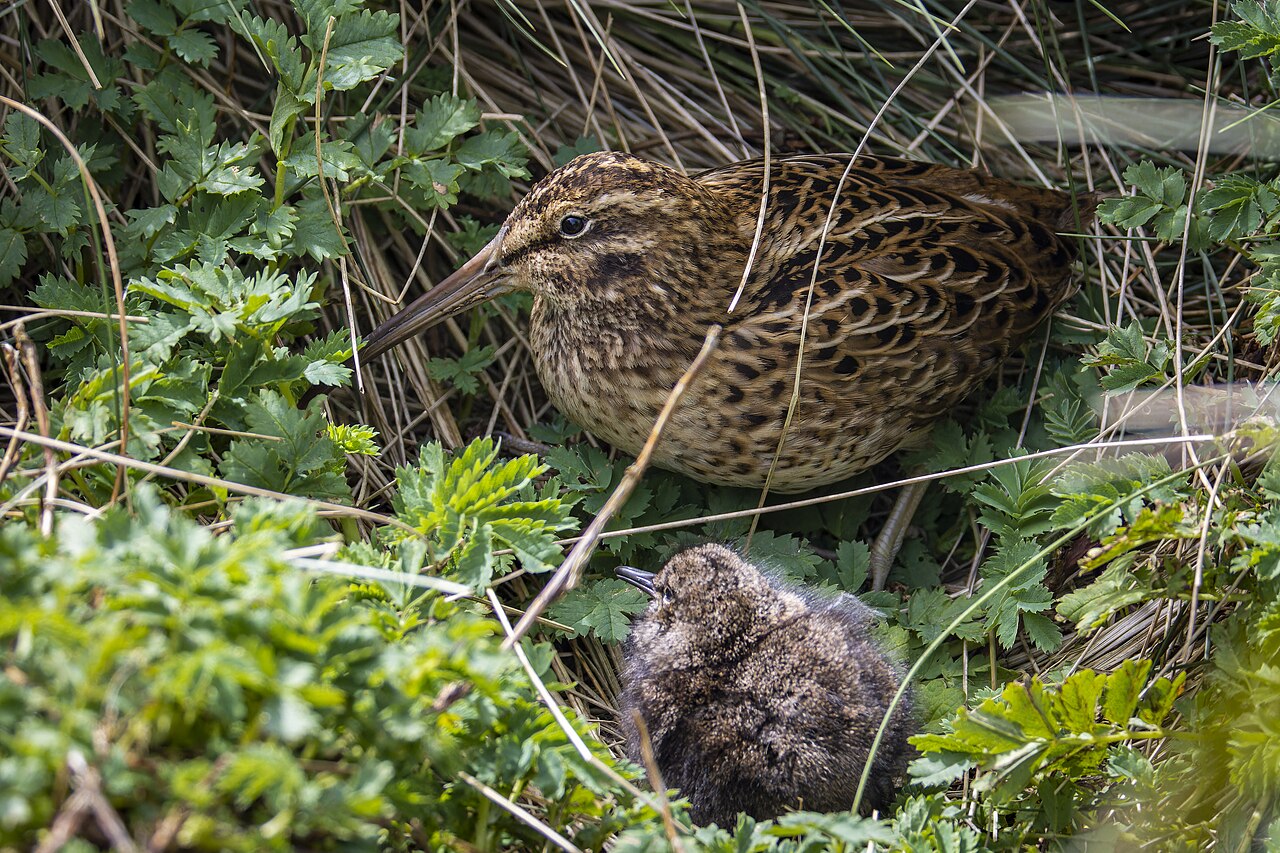
The Subantarctic Snipe is a squat, perfectly camouflaged snipe of New Zealand's subantarctic islands: invisible in the tussock by day, audible after dark as a sharp call and sometimes as an unearthly roar out of the sky. At twenty-three centimetres it is the largest of the three surviving New Zealand snipes and it has the longest bill and legs as well. It holds on precisely where no introduced mammal has ever landed.
Voice
The ordinary note is a sharp, briefly repeated chup chup, mostly after sunset and often from dense cover without the bird showing itself. On top of that all three island groups perform the nocturnal display flight the Maori called hakawai: the bird climbs high, calls as it climbs, then dives, and the vibrating outer tail feathers produce a low, drumming roar that was taken for the voice of an unseen creature. Standing on one of these islands in the dark, you will hear that roar long before you ever see the bird.
No freely licensed recording has been found for this species yet; what to listen for is described below.
Identification
A small, dumpy wader of twenty-three centimetres and about a hundred and ten grams, with a short neck, a short round body and very short legs. The bill is straight, slender and, at nearly five centimetres, the longest in the genus, flesh to horn-brown with a dark tip; the legs are pale yellow, except on Antipodes birds, which have grey legs. The upperparts are variegated brown and blackish with crisp buff feather edges running as pale lines down the back; the belly is almost unmarked off-white, which is a good mark. Auckland Island birds vary most in size, Antipodes birds are darker and more yellowish above, and Campbell birds are the smallest and darkest-backed, with a pinkish cast to the belly.
Confusion species
The only real confusion is with the two other New Zealand snipes, and in practice it is settled by where you are standing. Snares Snipe (Coenocorypha huegeli) is confined to the Snares and to the islets off Stewart Island it has been moved to; it is slightly smaller, shorter in bill and leg, and its belly feathers are barred rather than nearly plain. Chatham Islands Snipe (Coenocorypha pusilla) is confined to the Chathams, a good two thousand kilometres to the northeast, and at twenty centimetres with a bill of forty-two to forty-eight millimetres is clearly the smallest and shortest-billed of the three. None of the three ranges overlap: a snipe on the Aucklands, the Antipodes or Campbell is by definition this species. The migrant Asian snipes of the genus Gallinago do not reach the subantarctic islands.
Habitat
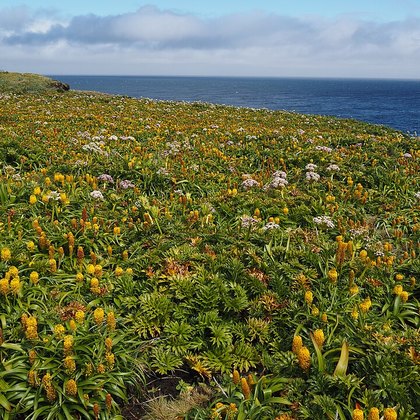
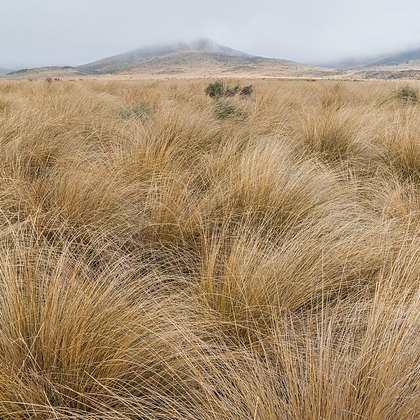
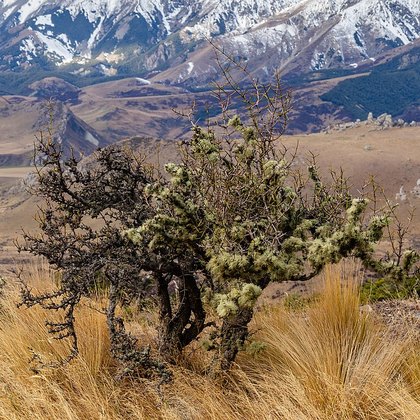
Dense low cover on predator-free islands: tall Poa and Chionochloa tussock, megaherb field, fernland under low forest, and scrub of rata and dracophyllum. It feeds in the damp humus and the peat below it, probing fast for earthworms, amphipods, beetles and larvae. Bare ground and open water it avoids; cover matters to it as much as food, and it spends the day under the thickest vegetation it can find.
Where the bird is most often found, arranged by main group and formation.
Range and movements
Three subantarctic island groups of New Zealand only. In the Auckland group it is on Adams, Disappointment, Ewing, Rose, Ocean and Enderby, but not on the large main island, where feral cats and pigs wiped it out; Adams alone probably holds tens of thousands of birds. Beyond that it occurs on the Antipodes Islands and on Campbell Island, where it has been back only since Norway rats were removed in 2001 and birds returned from the neighbouring stack of Jacquemart. It occurs neither in Australia nor on the New Zealand mainland.
- Resident
- dark = core range, pale = thinly spread
Where and when to look
You will only see this bird by joining one of the regulated voyages to the subantarctic islands; Enderby Island is the single landing point open to visitors where it walks about reliably. There, move slowly along the edge of the rata scrub and watch the ground at your feet rather than the distance, because it flushes only when nearly trodden on and drops back into cover a few metres on. At dusk stand still on deck or at the landing and listen for the roar of the hakawai.
Conservation
Near Threatened (NT) globally, and rated separately within New Zealand for each subspecies: Auckland and Antipodes birds count as naturally uncommon, Campbell birds as nationally vulnerable. The species persists only where introduced mammals are absent and goes where they arrive; cats and pigs did that on the main Auckland Island, Norway rats on Campbell. The turning point was the removal of the rats from Campbell in 2001, at the time the largest operation of its kind anywhere, after which the snipe spread across the island from Jacquemart on its own. The lasting threat is that a landing or a shipwreck puts a rodent ashore again.
Scientific name
Coenocorypha aucklandica | (Gray, 1845)
George Robert Gray described the species in 1845 as Gallinago aucklandica; because it was later moved to another genus, author and year stand in parentheses. Gray himself introduced the genus Coenocorypha for the New Zealand snipes in 1855. The epithet aucklandica simply means 'of the Auckland Islands', and that is where the type locality lies: the bird was taken on Enderby Island in November 1840 during the antarctic voyage of the ships Erebus and Terror. The Campbell Island subspecies was not found until 1997, by chance, on the stack of Jacquemart.