All species › Waders, gulls and terns › Sandpipers and allies › Snares Snipe
Snares Snipe | Coenocorypha huegeli
Snaressnip | Chochita de las Snares
The Snares Snipe naturally lives on barely more than three pieces of rock and tussock in the Snares group, some three hundred and thirty hectares in all. It feeds day and night by probing fast into the loose soil under the Olearia forest, and on North East Island it reaches densities of up to ten birds per hectare. Since 2005 it has also been moved to rat-free islets off Stewart Island, where it takes the place of the extinct South Island Snipe.
Voice
The male calls a strident, repeated chup chup chup that sometimes builds into a loud queeyoo queeyoo queeyoo. What stands out in this species is what you do not hear: the hakawai, the nocturnal dive with roaring tail feathers that the other New Zealand snipes perform, has never been recorded from Snares Snipe. That makes the soundscape here noticeably quieter than on the Aucklands or the Chathams, and it is one of the arguments used to keep the bird apart from its relatives.
No freely licensed recording has been found for this species yet; what to listen for is described below.
Identification
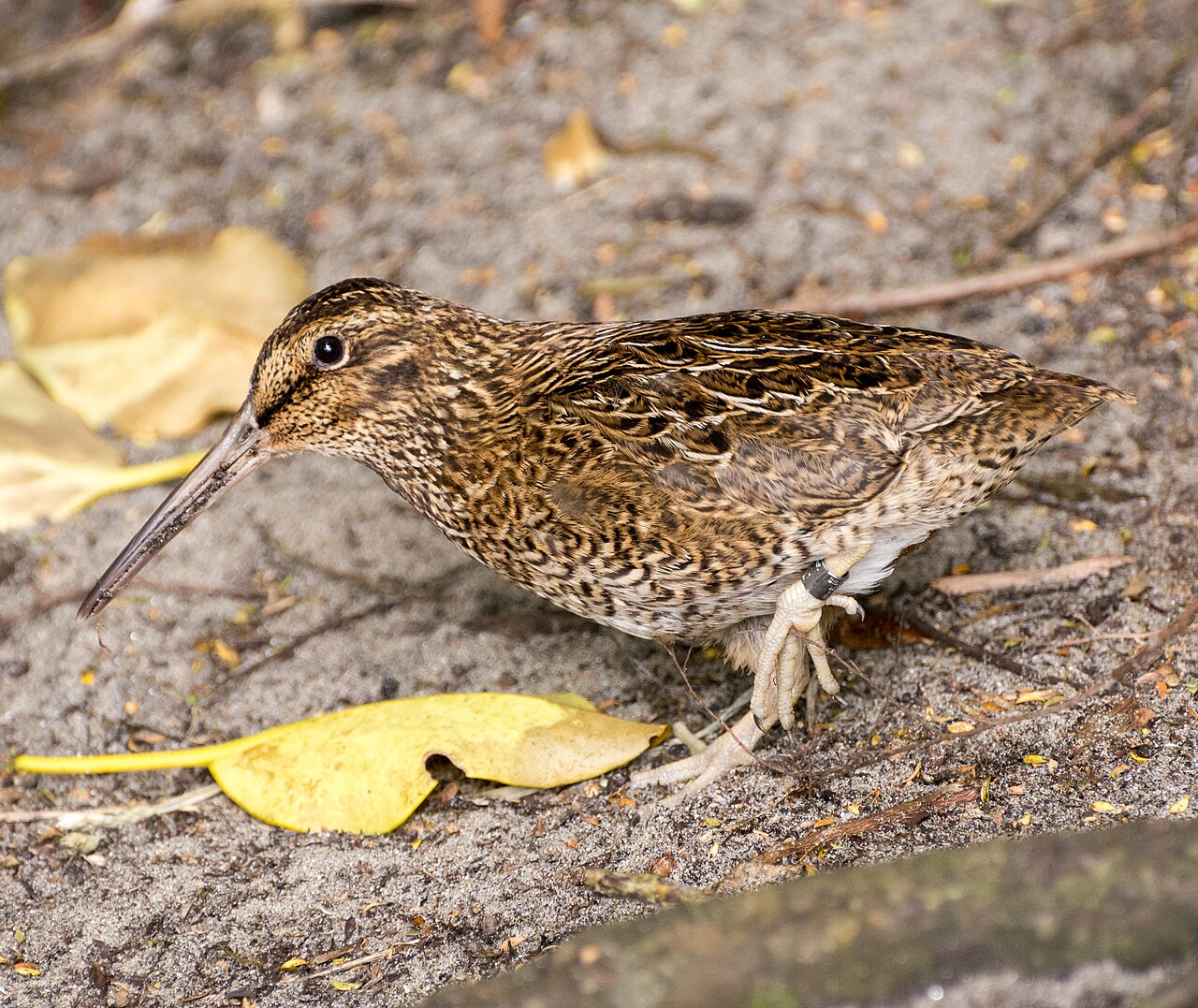
A squat, superbly camouflaged snipe of twenty-two centimetres and about a hundred and nine grams, with a short neck and very short legs. The bill is straight and slender, horn-coloured with a dark tip, shorter than on Subantarctic Snipe but longer than on Chatham Islands Snipe. Leg colour differs with sex: yellowish in the male, greenish in the female. The back is less variegated than in its relatives, and the best mark in the hand or at very close range is the belly: barred here, where Subantarctic Snipe has an almost unmarked off-white belly. Males carry clearer buff edges to the dorsal feathers.
Confusion species
Separation from the two relatives is above all geographical. Subantarctic Snipe (Coenocorypha aucklandica) occurs only on the Auckland Islands, the Antipodes and Campbell, hundreds of kilometres away, and is larger with longer legs and a longer bill and an unbarred belly. Chatham Islands Snipe (Coenocorypha pusilla) occurs only around Pitt Island in the Chatham group, on the other side of New Zealand, and is smaller with a strikingly short bill. What has complicated the map since 2005 is that Snares Snipe has been released on Putauhinu, Whenua Hou, Kundy and the Mokinui islets off Stewart Island, so a Coenocorypha snipe now sits outside its original range there, and it is this species rather than either of the other two. Migrant Asian snipes of the genus Gallinago do not reach these latitudes.
Habitat
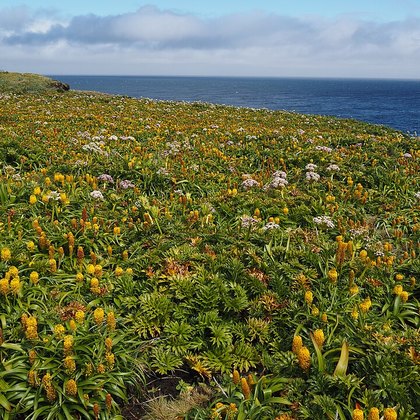
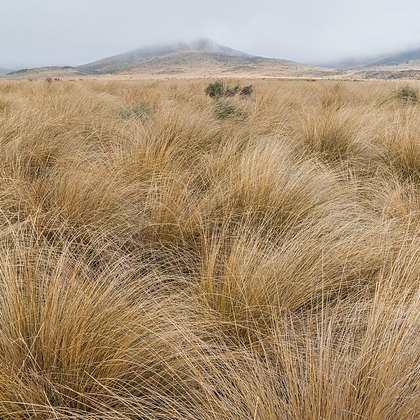
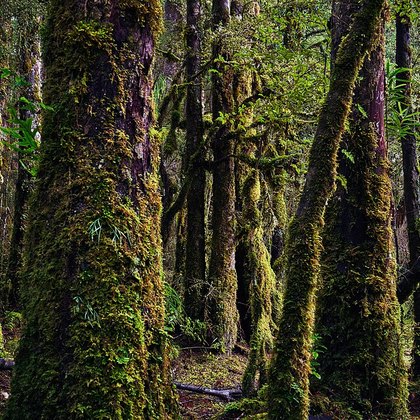
Dense, damp ground cover on cool predator-free islands: Poa tussock, Polystichum fernland under the low Olearia forest, and the loose, seabird-worked soil beneath it. It is exactly that petrel-burrowed ground that makes the island rich for it: out of it come amphipods, earthworms, beetles and the larvae and pupae of flies and beetles. Open rocky shore it uses only to walk across.
Where the bird is most often found, arranged by main group and formation.
Range and movements
Naturally on the Snares alone, two hundred kilometres south of the South Island: North East Island of two hundred and eighty hectares, Broughton Island of forty-eight hectares and the stack of Alert Stack of five hectares. Together those hold about four hundred pairs, some thousand adult birds. Since 2005 it has also been established by hand on Putauhinu, where thirty released birds had grown to at least three hundred and twenty by 2011, and later on Whenua Hou, Kundy and the Mokinui islets off Stewart Island. It occurs neither on the New Zealand mainland nor in Australia.
- Breeding (summer)
- dark = core range, pale = thinly spread
Where and when to look
Landing on the Snares is not permitted, so within the original range it comes down to watching from a zodiac along the shore. The chance now lies with the released populations: on the rat-free islets off Stewart Island, under permit, it walks the leaf litter under the forest in daylight and lets you come within a few metres. Stand still in a clearing and wait; the bird will simply walk past, probing like a sewing machine.
Conservation
Near Threatened (NT) globally and rated naturally uncommon within New Zealand. Numbers are steady and there is no human pressure on the Snares themselves, but the entire original population sits on less than three and a half square kilometres of rock: one rat ashore could clear the species out of its stronghold. That is exactly why insurance populations have been founded on rat-free islets off Stewart Island since 2005, which at the same time fill the gap left by South Island Snipe, last seen on Big South Cape Island in 1964 after rats came ashore there from a ship. The oldest ringed bird of this species reached seventeen years.
Scientific name
Coenocorypha huegeli | (Tristram, 1893)
Henry Baker Tristram described the bird in 1893 as Gallinago huegeli; because of the later move to another genus, author and year stand in parentheses. The epithet huegeli honours Anatole von Hugel, the British and Austrian naturalist who collected the type material. Until 2010 the bird was carried as a subspecies of Subantarctic Snipe; genetic and morphological work has established it as a species since. In Maori it is tutukiwi. The genus Coenocorypha was introduced by George Robert Gray in 1855.