All species › Waders, gulls and terns › Sandpipers and allies › Chatham Islands Snipe
Chatham Islands Snipe | Coenocorypha pusilla
Chatham-snip | Chochita de las Chatham
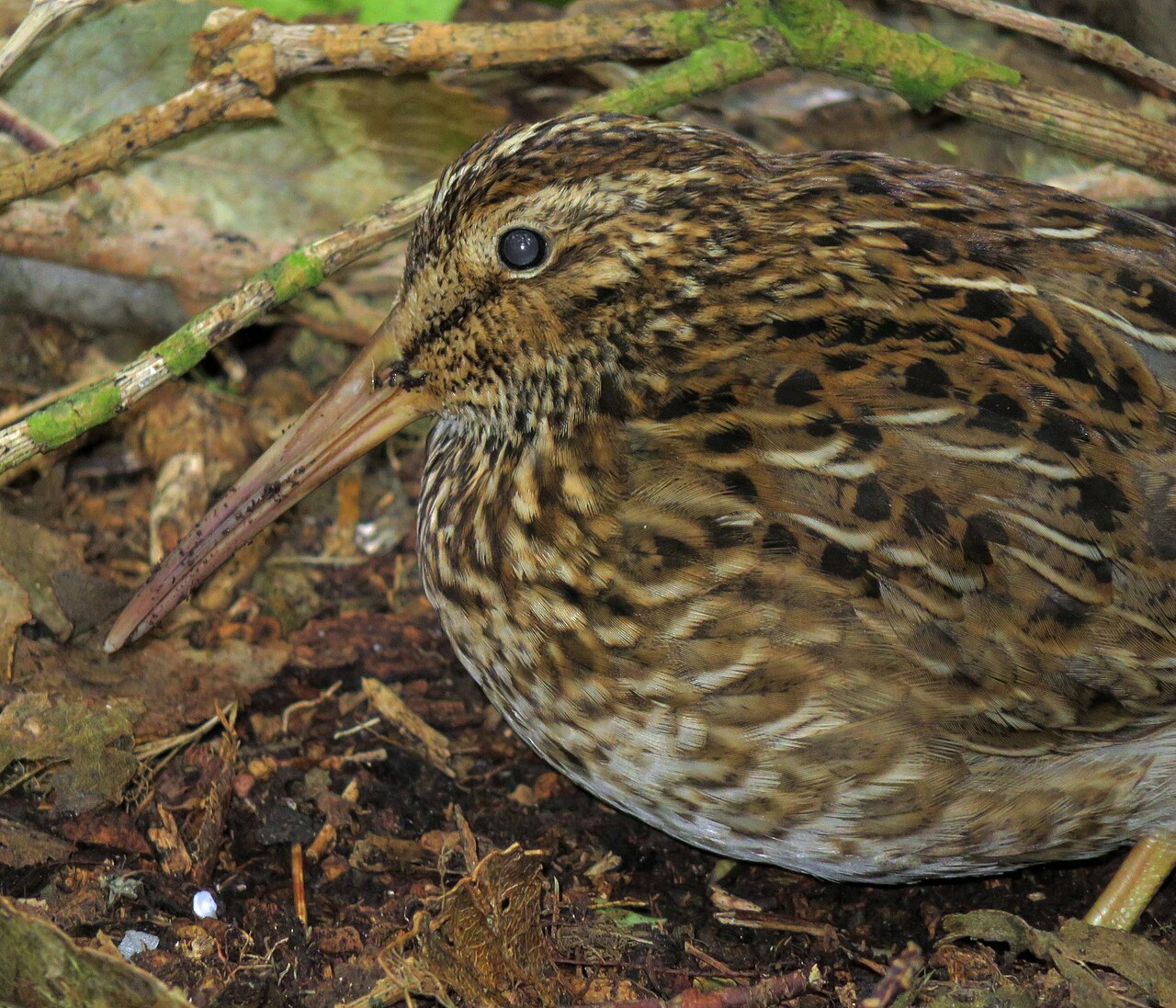
The Chatham Islands Snipe is the smallest of the New Zealand snipes: a brown-marbled, short-legged bird of twenty centimetres that now survives only on a handful of rat-free islets near Pitt Island. By day it walks openly among the sedge and the Muehlenbeckia tangle, something that has become unthinkable on most New Zealand islands. On Rangatira it is so numerous that you almost trip over it; twenty kilometres away, on Chatham Island itself, it has been gone for centuries.
Voice
The male calls a loud chup chup that can build into a disyllabic queeyoo queeyoo, above all in the nocturnal display flight. The alarm call is a strident chep and is likewise heard mostly in the dark. This species too performs the hakawai: a steep dive in which the outer tail feathers vibrate and produce a low roar, the sound Maori tradition assigned to an unseen bird.
No freely licensed recording has been found for this species yet; what to listen for is described below.
Identification
A small, rounded wader of twenty centimetres and about eighty grams, the smallest in the genus. The bill is straight and slender and, at forty-two to forty-eight millimetres, strikingly short, a good centimetre shorter than on Subantarctic Snipe, flesh-coloured with a dark tip. Leg colour differs with sex: pale yellow in the male, greenish in the female, and olive in young birds. The upperparts are rich brown and black with buff feather edges, the belly pale and all but unbarred. Males are slightly smaller than females but more strongly marked above.
Confusion species
Within the Chathams there is nothing to confuse it with; separating it from its two relatives is a matter of the map rather than of field marks. Subantarctic Snipe (Coenocorypha aucklandica) is confined to the Aucklands, the Antipodes and Campbell far to the southwest, and at twenty-three centimetres is larger and longer in bill and leg. Snares Snipe (Coenocorypha huegeli) is confined to the Snares and to a few islets off Stewart Island, is intermediate in size, and has clearly barred belly feathers where this bird has a nearly plain pale belly. None of the three ranges touch. On the Chathams the only other wader working the same shores is the far larger and longer-legged Chatham Islands Oystercatcher, which confuses nobody.
Habitat
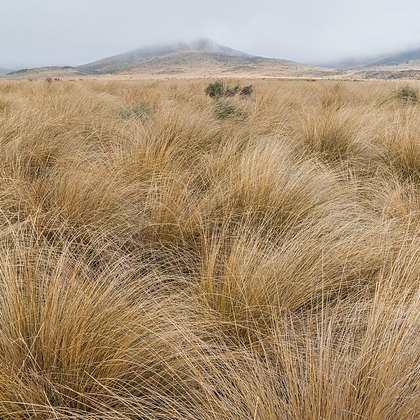
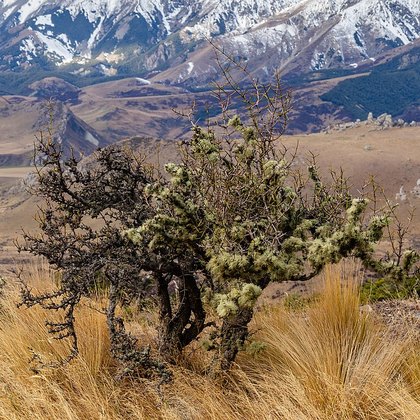
Dense low cover on small predator-free islands: sedgeland, mats of the climber Muehlenbeckia, rank grass and regenerating scrub of akeake and Olearia, often under seabird forest where petrels burrow into the ground. That seabird soil, loose and rich in worms and insects, is exactly what it needs: it probes into it fast and repeatedly, like a sewing machine. Bare rocky shore and open pasture it does not use.
Where the bird is most often found, arranged by main group and formation.

Range and movements
A few small islands in the Chatham group only, all close to Pitt Island: Rangatira, Mangere, Little Mangere, Rabbit Island and the Star Keys. It is absent from Chatham Island itself and from Pitt Island, where rats and cats are present. The whole world population is about two thousand birds, of which some thirteen hundred sit on the two hundred and forty-nine hectares of Rangatira alone. It occurs nowhere else, not even as a stray to the New Zealand mainland.
- Resident
- dark = core range, pale = thinly spread
Where and when to look
The islands that hold it are nature reserves entered only by permit, so most visitors get no closer than hearing it from a boat off Rangatira. If you are allowed ashore: walk the track through the low forest and watch the bare patches in the leaf litter, because it feeds there in broad daylight and barely bothers to move away. Use leg colour to tell male from female, and after dark listen for the hakawai above the seabird forest.
Conservation
Vulnerable (VU) globally and nationally vulnerable within New Zealand, with about two thousand birds on a handful of small islands. The reason that range is so small lies in the past: Pacific rats wiped the species from Chatham Island between roughly 1500 and 1800, feral cats did the same on Pitt Island late in the nineteenth century, and when cats reached Mangere it disappeared there too around 1900. After the cats were removed, twenty-three birds were put back on Mangere from Rangatira in 1970, and Little Mangere and Rabbit Island were then colonised unaided. An attempt in 2008 to establish twenty birds inside a predator fence on Pitt Island failed: they had dispersed within a year. The standing risk is that a single pregnant rat on Rangatira would cost two-thirds of the world population.
Scientific name
Coenocorypha pusilla | (Buller, 1869)
Walter Buller described the bird in 1869 as Gallinago pusilla; because it later moved to another genus, author and year stand in parentheses. The epithet pusilla is Latin for 'very small', and it is meant literally: this is the smallest snipe in New Zealand. The type locality is Mangere Island in the Chatham group, where the species was found for science in that same year of 1869 and where cats removed it again around 1900, to be carried back by hand seventy years later.