All species › Passerines › Finches, euphonias and allies › European Greenfinch
European Greenfinch | Chloris chloris
Groenling | Verderón
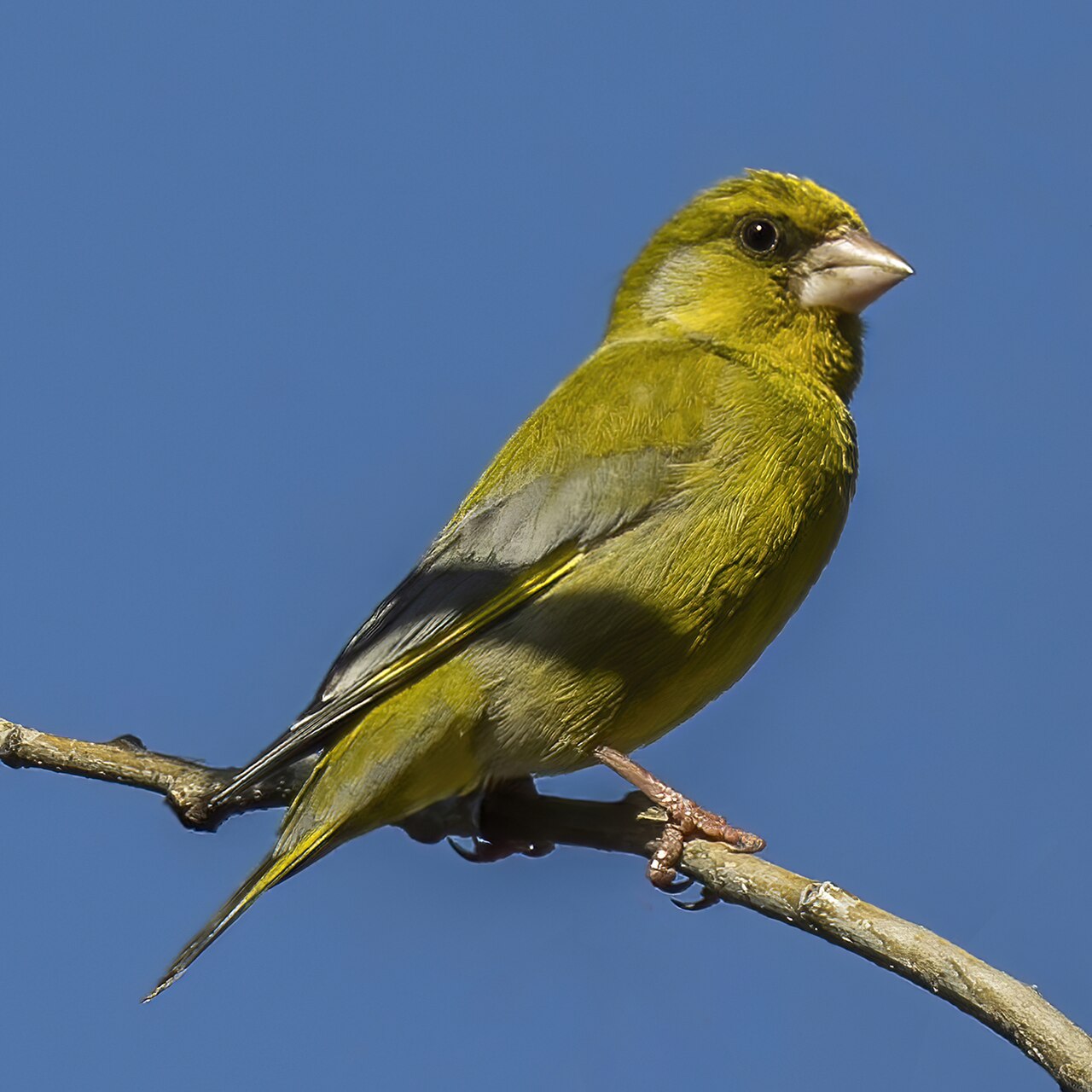
The European Greenfinch is the stout, green-yellow finch with the heavy pale bill and the bright yellow flash in the wing that lives in gardens, orchards, pine plantations and farmland in New Zealand and south-eastern Australia. It too is a nineteenth-century import from Europe; its thickset build, its slow bounding flight and its long-drawn nasal whine make it easy to pick out among the other small birds of open country.
Voice
Two sounds dominate the repertoire. The first is a fast, hard rattling chi-chi-chi-chit, given on flushing and in flight, recalling a sewing machine. The second is a long-drawn, nasal, downward dzweee, a whining note repeated at intervals from a treetop for minutes on end and the most characteristic sound of the species. The song strings the two together with whistled and trilled phrases between, and is often delivered in a slow, butterfly-like song flight with notably slow, wide wingbeats above the gardens.
No freely licensed recording has been found for this species yet; what to listen for is described below.
Identification
A thickset, heavily built finch of fourteen to sixteen centimetres with a thick, conical, pale horn-coloured bill and a short, clearly forked tail. The male is olive-green with a yellow-green breast and belly, a grey wash over cheek and wing, and two conspicuous yellow fields: a bright yellow stripe along the closed wing, formed by the yellow outer edges of the primaries, and yellow sides to the tail base, which show at once as the bird takes off. The female is duller, greyer and browner, with far less yellow and a faintly streaked look. Juveniles are grey-brown and clearly streaked on breast and flanks, but already have the yellow along the wing edge. The heavy bill and the short forked tail also give the bird a recognisable, somewhat lumpish silhouette.
Confusion species
Female and juvenile greenfinches are most often taken in New Zealand for a female House Sparrow (Passer domesticus): equally thickset and brown-streaked, but without any trace of yellow in wing or tail, and with a shorter, blunter bill than the long, heavy cone of the greenfinch. European Goldfinch (Carduelis carduelis) carries its yellow as a broad crossband over a black wing, whereas the greenfinch has it as a narrow stripe along the wing edge; the goldfinch is also slimmer and has a thin, pointed white bill. Redpoll (Acanthis flammea) is far smaller, streaked throughout, with a red forehead and no yellow. The native Silvereye (Zosterops lateralis) is greenish too, but not half the weight and wears a conspicuous white eyering.
Habitat
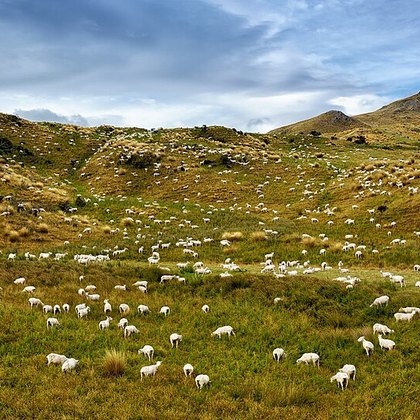
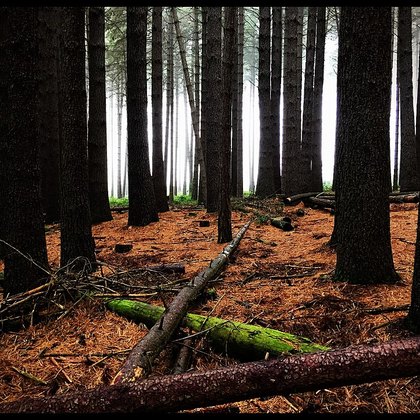
Half-open, well-treed farmed country: gardens and parks, orchards, hedges and shelterbelts, field margins, pine and spruce plantations and coastal dune scrub. The greenfinch eats large, hard seeds that other finches leave — sunflower, rape, thistle, rose hips and above all the seed of the planted conifers — and cracks them with its heavy bill. Garden feeding tables are used eagerly and in New Zealand often give the best viewing. The nest sits in a dense shrub, a hedge or a young conifer, usually low and well hidden; outside the breeding season the species forms loose flocks that feed on stubble and seed crops.
Where the bird is most often found, arranged by main group and formation.



Range and movements
Naturally a bird of Europe, north-west Africa and western Asia. In New Zealand it was released in the 1860s by the acclimatisation societies and has spread over the lowlands of both main islands; it now also occupies the Chathams and several offshore islands. In Australia it is established in the south-east — Victoria, southern New South Wales, south-eastern South Australia — and in Tasmania, where it is locally common. There is no migration; after breeding the birds wander the lowlands in flocks.
- Resident
- dark = core range, pale = thinly spread
Where and when to look
Look for it in early spring at the top of a tall tree or on a telephone wire above a garden and listen for that long-drawn nasal dzweee that simply will not stop: once you know the sound you will count the species by ear from then on. If a dull brown bird leaves you in doubt, wait until it flies — the yellow sides of the tail base then flash for half a second, and in every plumage, juveniles included, that is decisive.
Conservation
Least Concern (LC), with a large range and a large world population. In New Zealand and Australia the greenfinch is a naturalised exotic with no conservation status; it is common there and counts at most as a mild nuisance to seed crops and orchards. Its arrival belongs to the same wave as that of the goldfinch and the redpoll: in the second half of the nineteenth century the acclimatisation societies systematically released European songbirds, out of homesickness for familiar sound and in the expectation that they would deal with insects on the farms. Strikingly, the bird is doing less well in its country of origin: in Britain and parts of western Europe numbers have fallen sharply since 2005 because of an infectious disease that spreads at garden feeders. No such collapse has been reported from New Zealand or Australia.
Scientific name
Chloris chloris | (Linnaeus, 1758)
Linnaeus described the species in 1758 as Loxia Chloris; because it has moved to another genus, author and year stand in parentheses. Both the genus name Chloris and the epithet come from the Greek word for yellow-green, already used in antiquity for a greenish songbird — so the name says the same thing twice. The English name European Greenfinch and the Dutch groenling in effect do so as well. The species was long placed in the genus Carduelis and has only recently been taken out of it again.