All species › Passerines › Finches, euphonias and allies › European Goldfinch
European Goldfinch | Carduelis carduelis
Putter | Cardelino
The European Goldfinch is the finch with the red, white and black face and the broad golden band across a black wing, living in New Zealand and south-eastern Australia on thistles, nettles and other seeding herbs in farmland and gardens. It does not belong there by nature either: it was brought in by the acclimatisation societies in the nineteenth century and has since become one of the commonest and most conspicuous small songbirds of the open landscape.
Voice
The flight call is unmistakable: a clear, liquid, lightly ringing tickelit or dee-dee-lit with a metallic, bell-like quality, given constantly by parties and the sound by which the species most often announces itself. In alarm there is a sharper, nasal dweeh. The song is a brisk, canary-like twittering that strings the same bell-like motifs together, laced with short trills and that nasal whine; the male sings from a branch, a wire or a post, usually with the wings slightly quivering.
No freely licensed recording has been found for this species yet; what to listen for is described below.
Identification
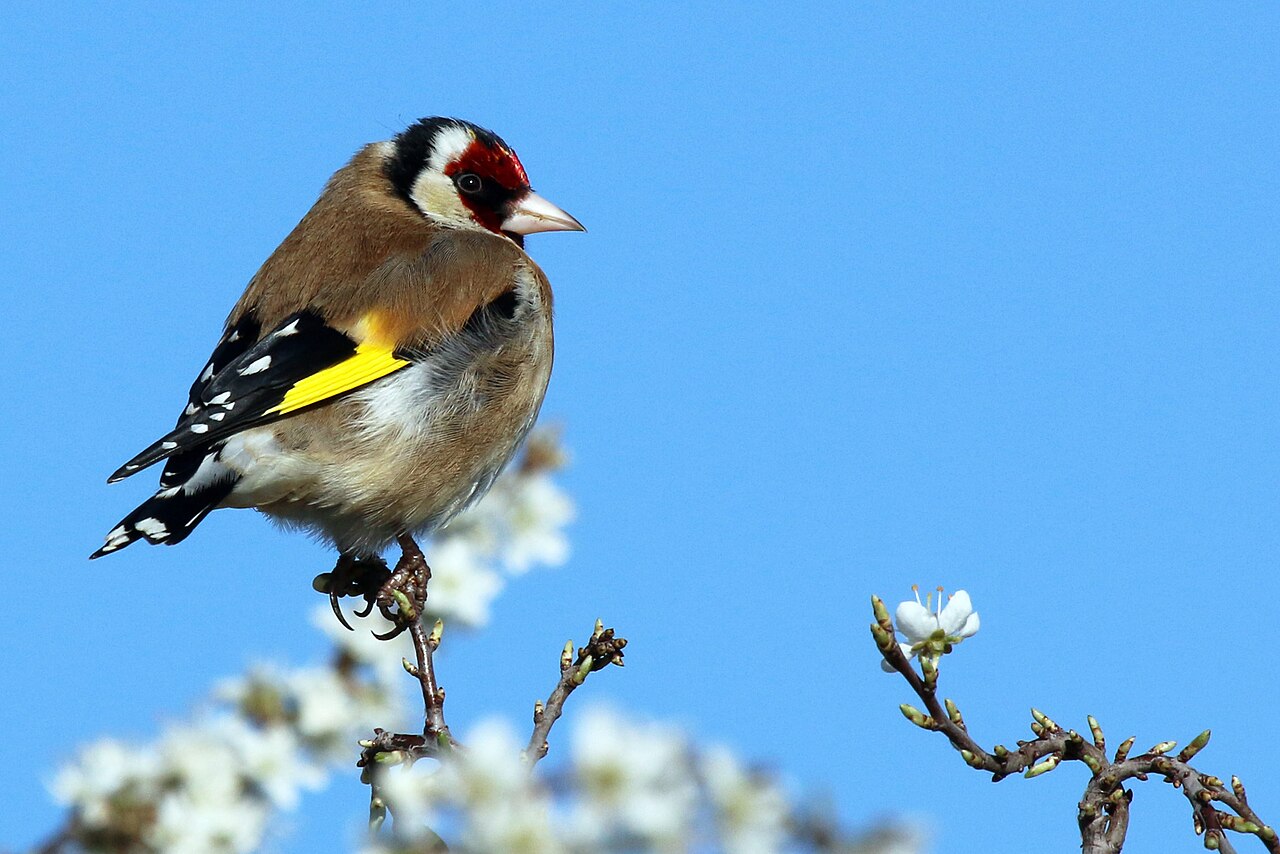
A small, elegant finch of twelve to thirteen centimetres with a slender, sharply pointed ivory-white bill. The adult face cannot be mistaken: a scarlet mask round bill and eye, white behind it, and from the crown over the nape a black cap running down into two black horns at the side of the neck. Back and flanks are warm buff-brown, the belly white. The wing is black with a broad bright yellow band that flashes in flight, and fine white tips to the primaries; the tail is black with white spots. Male and female are closely alike, the male's red reaching a little further behind the eye. The juvenile is quite different: it lacks the face mask altogether and is dull brown with fine streaking on head and breast — but it already has the yellow wing band, and that mark settles it. The species feeds much of the time hanging and balancing on seed heads.
Confusion species
Adults can be confused with nothing. Juveniles can: they are regularly taken for Redpoll (Acanthis flammea), which is also small and streaky brown. The Redpoll, however, has a red forehead, a black chin spot and at most two faint pale wing bars, while the juvenile goldfinch has a plain head without red and carries a broad, unbroken golden band across the black wing. European Greenfinch (Chloris chloris) is bulkier and heavier billed and has its yellow along the wing edge and at the tail base rather than as a crossband. House Sparrow (Passer domesticus) has no yellow in the wing at all. In New Zealand no native songbird shows this pattern.
Habitat
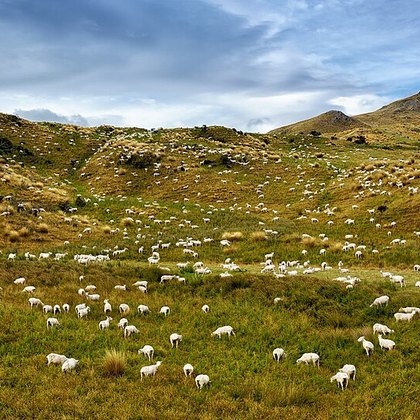
Open country with plenty of seeding herbs: field margins, fallow, road verges with thistles, orchards, vegetable gardens, parks and gardens, and along the coast dunes and rough ground. The species is specialised on the seed of composites — thistle, teasel, spear thistle, dandelion — which it extracts from the seed head with its fine pointed bill while hanging upside down on the stem. In winter it forms roving parties that move from one patch of rough ground to the next. To breed it needs a tree or a tall shrub; the small, neat nest is often built out at the end of a branch.
Where the bird is most often found, arranged by main group and formation.



Range and movements
Naturally a bird of Europe, North Africa and western and central Asia. In New Zealand it was released between 1862 and the early 1880s by the acclimatisation societies of Nelson, Canterbury, Otago, Auckland and others, and spread with great speed over both main islands; it now also occupies the Chathams, the Kermadecs and the subantarctic islands. In Australia it is established in the south-east, roughly from Sydney through Melbourne to Adelaide, and in Tasmania, without reaching far inland. There is no true migration: the birds wander within the district.
- Resident
- dark = core range, pale = thinly spread
Where and when to look
In late summer find a field or a verge of spent thistles and wait there. The goldfinches come in parties, give their bell-like call well before arriving, and then set to work hanging on the seed down, loosening little clouds of thistledown — that drifting down is often visible before the birds are. If you see a brown, unmarked finch among the adults, look only at the wing: the golden band makes it a juvenile goldfinch.
Conservation
Least Concern (LC) and common over most of its range. In New Zealand and Australia the goldfinch is a naturalised exotic with no conservation status; it is locally regarded as a mild nuisance to orchards and seed crops, but does little damage and barely competes with native birds, because it has settled on the seed of equally introduced herbs. That introduction belongs to a larger story: in the second half of the nineteenth century the acclimatisation societies in New Zealand systematically released European songbirds, out of homesickness for familiar sound and in the hope that they would control insect pests. With this species the result was ironic: the goldfinch came with the settlers and found in New Zealand mainly the European thistles that had come with them too. In Europe itself numbers have been rising again for some decades after a long period of trapping for the cage-bird trade.
Scientific name
Carduelis carduelis | (Linnaeus, 1758)
Linnaeus described the species in 1758 as Fringilla carduelis; because it later came to head the genus Carduelis, author and year stand in parentheses. Both the genus name and the epithet go back to Latin carduus, thistle — the food by which the bird has been known everywhere. The English name Goldfinch, by contrast, names the golden wing band. The Dutch name putter comes from the days when the bird was kept in cages and trained to haul up its own drinking water in a tiny bucket on a chain — to 'draw' it from a well.