All species › Passerines › Finches, euphonias and allies › Redpoll
Redpoll | Acanthis flammea
Barmsijs | Pardillo norteño
The Redpoll is the small, streaky brown finch with a crimson forehead and a black chin patch that roams in parties through the tussock grassland, mountain scrub and farmland of New Zealand. It does not belong there by nature: the acclimatisation societies of the nineteenth century brought it, and of all the European finches introduced it is the one that has pushed furthest into the high country.

Voice
The flight call is a hard, dry, quickly rattled chuch-uch-uch, usually in groups of three or four notes, which gives the species away at a distance as a party crosses high over a tussock slope. There is also a drawn-out, plaintive, slightly rising tsoo-eet, often given from a wire or the top of a bush. The song strings those same rattles together with a vibrating trill between them, and is preferred in a slow, wide display flight with stiff, unhurried wingbeats over open ground.
No freely licensed recording has been found for this species yet; what to listen for is described below.
Identification
A small, finely built finch of about twelve centimetres with a short forked tail and a small, pointed, yellowish conical bill. The plumage is brown and heavily dark-streaked throughout, on back, flanks and breast; the underside is off-white. Two marks make the species: a bright crimson patch on the forehead, and a small black spot on chin and throat right below the bill. Two faint pale bars cross the wing. In the breeding season the male adds a rose-pink wash over breast and rump; females and young birds lack this and show only the red forehead, or, in freshly fledged birds, not even that at first. In flight it is a small, dark, compact bird with a fast bounding path and a rattling call.
Confusion species
In New Zealand the chief problem is the juvenile European Goldfinch (Carduelis carduelis): it too is streaky brown and still lacks the red-white-black face of the adult, but it does have the broad, bright golden-yellow band across the black wing, which the Redpoll never shows. European Greenfinch (Chloris chloris) is much larger, heavier built and mostly green-grey, with yellow on the wing edge and tail sides instead of streaking. House Sparrow (Passer domesticus) is bulkier, has a far thicker bill and lacks both the red forehead and the black chin spot. Note finally that the species limits within the redpolls themselves are disputed: the small dark British form from which the New Zealand birds descend was long treated as a separate species and is now returned by most works to Acanthis flammea.
Habitat
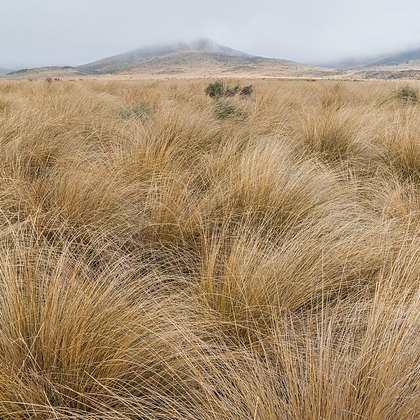
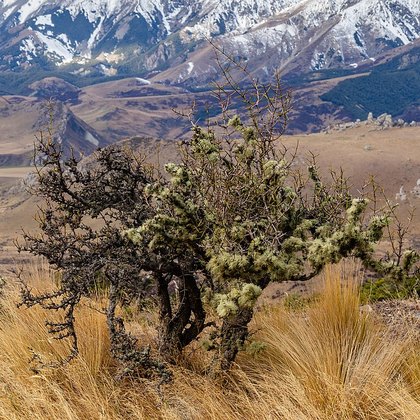
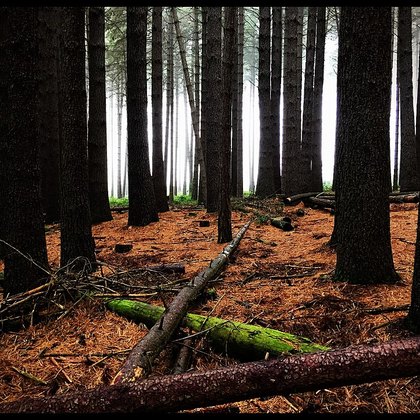
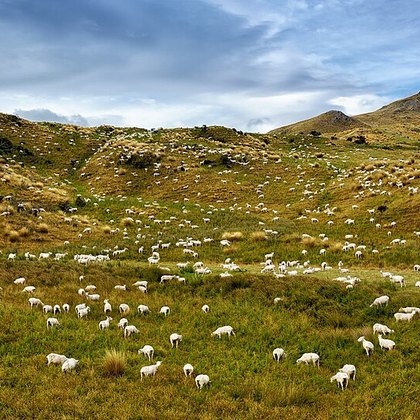
In New Zealand chiefly open herb-rich country: tussock grassland high into the mountains, matagouri and manuka scrub, even alpine herbfield above the treeline, and besides that farmland, road verges, pine plantations, orchards and gardens. Food is the fine seed of herbs, grasses, birch and alder catkins and conifers, supplemented with insects in summer. Of all the European finches released in New Zealand this is the one that has stayed least tied to people and penetrated deepest into the natural landscape. In its original range in the northern hemisphere the species belongs to birch woodland, willow scrub and the tundra edge.
Where the bird is most often found, arranged by main group and formation.


Range and movements
Naturally a bird of northern Europe, Asia and North America, breeding in the birch belt and tundra scrub and spreading irregularly south in winter. In New Zealand it is introduced: between 1862 and the 1870s the acclimatisation societies of Nelson, Canterbury, Otago and others released birds, and within a few decades the species had occupied both main islands. It has since reached the Chathams and the subantarctic islands — Auckland, Campbell, the Snares — and Macquarie Island, partly under its own power. In Australia it has become established only in Tasmania and locally in the far south-east.
- Resident
- dark = core range, pale = thinly spread
Where and when to look
In New Zealand in summer, walk a track through tussock grassland or along a verge of thistles and listen for the dry rattle overhead: a party of Redpolls almost always calls as it moves. They feed clinging to seed heads, often upside down like a tit, and then allow a surprisingly close approach — that is the moment to look for the crimson forehead and the black chin spot, the two marks that settle everything.
Conservation
Least Concern (LC): the world range is enormous and the population large, though numbers in the north swing sharply with the birch and alder seed crop. In New Zealand the Redpoll is a naturalised exotic and is not a conservation question but rather a mild nuisance: it pecks at buds and at ripening small fruit and is locally regarded as an orchard pest. The story of its arrival is that of a whole generation: in the second half of the nineteenth century British colonists in New Zealand deliberately released European songbirds, partly out of homesickness for the sounds of home, partly in the belief that such birds would control insect pests on the farms. Of the finches released that way, the Redpoll, the European Goldfinch and the European Greenfinch are among the few that established permanently.
Scientific name
Acanthis flammea | (Linnaeus, 1758)
Linnaeus described the species in 1758 as Fringilla flammea; because it has moved to another genus, author and year stand in parentheses. The epithet flammea is Latin for 'flaming', after the red forehead patch, and the genus Acanthis goes back to a Greek word for a small seed-eating bird of thistles. The English name Redpoll means literally 'red crown'. The Dutch name barmsijs is an old bird-catcher's name in which 'sijs' denotes the kind of bird.