All species › Parrots › Cockatoos › Glossy Black Cockatoo
Glossy Black Cockatoo | Calyptorhynchus lathami
Bruine raafkaketoe | Cacatúa negra de Latham
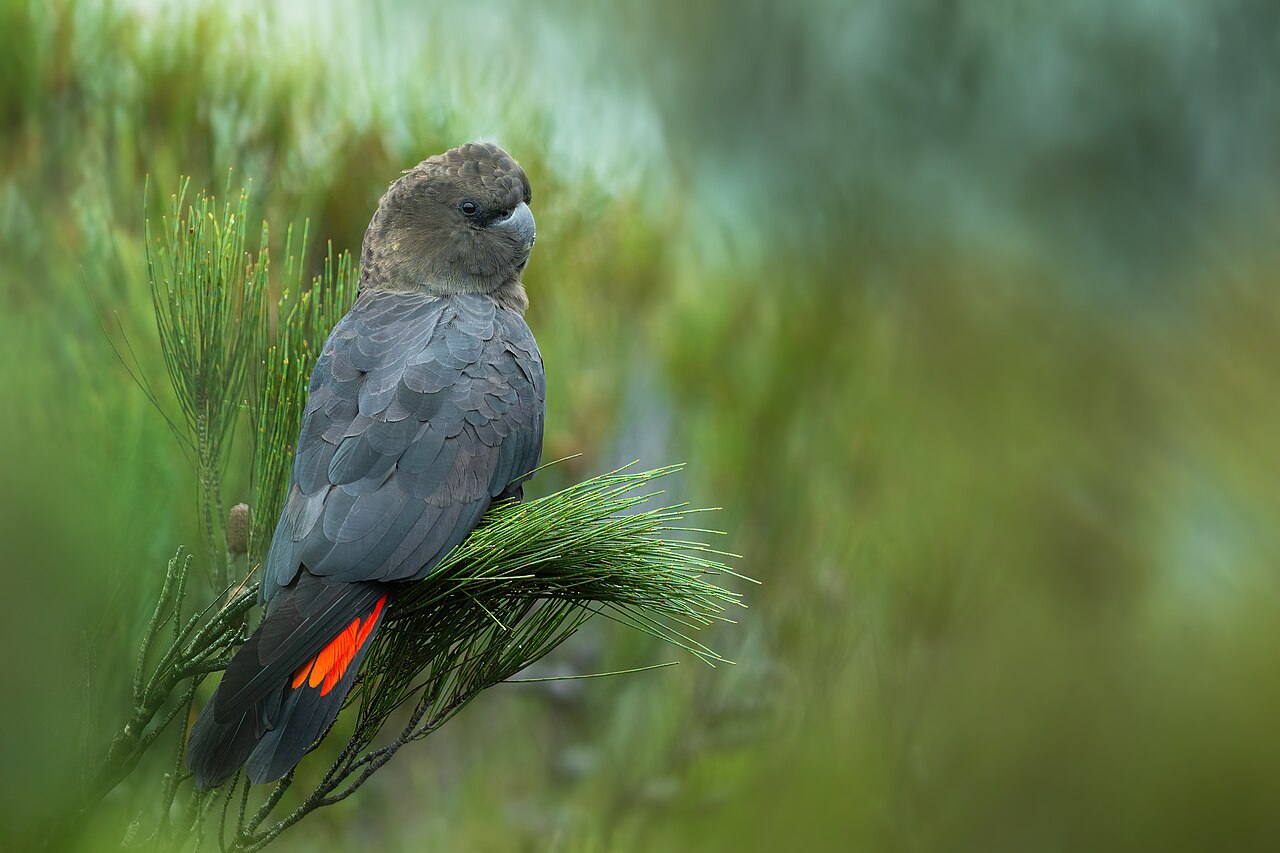
The Glossy Black Cockatoo is the smallest of Australia's five black cockatoos and the only one to have staked its whole existence on a single genus of tree: it eats almost nothing but she-oak seed. A dull brownish-black bird with a barely visible crest, a thick bulbous pale bill and red tail panels that light up only as it takes off.
Voice
Far quieter and less strident than the other black cockatoos, and recognisable on that alone: a creaky, slightly wheezy tarr-red or a soft, plaintive kee-airrk, usually in flight and already inaudible a few hundred metres off. Feeding birds are near silent; only the cracking of she-oak cones and the patter of falling debris give the flock away. Young birds beg with a persistent high squeak and add a separate swallowing note at every mouthful.
Recording: Andrew Galbraith — CC BY-NC-SA 4.0 · Duncan, Kangaroo Island Council, South Australia, Australia · xeno-canto
Identification
A heavy cockatoo of just under half a metre, but beside the other black cockatoos strikingly small and compact, with a short tail and a large-looking head. Head, neck and underparts are dull brown-black, back and wings blacker and glossier; the crest is short and usually flat, so the head reads as round. The bill is large, bulbous and pale horn-grey with a blunt tip — a nutcracker, not a forceps. The male has plain scarlet tail panels; the female carries irregular yellow blotches on head and neck and orange-red tail panels barred with black. Flight is slow and somewhat lurching, on deep beats.
Confusion species
Red-tailed Black Cockatoo (Calyptorhynchus banksii) has the same red tail panels and is the one real trap: it is a quarter larger, blacker and glossier, with a tall erectile helmet crest, a slender dark grey bill and a loud, metallic rolling call. Its female is spotted yellow over head, neck and wings and barred yellow on the breast, where the female Glossy has only a yellow patch on head and neck and keeps plain brown underparts. The three Zanda species — Yellow-tailed (Zanda funerea), Carnaby's (Zanda latirostris) and Baudin's (Zanda baudinii) — show yellow or white tail panels rather than red and barely overlap in range; tail pattern alone rules them out.
Habitat
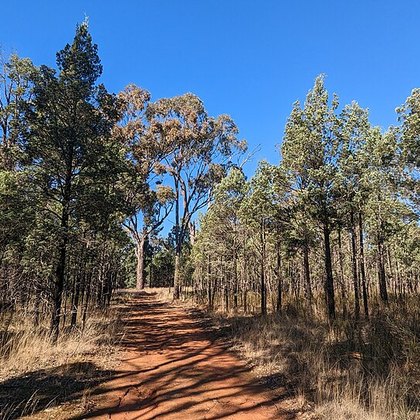
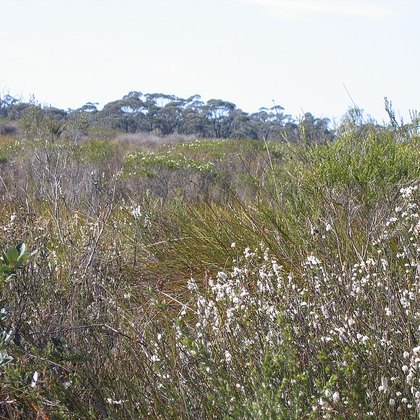
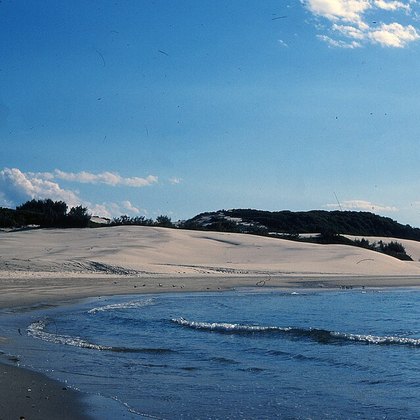
She-oak woodland and scrub is the whole story: open country carrying Allocasuarina verticillata or A. littoralis, often as an understorey in dry eucalypt forest, along coastal dunes or as a remnant clump in a paddock. In any one district the birds may take only a single she-oak species, so a scattered stand of trees can carry an entire local population. They nest in large hollows in old eucalypts, often kilometres from the feed trees.
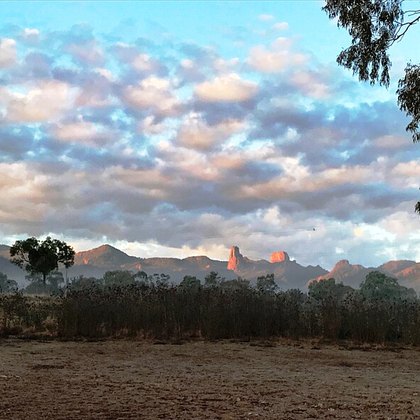
Where the bird is most often found, arranged by main group and formation.
Range and movements
Eastern Australia, from Eungella near Mackay in Queensland in a narrow band along the coast and ranges south to East Gippsland in Victoria, and inland to the Pilliga in New South Wales. Beyond that an isolated population on the north and west of Kangaroo Island off South Australia; the linking birds on the mainland Fleurieu Peninsula were gone by the 1970s. The species is absent from Tasmania, from Western Australia and from New Zealand.
- Resident
- dark = core range, pale = thinly spread
Where and when to look
Search the ground first, not the sky: beneath a she-oak in use lies a fresh carpet of chewed cones and wood chips. Sit down there and wait — the birds feed slowly and silently and are often much closer than you think. Towards evening they come to water, a farm dam or a bend in a creek, and that is the best moment to catch the tail in good light.
Conservation
Vulnerable (VU). The species stands or falls with old she-oaks and with hollows in old eucalypts, and both disappear faster than they grow back; on the mainland the subspecies lathami has been listed nationally as vulnerable since August 2022. The Kangaroo Island population is the sharpest case: once down to about 158 birds, back to around 370 by 2019 and 446 in the summer of 2025/26 after decades of work. Possums raid virtually every unprotected nest there, so tin collars around the nest tree and nest boxes are essential — some eighty per cent of pairs now breed in a box. The 2019/20 bushfires had burnt at least 170,000 hectares, a third of the island, by 6 January 2020, taking much of the feed with them; in 2025 some 1,200 young she-oaks were planted in the fenced Lathami Conservation Park.
Scientific name
Calyptorhynchus lathami | (Temminck, 1807)
Temminck described the species in 1807 as Psittacus lathami, for the English ornithologist John Latham, whose specimen from Botany Bay in New South Wales supplies the type locality; because the bird later moved to another genus, author and year stand in parentheses. The genus Calyptorhynchus was introduced by Desmarest in 1826, from Greek kalyptos (covered, hidden) and rhynchos (bill), for the base of the bill concealed under the feathers of forehead and lores. The English name refers to the gloss on wing and back, the Dutch guide name to the dull brown head and underparts.