All species › Parrots › Cockatoos › Red-tailed Black Cockatoo
Red-tailed Black Cockatoo | Calyptorhynchus banksii
Roodstaartraafkaketoe | Cacatúa colirroja
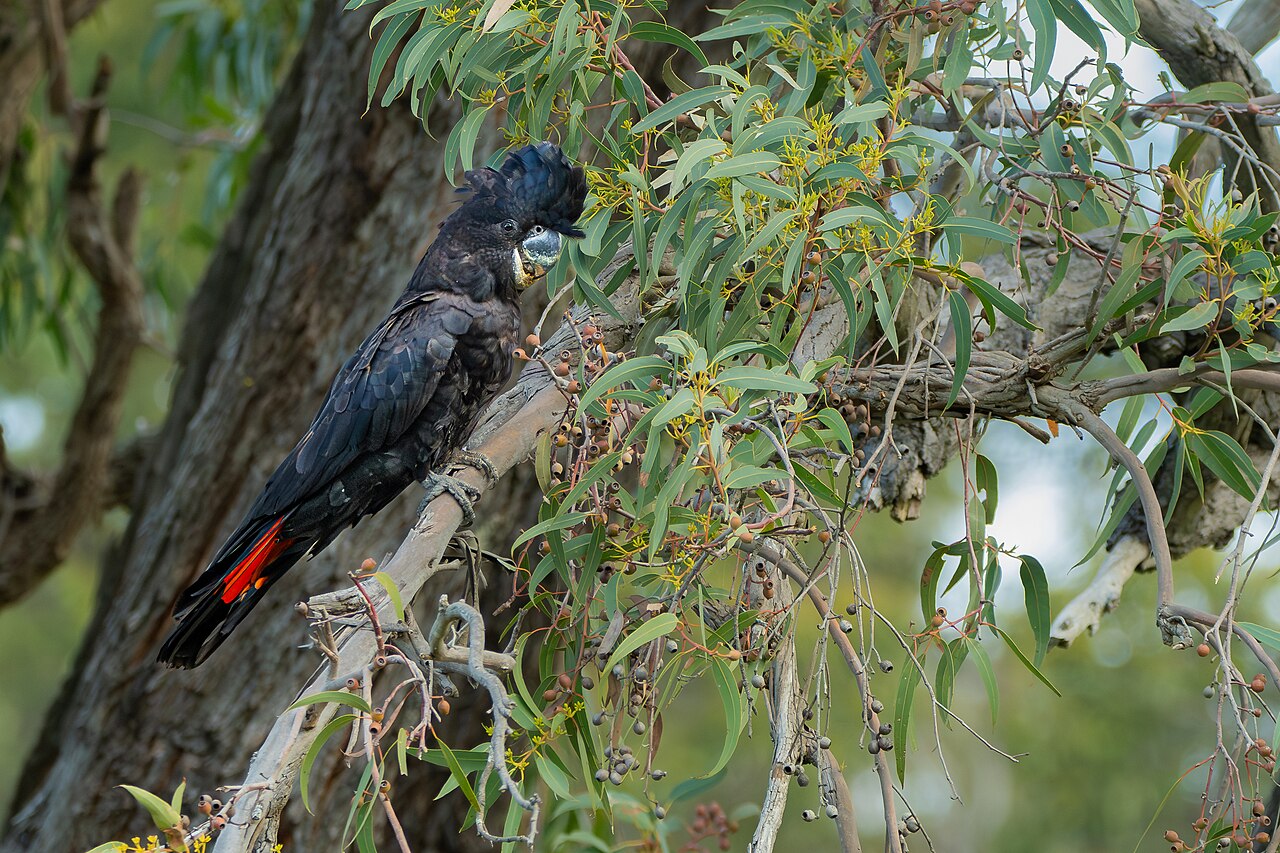
The Red-tailed Black Cockatoo is the blackest and heaviest of Australia's black cockatoos: a glossy black bird the size of a raven, with a tall helmet-shaped crest and, in the male, two fiery red panels that open out in the spread tail. It occurs across nearly the whole mainland, but always in separate and strongly isolated populations.
Voice
Loud, harsh and far-carrying: a rolling metallic kree or krurr-rr, repeated in flight, with a sharp krur-rak in alarm. Many observers compare it to a rusty windmill turning. Flocks call almost continuously on the move, so they are usually heard well before they are seen; feeding birds add a soft throaty note between partners.
No freely licensed recording has been found for this species yet; what to listen for is described below.
Identification
A substantial cockatoo of some sixty centimetres, with broad wings, a slow beat and a long tail. The male is evenly glossy black with a dark grey bill and two scarlet tail panels visible only in flight or on the turn. The female is browner-black and finely spotted yellow over head, neck and wing coverts, with yellow barring across breast and undertail, orange-yellow tail panels barred with black, and a pale horn-coloured bill. Both sexes raise a tall narrow crest when excited, giving the head a helmeted shape. Young birds resemble the female.
Confusion species
Glossy Black Cockatoo (Calyptorhynchus lathami) also shows red tail panels but is a quarter smaller, dull brown-black rather than glossy, with a short flat crest, a thick bulbous pale bill and a far softer, creaking voice; its female carries yellow only on head and neck, never on the wing and never as breast barring. The three Zanda species — Yellow-tailed (Zanda funerea), Carnaby's (Zanda latirostris) and Baudin's (Zanda baudinii) — have yellow or white tail panels and a pale cheek or ear patch, and drop out at once; in south-western Australia, where the Forest subspecies naso lives alongside both white-tailed species, the colour of the tail panel is the quickest mark of all.
Habitat
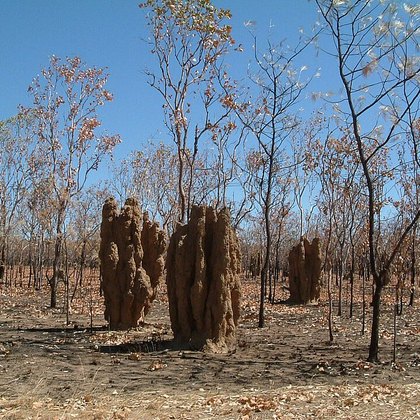
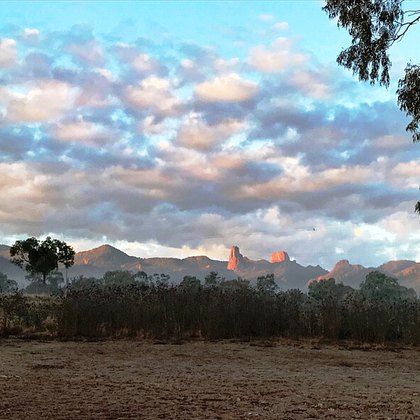
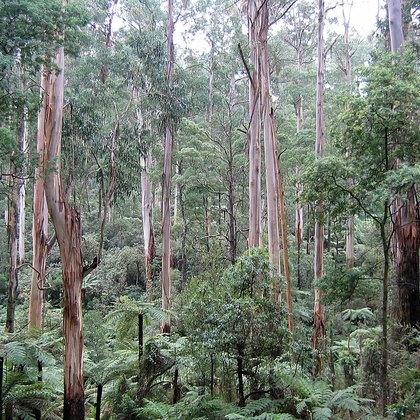
Very broad: eucalypt savanna and open woodland in the tropical north, river red gum woodland along inland creeks, jarrah and marri forest in the south-west, and in the south-east mallee and the stringybark woodlands carrying buloke. It takes the seed of eucalypts, she-oaks and acacias, inland often from the ground beneath the trees, and also uses farmland and regional towns.
Where the bird is most often found, arranged by main group and formation.


Range and movements
Mainland Australia only, but there in nearly every state: from the Kimberley and the Top End through Queensland into New South Wales, in an inland belt along the creeks into South Australia, in the south-west of Western Australia, and in a small isolated pocket on the South Australia–Victoria border. It is absent from Tasmania and from New Zealand. The five subspecies together make up some eight separate populations, which differ sharply in numbers and in the threats they face.
- Resident
- dark = core range, pale = thinly spread
Where and when to look
Watch the flight silhouette: broad wings, slow beats and a long tail make it recognisable at distance, and the red appears only as the bird banks — males often flash it coming in to a tree. Inland, flocks feed on the ground under river red gums; drive a creek line early and watch for black birds lifting off the road. In the north they come to water at sunrise and again towards dusk.
Conservation
Not globally threatened (LC): the northern and inland populations are numerous and locally even profit from introduced seed trees. The average hides two worrying ends, however. The south-eastern subspecies graptogyne, of the stringybark and buloke country on the South Australia–Victoria border, is treated as endangered and numbers only a few thousand birds; the Forest subspecies naso of the south-western jarrah and marri forest is listed as vulnerable. For both, the loss of old hollow-bearing trees is decisive: a hollow large enough takes a couple of centuries to form and goes with the felling of a single old tree.
Scientific name
Calyptorhynchus banksii | (Latham, 1790)
Latham described the species in 1790 as Psittacus Banksii, for Sir Joseph Banks, the botanist who visited the east coast of Australia with Cook; because the bird later moved to Calyptorhynchus, author and year stand in parentheses. That genus was introduced by Desmarest in 1826, from Greek kalyptos (covered) and rhynchos (bill), for the feathered base of the bill. The Dutch, English and Spanish names all point at the same thing: the red tail panels of the male.