All species › Parrots › Cockatoos › Gang-gang Cockatoo
Gang-gang Cockatoo | Callocephalon fimbriatum
Helmkaketoe | Cacatúa gang gang
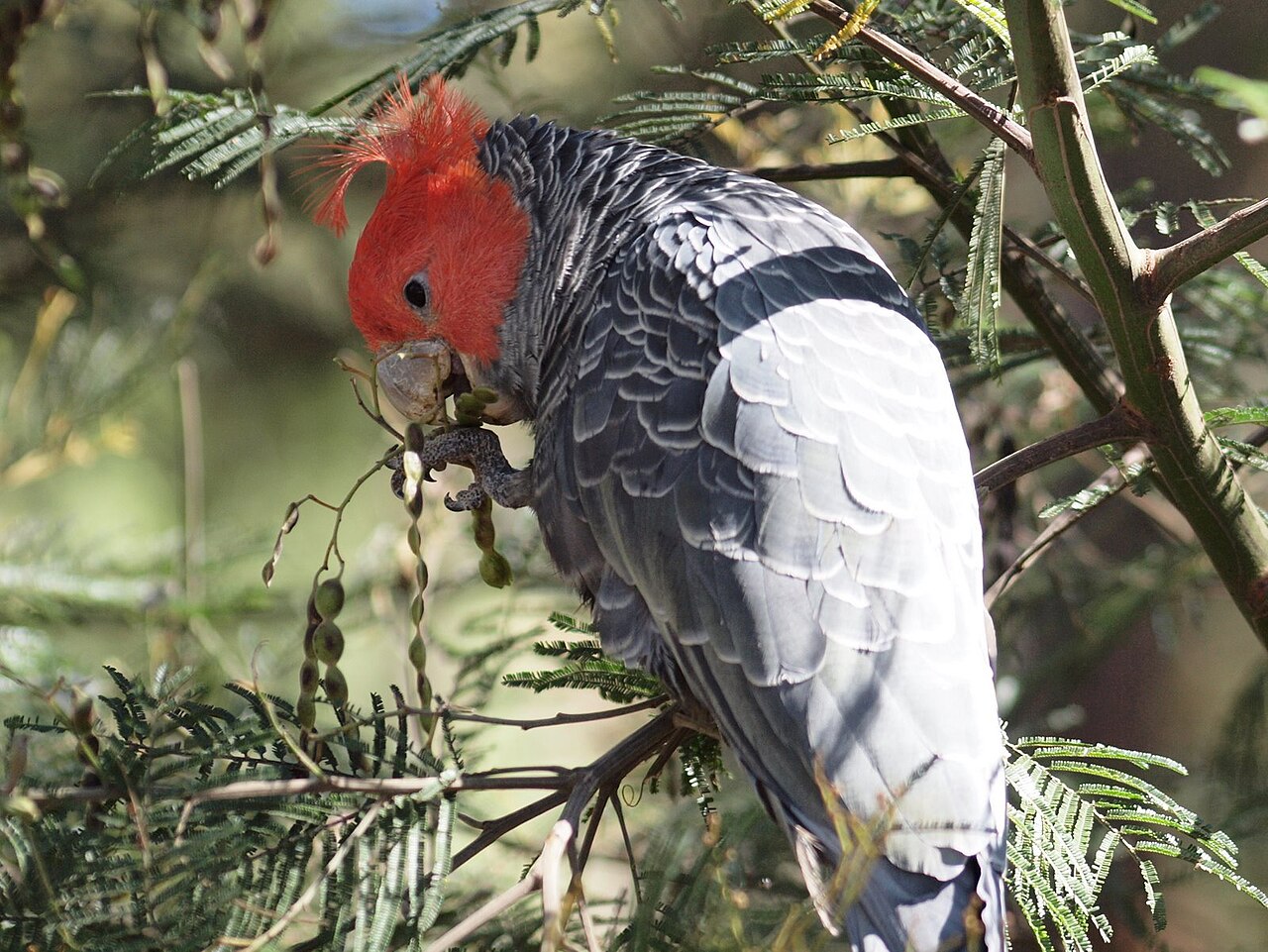
The Gang-gang Cockatoo is the smallest and most compact cockatoo of south-eastern Australia: ash-grey, short-tailed and broad-winged, the male with a fiery red head and a thin, forward-curling crest of loose feather tips. It is the faunal emblem of the Australian Capital Territory and in winter an everyday sight in the gardens of Canberra.
Voice
The call is a hoarse, creaking, rising note that sounds exactly like a rusty hinge or a cork drawn from a bottle: cruh-or-ark, usually given in flight and carrying a long way. While feeding, a flock keeps up a soft, continuous growling and muttering — normally the sound that gives away a food tree full of Gang-gangs before a single bird is seen.
No freely licensed recording has been found for this species yet; what to listen for is described below.
Identification
A stocky cockatoo of 34–35 cm and about a quarter of a kilo, ash-grey with pale feather edges that give the plumage a finely scaled look, with broad rounded wings and a strikingly short, square tail. The male has head and crest scarlet, the crest made of loose, forward-curling feather tips rather than a closed raised shield. The female has an entirely dark grey head with a small grey crest, and breast and belly feathers edged orange-yellow and pink, so the underparts look barred. Young birds resemble the female; young males gain red feathers on the crown in their first year.
Confusion species
There is no second grey cockatoo of this size. Galah (Eolophus roseicapilla) is grey on back and wing but bright pink on head and underparts, with a whitish-pink crest, and flies in alternating grey and pink flashes. The black cockatoos — Yellow-tailed Black Cockatoo (Zanda funerea) and Glossy Black Cockatoo (Calyptorhynchus lathami) — are far larger and black, with a long tail carrying a yellow or red panel and a slow, rowing wingbeat. A female Gang-gang against the light can suggest a small black cockatoo; the short square tail, the broad wings and the quick, clattering flight rule that out.
Habitat
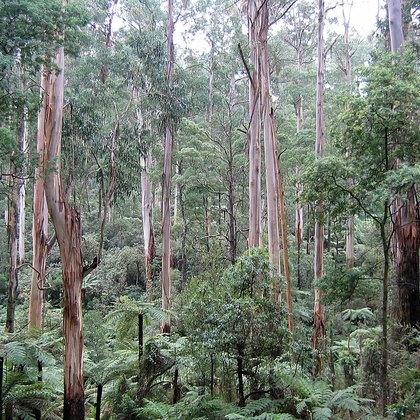
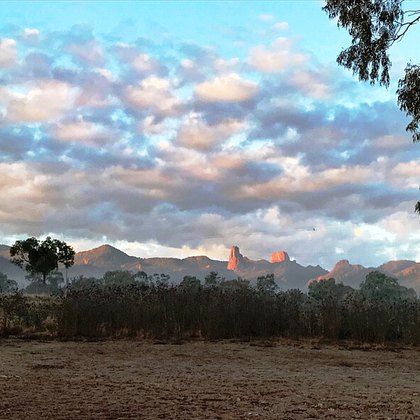
In summer high up in wet montane eucalypt forest with a dense shrubby understorey, where old, thick trees supply the nest hollows. In autumn and winter it drops to lower, drier and more open forest and woodland, and then also into parks, street trees and gardens — above all where introduced hawthorn, cotoneaster and firethorn are in fruit. Nests sit in vertical hollows of living or dead eucalypts, usually close to water.
Where the bird is most often found, arranged by main group and formation.


Range and movements
Endemic to south-eastern Australia. The main range runs from the central tablelands and south-western slopes of New South Wales through the Australian Capital Territory southwards, through Gippsland and the Central Highlands of Victoria to Seymour and the eastern edge of Melbourne. A separate population holds western Victoria from the Otway region to the South Australian border. It has been introduced to Kangaroo Island; it has gone from King Island, and it does not occur naturally in Tasmania.
- Resident
- dark = core range, pale = thinly spread
Where and when to look
Look for it in winter in Canberra, the Dandenongs or the gardens of Bright and Beechworth, in fruiting hawthorn and cotoneaster. It feeds low, slowly and without alarm, and drops a carpet of chewed fruit debris under the bush — that carpet, and the soft growling, give it away sooner than its outline does. Check the crown: only the male carries red.
Conservation
Vulnerable (VU) on the global list, and nationally listed as endangered in Australia. The decline is put at roughly 69 per cent over twenty-one years. At the heart of it is the loss of old hollow-bearing trees to logging and the tidying away of dead wood: a usable eucalypt hollow is centuries old and is not replaced within one generation. On top of that came the bushfires of 2019–20, which burned 28 to 36 per cent of the species' range, and the rising summer heat in the mountain forests where it breeds.
Scientific name
Callocephalon fimbriatum | (Grant, 1803)
James Grant figured and named the species in 1803 as Psittacus fimbriatus, in the narrative of the voyage of the Lady Nelson to New South Wales. Author and year stand in parentheses because the species later moved to the genus Callocephalon, introduced by Lesson in 1837. That genus name is built from Greek kallos 'beauty' and kephalē 'head'; fimbriatum is Latin for 'fringed', after the ragged crest. The type locality is recorded as New South Wales but is in practice placed on the Bass River in Victoria. The name gang-gang comes from an Aboriginal language of the New South Wales coast, possibly Wiradjuri, and is onomatopoeic.