All species › Parrots › Cockatoos › Long-billed Corella
Long-billed Corella | Cacatua tenuirostris
Oostelijke langsnavelkaketoe | Cacatúa picofina
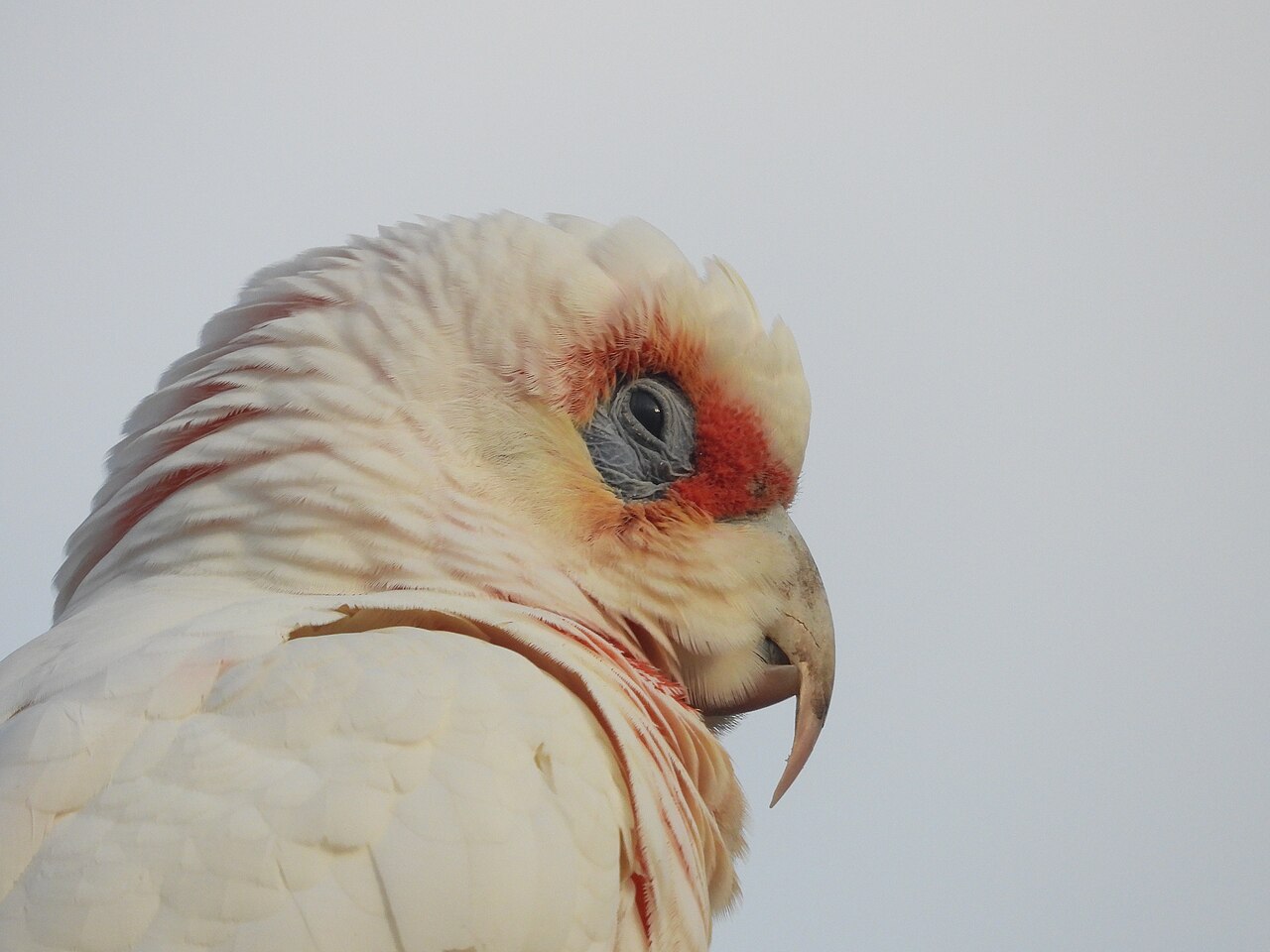
This cockatoo, Cacatua tenuirostris, is the one with the chisel: a solid white bird whose upper mandible has grown into a long pale point with which it levers tubers and roots out of the turf. An orange-red crescent across the upper breast makes it unmistakable once you have it perched. Note that in this guide Cacatua pastinator carries the same Dutch name, Oostelijke langsnavelkaketoe.
Voice
The call is a quick, quavering falsetto note, currup!, which in a flock turns into a two-syllable wulluk-wulluk or, as Australians hear it, cadillac-cadillac. Harsh screeches run between them. Of all the Australian cockatoos this is the best mimic of the human voice, which has made it a sought-after cage bird and, as a result, locally feral.
No freely licensed recording has been found for this species yet; what to listen for is described below.
Identification
A stocky white cockatoo of 38–41 cm with a short crest that is usually not visible, a short tail and a heavy body. Everything turns on two features: the upper mandible is greatly elongated, pale horn-coloured and projects as a narrow point well beyond the lower, and a broad orange-red crescent crosses the upper breast, with red also on forehead, lores and throat. A rim of bare blue-grey skin surrounds the eye. Underwing and undertail carry a faint yellow wash. The sexes are alike.
Confusion species
Little Corella (Cacatua sanguinea) is smaller, has a short bill with mandibles of equal length, no breast band and only a faint pink patch between eye and bill. The second species this guide calls Oostelijke langsnavelkaketoe, Cacatua pastinator, also has a long bill but is larger and heavier, lacks the orange-red breast band and shows only a small pink throat patch; it also belongs to the south-west and this one to the south-east — except where feral birds of this species have reached Perth. Pink Cockatoo (Cacatua leadbeateri) has a short bill, a white-feathered surround to the eye and a red-and-yellow crest. Sulphur-crested Cockatoo (Cacatua galerita) is larger, pure white and yellow-crested.
Habitat
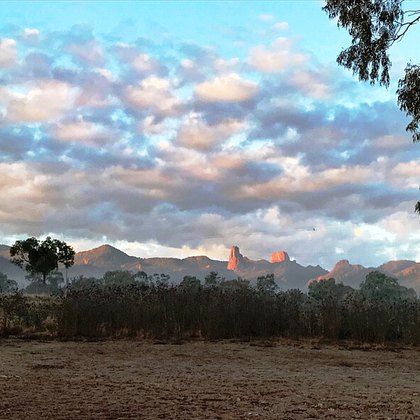
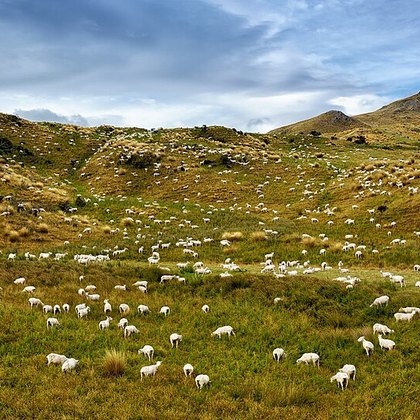
Grassy woodland and grassland: pasture, grazing land, grain crops and stubble, with stands of river red gum along the creeks for nest hollows. In the south-east it is also a fixture in town parks and on sports fields. It feeds almost always on the ground, digging out tubers, bulbs and roots with the long upper mandible; roughly nine tenths of its present food is introduced plants, above all the bulbs of onion grass, in place of the native murnong that has largely gone. Nests are in hollows of large old eucalypts and sometimes in crevices of loose scoria cliffs.
Where the bird is most often found, arranged by main group and formation.




Range and movements
Naturally confined to the extreme south-east of Australia: from south-eastern South Australia through western Victoria to southern New South Wales. Since the 1970s the range has expanded a long way, partly under its own steam and partly through escaped cage birds: Melbourne, Tasmania, parts of South Australia and south-eastern Queensland north to around Cairns. A feral population has held near Perth in Western Australia since the mid-1980s, far outside the natural range.
- Resident
- dark = core range, pale = thinly spread
Where and when to look
Look for it on the ground in closely grazed pasture or on an irrigated sports field in western Victoria, where flocks work shoulder to shoulder. Watch the head: where a Little Corella pecks, this bird levers, with a sideways movement that turns over clumps of turf. The worked patches in the grass stay visible for days.
Conservation
Not threatened (LC). The species has gained from the conversion of woodland into cropland and pasture and has increased in both numbers and range; in many places it is regarded as a pest for damage to crops and to bark, cables and timber, and culling permits are issued regularly. The one conservation concern lies on the other side of the country: the feral population near Perth is a risk to the scarce south-western relative Cacatua pastinator, with which it can hybridise and compete for nest hollows.
Scientific name
Cacatua tenuirostris | (Kuhl, 1820)
Heinrich Kuhl described the species in 1820 as Psittacus tenuirostris, so author and year stand in parentheses. The epithet is Latin: tenuis 'slender' and rostrum 'bill', after the long narrow upper mandible. The type locality is New Holland, narrowed to the vicinity of Port Phillip Bay in Victoria. The word corella in the English name comes from an Aboriginal language of inland New South Wales. It is worth knowing that in this guide this species shares its Dutch name with Cacatua pastinator, which elsewhere in the literature is called the western corella — when in doubt, use the scientific name.