All species › Waterfowl › Ducks, swans and geese › Greylag Goose
Greylag Goose | Anser anser
Grauwe gans | Ansar común
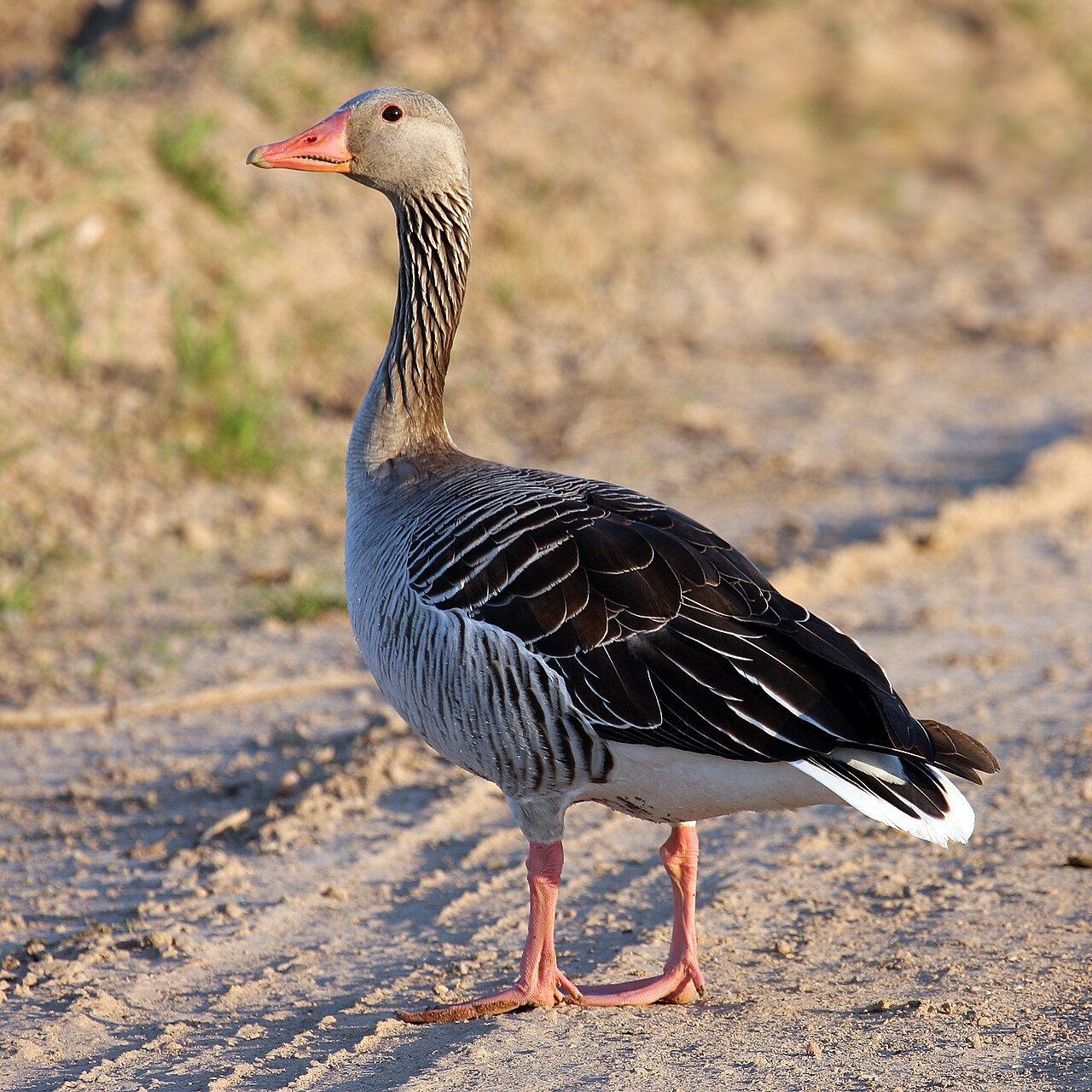
Here the Greylag Goose is the bird of the town pond and the farmyard: a feral domestic goose descended from the European wild goose, domesticated three thousand years ago. Unlike in Europe it is seldom plain grey-brown in this area — most birds are white, or white blotched with grey-brown, exactly like the farmyard stock they come from. The orange bill and orange legs are the constant mark.
Voice
Loud, hoarse and unmistakably the sound of the farmyard: a ringing three-note cackle, aahng-ung-ung, taken up by the whole group at any disturbance. Geese know one another by voice. In threat the bird stretches its neck low and forward and hisses at length; young birds peep and whistle softly. Flocks overhead honk raggedly across one another, less rhythmically than Canada Goose.
No freely licensed recording has been found for this species yet; what to listen for is described below.
Identification
About eighty centimetres and some three kilos, with a heavy, deep orange bill, orange-pink legs and a solid, thickset build. In the feral population of this area the males are usually wholly white and the females carry large grey-brown patches, above all on the neck, the lower breast and the flanks; pure wild-type birds — grey-brown, finely barred, with a pale head — occur but are in the minority. On grey birds the strikingly pale, silvery forewing shows in flight. Goslings are yellow, browner above. The walk is upright and waddling, and the birds are tame enough to let you approach within a few metres.
Confusion species
Canada Goose (Branta canadensis) is the other goose of the New Zealand paddock: larger, with a black head and neck, a white chinstrap and black bill and legs, and never any white in the plumage. White birds are taken at distance for Mute Swan (Cygnus olor), but that is twice the length, far longer in the neck, and carries a black knob on the bill. Feral domestic ducks and Muscovy Duck (Cairina moschata) share the same park water but are much smaller. Hybrids with Swan Goose occur in parks: those show a dark stripe down the hindneck and a black bill.
Habitat
Short grass beside water — town parks, sports fields, the margins of ponds and lakes, and beyond that farmland with ditches and pools. It grazes like a sheep and in numbers can foul and crop a paddock bare. The nest is on the ground, usually under a shrub or in rank grass close to the shore, with four to six creamy white eggs and about thirty days of incubation; the young fly at fifty to sixty days and stay with the parents for some ten months. It asks for no wild country, only grass, water and quiet.
Where the bird is most often found, arranged by main group and formation.


Range and movements
In New Zealand it is widespread on both main islands, the chief exceptions being Fiordland and Westland south of Greymouth; on the Chatham Islands it is common. The total is put at a few thousand birds, though counting is awkward because farmyard and feral geese grade into one another. In Australia there are scattered groups on town ponds, park lakes and farm dams in the south-east and south-west, with no established wild range — almost every bird is within walking distance of buildings. Neither country holds anything like a continuous distribution.
- Resident
- dark = core range, pale = thinly spread
Where and when to look
Look where people are: the pond in the town park, the picnic lawn by the lake, the sports field beside the river. The birds are tame because they are not hunted, so you can check bill and leg colour at leisure — orange in this species. In a flock, note the share of wild-type birds: where that is high, the population is usually older and longer feral.
Conservation
Least Concern (LC) worldwide, and the population here is introduced rather than natural. The story starts with Cook, who released geese from South Africa at Goose Cove in Dusky Sound in 1773; that attempt failed. Today's birds descend almost entirely from stray farmyard geese, in the New Zealand phrase 'managed by benign neglect'. Because they are not hunted they are tame and can become locally numerous; complaints concern fouling and grazing of pasture and playing fields, not damage to native habitat. In neither country is it counted as a pest with consequences for native species.
Scientific name
Anser anser | (Linnaeus, 1758)
Linnaeus described the species in 1758 as Anas anser, in the tenth edition of the Systema Naturae; because it later moved to Anser, author and year stand in parentheses. The genus Anser was introduced by Brisson in 1760; anser is simply the Latin word for 'goose', and because the species name was repeated as the genus name, the Greylag is by tautonymy the type species of the genus. The type locality is Sweden. This is the ancestor of nearly all European domestic goose breeds, domesticated by at least 1360 BCE, which is why the birds here are so often white.