All species › Waterfowl › Ducks, swans and geese › Pacific Black Duck
Pacific Black Duck | Anas superciliosa
Wenkbrauweend | Pato negro del pacífico
The Pacific Black Duck is the ordinary large dabbling duck of Australasia: dark brown, with a cream face crossed by two black stripes, and a green speculum that flares only when the wing is stretched. It sits on every kind of water from a forest pool to a tidal flat. In New Zealand it has also become the textbook case of a species disappearing from within, hybridised away by the introduced Mallard.

Voice
The female quacks loud and raucous in a rapid series that fades in volume: quack-quak-quak-quak, the same descending laugh as a Mallard and often the first sign of a hidden pair. The male is far quieter, giving a short, high, hoarse rrep, usually only once or twice. Displaying groups add rapid head-pumping with a soft murmuring undertone.
No freely licensed recording has been found for this species yet; what to listen for is described below.
Identification
A big dark dabbling duck of 50 to 60 cm, looking almost plain mid-brown from above because every feather carries a narrow pale edge. The mark is on the head: a cream face with a dark crown and a sharp dark line straight through the eye, the upper edge of which forms the 'eyebrow' that names the bird. In flight the underwing is clean white against the brown body, and the wing carries a glossy green speculum with a thin white border. The sexes look alike.
Confusion species
The real problem is Mallard (Anas platyrhynchos), introduced to Australia and above all New Zealand and hybridising on a large scale: hybrids show blurred, smudged head stripes, a greenish sheen on the crown or orange legs, and pure Pacific Black Ducks have become scarce in New Zealand. Grey Teal (Anas gracilis) is far smaller, paler grey-brown and has a plain face with a white throat. Chestnut Teal (Anas castanea) is smaller and darker and lacks the head stripes entirely.
Habitat
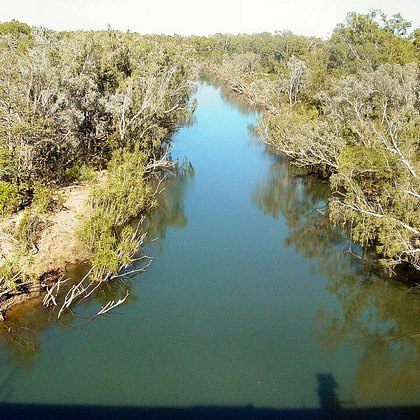
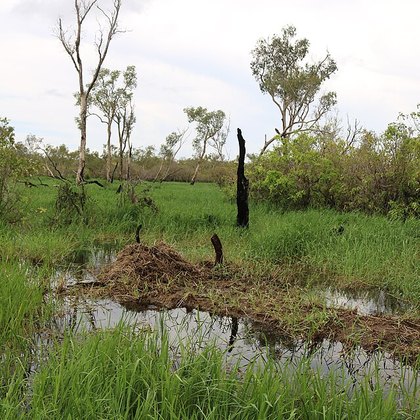
Almost any water with an edge: lakes, reservoirs, creeks and rivers, reed swamp and billabong, down to roadside ditches, city ponds and sewage lagoons. In the north it uses forest pools, and in winter estuaries and tidal flats as well. It feeds by dabbling in the shallows and upending in deeper water; the nest sits in dense bankside cover, on a fallen trunk or in a tree hollow.
Where the bird is most often found, arranged by main group and formation.


Range and movements
Everywhere in Australia except the driest desert cores, throughout New Zealand, on Norfolk Island and on across New Guinea, Indonesia and much of the Pacific to French Polynesia. On the Australian mainland it is the commonest duck and holds its ground; in New Zealand it has gone from the subantarctic islands, become rare on the Chathams and fallen away badly on the main islands. It does not migrate, but in dry years large numbers shift to the coast and to the southeast.
- Resident
- dark = core range, pale = thinly spread
Where and when to look
Read the head stripes, not the body: on any brown duck the face pattern says at a glance whether the bird is pure. On a pair in late winter and early spring, check for orange legs and a greenish gloss on the crown — that is Mallard showing through. Flush a resting flock and watch the white underwing, which is the best mark against the light.
Conservation
Least Concern (LC) globally, but the figure hides the New Zealand story: there the bird is rated Nationally Vulnerable and few genetically pure individuals remain, because the Mallard released since 1867 both outbreeds and outnumbers it. That the duck season stays open while hybrids can barely be told from pure birds in the field only sharpens the problem. In Australia numbers are stable and artificial water suits it well.
Scientific name
Anas superciliosa | Gmelin, 1789
Gmelin described the species in 1789 as Anas superciliosa, and it remains in that genus, so author and year carry no parentheses. Anas is simply the Latin word for duck, taken up as a genus name by Linnaeus in 1758. superciliosa belongs with supercilium, 'eyebrow', after the pale line above the eye. The type locality is Dusky Sound in Fiordland, New Zealand; the Maori name parera is still in daily use there.