All species › Passerines › Cuckooshrikes › Ground Cuckooshrike
Ground Cuckooshrike | Coracina maxima
Grondrupsvogel | Oruguero terrestre
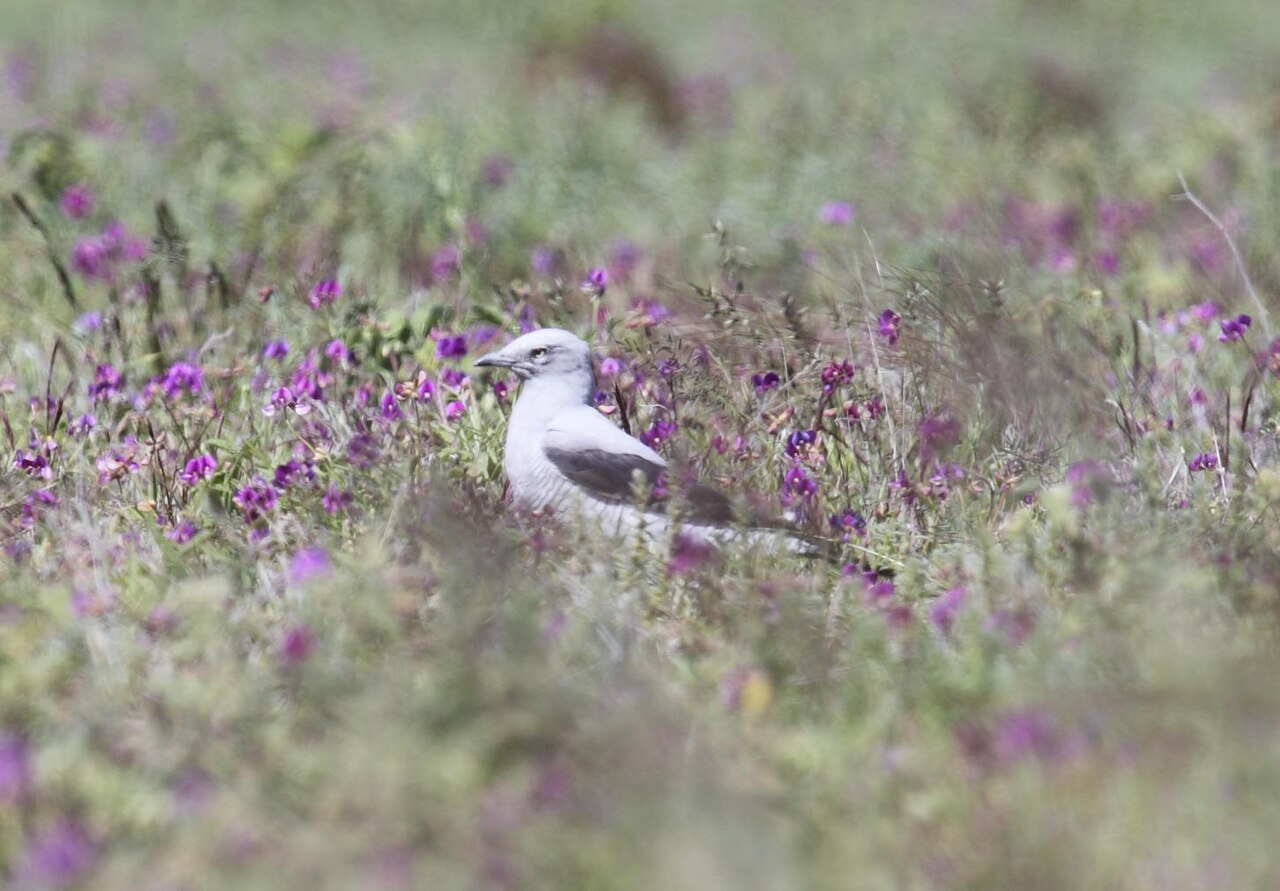
The Ground Cuckooshrike is the only cuckooshrike that lives on the ground: a slender, pale grey bird on long legs that walks across bare plains and flushes only at the last moment. Cuckooshrikes are songbirds that shuffle their wings one after the other on landing, and this species does it too. It is the largest of the family and at the same time the hardest to find, because it wanders the interior without a fixed address.
Voice
A clear, two-syllable pee-ew, pee-ew in flight, carrying far over open country and usually the first sign of a party. There is also a drier chill-chill … kee-lik, higher and sharper, from birds following one another across the ground. Away from flight the species is strikingly silent and gives itself away hardly at all. It pays, when crossing an empty plain, to listen for a single call out of the sky.
No freely licensed recording has been found for this species yet; what to listen for is described below.
Identification
Thirty-three to thirty-seven centimetres, much of it tail; slender, long-legged and with a slightly forked tail no other Australian songbird has. The adult is pale grey on head, back and breast, with black wings and black tail, white underparts finely barred with black, and a pale yellow iris. Male and female are alike, in size as well. Young birds have a dark iris and a coarser, broken black barring that runs up onto throat and crown. In flight the long, shallowly forked tail and the loose, undulating wingbeat stand out.
Confusion species
The other cuckooshrikes of the region are darker grey, have a rounded tail and keep to trees; they do not walk. The largest of them, Coracina novaehollandiae, has a black mask and lacks the black barring below. At range and on the ground the species is taken for a butcherbird or a lapwing; the forked tail and the pale iris settle it. A heavily barred young bird suggests a cuckoo, but it sits more upright and walks rather than clambers.
Habitat
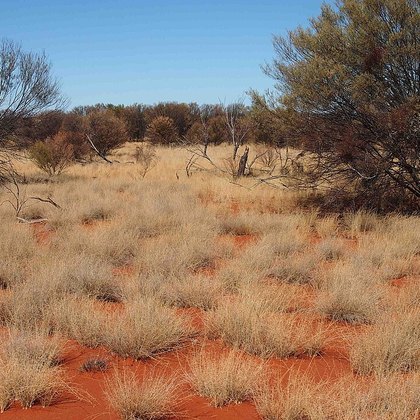
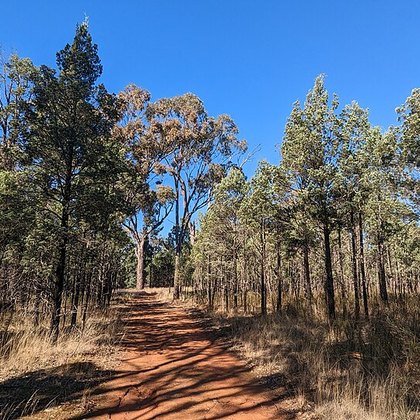
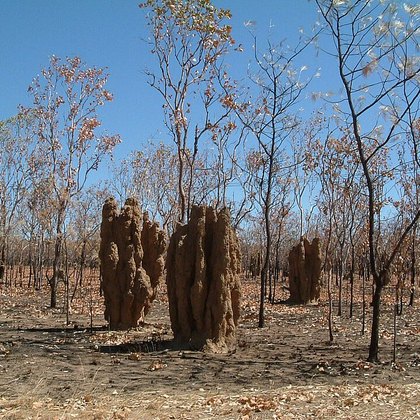
Open, near-treeless interior: mulga and other acacia scrub, Mitchell grassland, bare plains with dead trees, and the strips of riverine woodland along creeks where it nests. It feeds on bare ground between the bushes and needs open soil for it; dense grass is useless. Plains that turn green after rain draw it in, and drying floodplains do the same. It avoids closed forest and the humid east coast.
Where the bird is most often found, arranged by main group and formation.



Range and movements
Across almost the whole Australian mainland west of the Great Dividing Range, from Queensland and the Northern Territory into Western Australia and northern Victoria. Resident is the wrong word: the species wanders great distances after rain and can be absent from a district for years, then suddenly breed there. Records are few — some three thousand in ten years, against hundreds of thousands for an ordinary woodland bird — and that reflects both its scarcity and the empty country it occupies. In Victoria it has been listed as threatened since 2013.
- Resident
- dark = core range, pale = thinly spread
Where and when to look
In the dry interior drive slowly along creek woodlands and watch the sky: it is usually a party of three to six that passes over, calling, with a forked tail. Go after a wet spell; then the birds move onto the greened plains and breed, from August to November. On the ground it is already indistinguishable at a hundred metres, so search the dead trees it rests in.
Conservation
Not threatened globally, but numbers are falling and the species was never numerous. Conversion of inland plains to grazed rangeland, the loss of dead trees and the failure of good rain years are the causes usually named. How many birds there are nobody knows; the empty range makes counting all but impossible.
Scientific name
Coracina maxima | (Rüppell, 1839)
Eduard Rüppell described the species in 1839 as Ceblepyris maxima; because it was later moved to another genus, author and year stand in parentheses. Vieillot introduced the genus Coracina in 1816, from Greek korakinos ('little raven'), a diminutive of korax (raven), after the grey and black plumage of the cuckooshrikes. maxima is Latin for 'largest': it is the largest species of the family. Many works place it in a genus of its own as Pteropodocys maxima; this guide follows AviList, which keeps it in Coracina. The type locality reads 'New Holland' and is understood as New South Wales.