All species › Nightjars › Nightjars and nighthawks › Large-tailed Nightjar
Large-tailed Nightjar | Caprimulgus macrurus
Horsfields nachtzwaluw | Chotacabras macruro
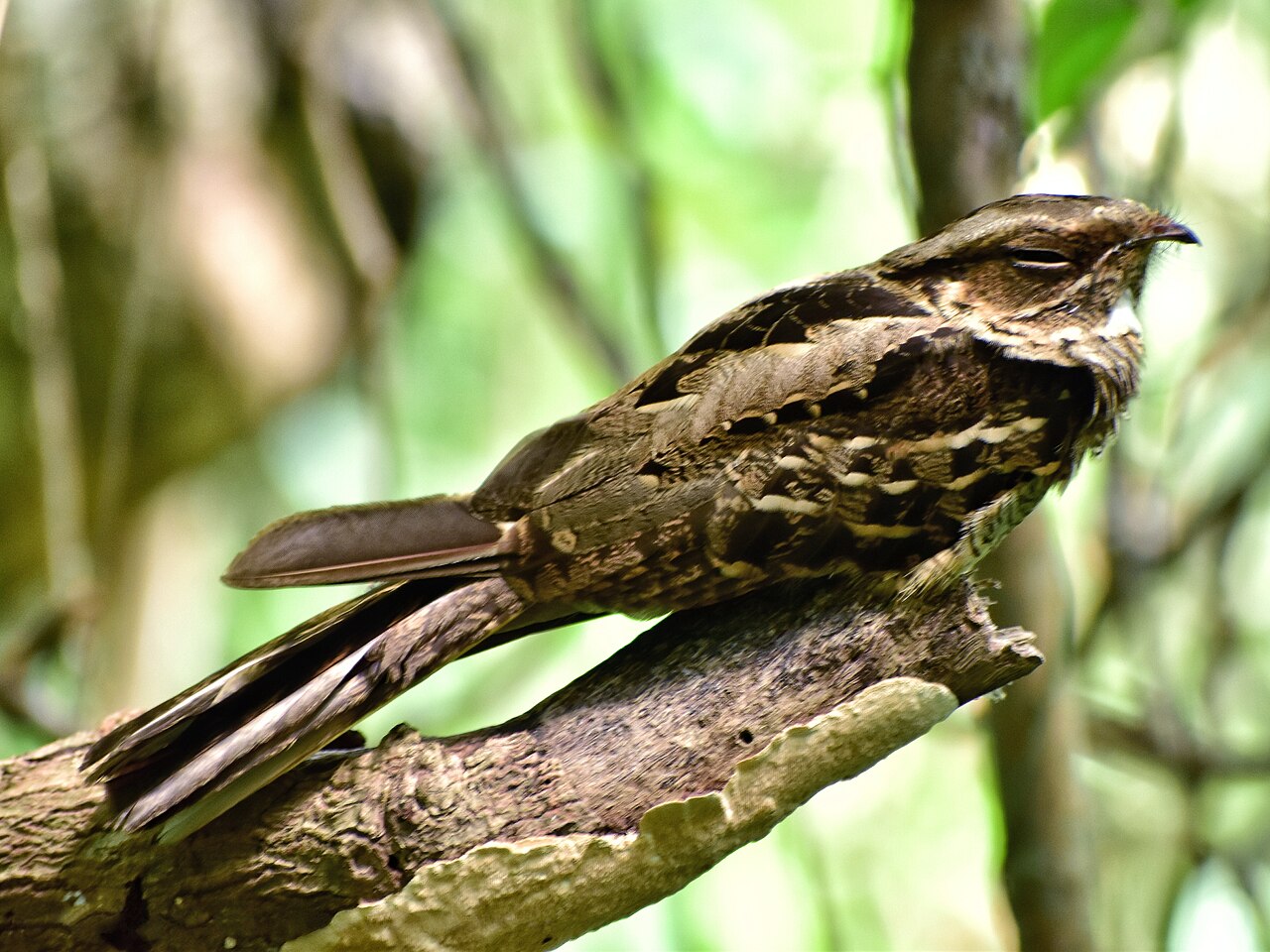
The Large-tailed Nightjar is the nightjar of tropical northern Australia, and the only one you might simply meet on a garden path or a back road in Darwin. Anyone who does not see it will hear it: all night long comes a monotonous, wooden knocking that has earned the species nicknames like 'hammer-bird' and 'carpenter' right across Asia.
Voice
The call is what identifies it with certainty in the dark: a hard, hollow chonk ... chonk ... chonk, about one note a second, as though someone further off were tapping a tree trunk with an axe. It keeps the series going for minutes at a time and usually starts as the light fails, returning again at first light. In flight come softer croaking notes, and at the nest it hisses and puffs and spreads its wings in a distraction display. The knocking carries a long way and is one of the standard background sounds of a northern Australian night.
No freely licensed recording has been found for this species yet; what to listen for is described below.
Identification
A medium-sized nightjar of twenty-five to thirty-three centimetres, proportionally long-tailed — hence the English name. The plumage is grey-brown, finely mottled and streaked, with a white throat patch and buff, barred underparts. The male has clear white spots on the outer primaries and broad white tips to the outer tail feathers; in the female those spots are smaller and buffier and the tail tips narrower. Those broad white tail corners are the best mark: they flare the moment the bird flushes or turns. By day it presses flat to the forest floor among the litter, where the plumage makes it all but invisible.
Confusion species
White-throated Nightjar (Eurostopodus mystacalis) is larger and darker, has large white throat patches and — decisively — no white in the tail; it belongs to the eastern ranges and overlaps only in north-east Queensland. Spotted Nightjar (Eurostopodus argus) is paler and more rufous-spotted, has large white windows in the primaries but likewise no white tail corners, and lives in the dry interior. Australian Owlet-nightjar (Aegotheles cristatus) is smaller, shorter-winged and flutters low around tree hollows. In every case the call settles it at once: the wooden knock of the Large-tailed Nightjar resembles none of the others.
Habitat
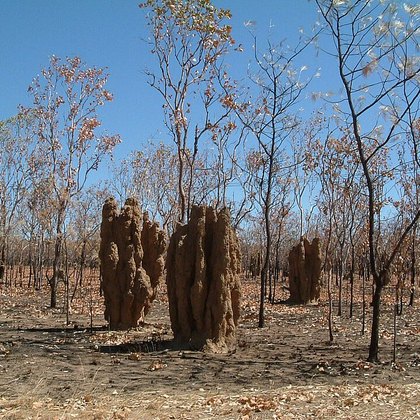
Forest edges and semi-open country in the tropics: monsoon forest and vine thicket, mangrove and the fringe behind it, eucalypt savanna, riverine forest along creeks, and beyond that plantations, yards, gardens and parks right into the suburbs of Darwin and Cairns. It needs open bare ground to roost and nest on, with thickets or shrubs close by to hunt from. Closed rainforest without clearings, and the dry interior, it avoids.
Where the bird is most often found, arranged by main group and formation.




Range and movements
Tropical northern Australia: the Kimberley in Western Australia, the Top End of the Northern Territory including Darwin and Kakadu, and the east coast of Cape York south along the Queensland coast. Within that belt it is resident and does not migrate, although young birds wander somewhat. Beyond Australia the range stretches across New Guinea and much of South and South-East Asia, but inside the map window of this guide it stays confined to the northern coastal strip. It does not occur in New Zealand.
- Resident
- dark = core range, pale = thinly spread
Where and when to look
In the first hours after sunset, drive slowly along a dirt road through monsoon forest or beside a mangrove fringe and watch for the red eyeshine on the surface; the bird lets a car come close and then flies off showing white tail corners. Simpler still is to listen: stand still after dark in a yard or a campground in the north and the knocking will come to you. Around Darwin it lives right into residential streets, so no special journey is needed.
Conservation
Least Concern (LC), with a huge range from Pakistan to Australia and no sign of decline within Australia. It adapts well to people and will nest in gardens and yards, which leaves it less vulnerable than most ground-nesters. Such losses as there are come mainly from collisions on country roads, where it rests on warm bitumen, and from feral cats around towns and campgrounds.
Scientific name
Caprimulgus macrurus | Horsfield, 1821
Thomas Horsfield described the bird in 1821 as Caprimulgus macrurus, and it has stayed in that genus, so author and year carry no parentheses. Horsfield was an American physician and naturalist who worked for years in Java, and the Dutch name honours him. The genus Caprimulgus was introduced by Linnaeus in 1758, from Latin capra, 'goat', and mulgere, 'to milk' — the old belief that nightjars drained goats by night. macrurus is Greek for 'long-tailed', from makros and oura, which the English name also picks up. The type locality is Java; Australian birds belong to the subspecies schlegelii.