All species › Nightjars › Nightjars and nighthawks › Spotted Nightjar
Spotted Nightjar | Eurostopodus argus
Argusnachtzwaluw | Chotacabras argos
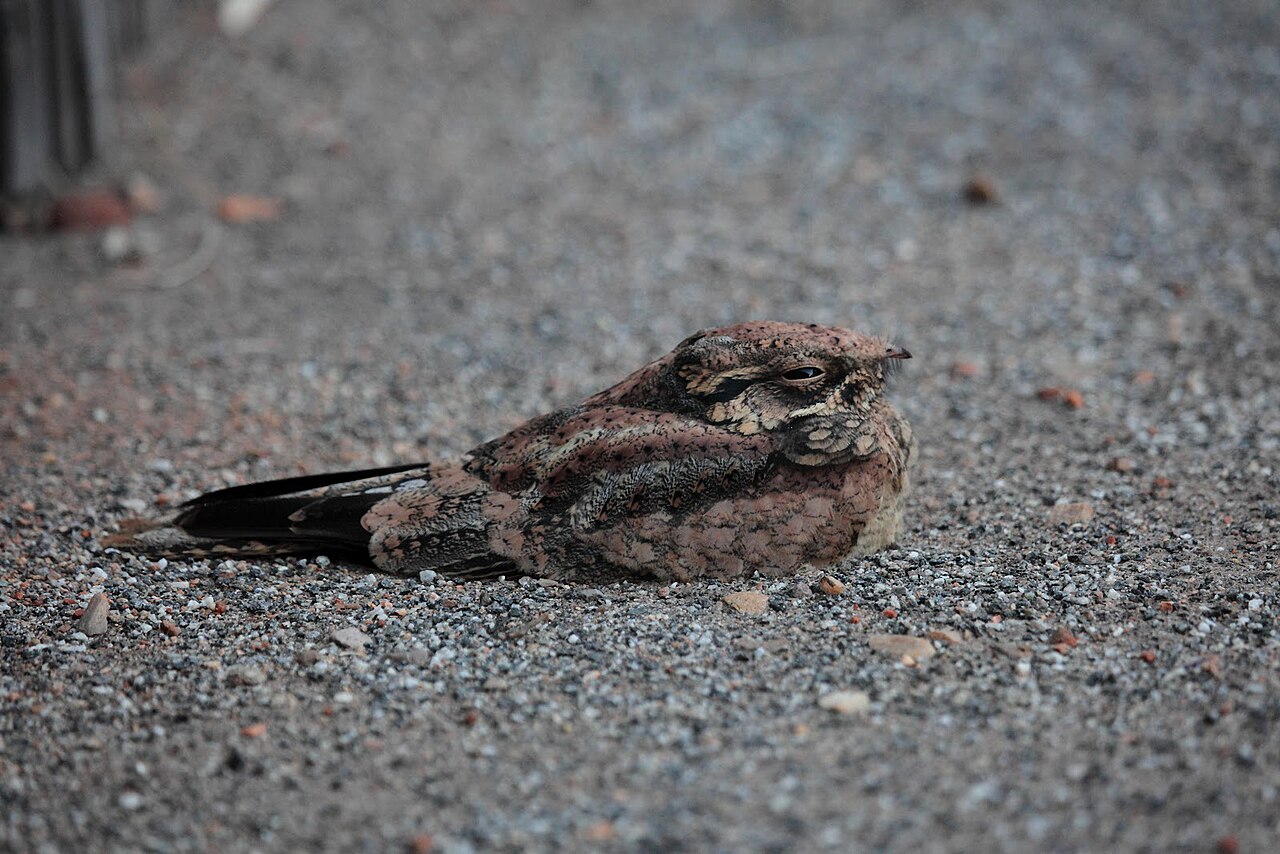
The Spotted Nightjar is the nightjar of the dry Australian interior, named after the hundred-eyed watchman of Greek myth because it is spotted from head to tail. It rests by day on bare ground among spinifex and stone, and gives itself away only when it flushes and four large white spots light up in the primaries.
Voice
The song lasts four to six seconds and opens with nine to twelve notes rising in pitch, followed by a fast run of gobbling, gurgling sounds: kwo-kwo-kwo-kwoo-kwoo ... gobble-gobble-gobble. It sings from the ground or from a low bare branch, mainly in the first hours after sunset and, on moonlit nights, on through until light. The song belongs to the breeding season from September to December; outside it the species is all but silent. Flushed birds give a short sharp note that is easily missed.
No freely licensed recording has been found for this species yet; what to listen for is described below.
Identification
A nightjar of twenty-five to twenty-eight centimetres with long pointed wings and a long tail, pressed almost flat to the ground at rest. The most workable character is the set of large white spots on the four outer primaries, which light up as a bright window in the wing in flight and are present in both sexes. The head is speckled grey with black crown feathers edged rufous or buff, the upperparts mid-grey with tawny and rufous streaking, and the throat carries a pair of large oval white patches. The underparts are tawny to ochre with blackish-brown barring. In flight it is high, light and erratic, with long glides on raised wings.
Confusion species
White-throated Nightjar (Eurostopodus mystacalis) of the east coast and eastern ranges is darker and greyer and lacks the large white primary spots; where both occur the wing flash settles it. Large-tailed Nightjar (Caprimulgus macrurus) of the tropical north has white tail corners and a wholly different chopping call. Australian Owlet-nightjar (Aegotheles cristatus) is smaller, hunts low on fluttering wings and sits in tree hollows, never on bare ground. Tawny Frogmouth (Podargus strigoides) is far larger, has a heavy grey bill and sits upright against a branch by day.
Habitat
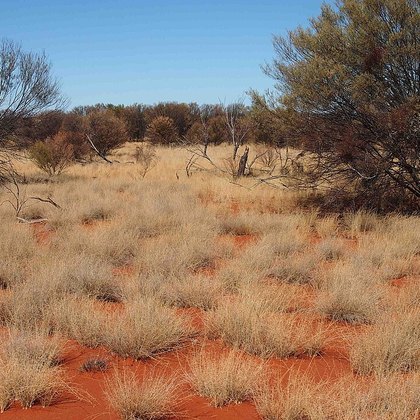
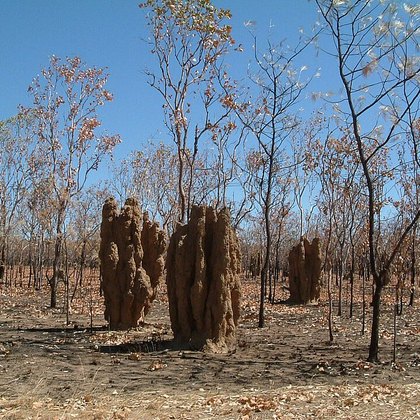
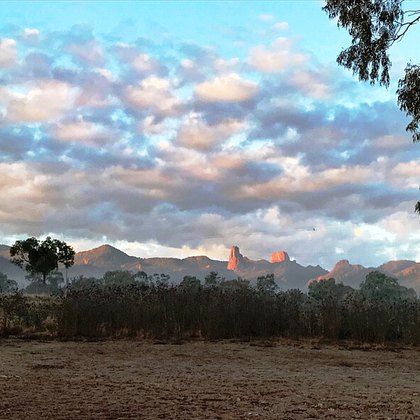
Warm, dry open country: savanna woodland, low open sclerophyll forest, mallee, mulga and acacia scrub, spinifex, tussock grassland and gibber plain. What it needs is bare or thinly vegetated ground to rest and nest on, with scattered shrubs or trees to hunt from. It passes over dense grassland and closed forest, and it is absent from Tasmania.
Where the bird is most often found, arranged by main group and formation.



Range and movements
Across most of mainland Australia, but as a rule absent east and south of the Great Dividing Range from central Queensland to southeastern South Australia. Southern birds are part sedentary and part migratory: some winter in northern Australia from May to September, and some cross to the islands of the Banda Sea, the Aru Islands and the Lesser Sundas. It does not occur in New Zealand. Its presence in a district shifts from year to year with the rain and with the insects the rain brings.
- Resident
- dark = core range, pale = thinly spread
Where and when to look
After dark drive at walking pace along a gravel road through mulga or spinifex and watch for red eyeshine on the road surface; nightjars settle on the still-warm road and let a car come close. When a bird flushes, go straight to the primaries: the white window makes the species certain at a glance. Search and listen above all in the first two hours after sunset, between September and December.
Conservation
Least Concern (LC) and widely spread across the dry interior, though nowhere at high density. Road deaths on inland roads are the most visible cost, precisely because the bird chooses the road surface to rest on. Beyond that, changed fire regimes and feral cats and foxes press on a bird that nests on the ground and lays a single egg.
Scientific name
Eurostopodus argus | Hartert, 1892
Hartert described the species in 1892 as Eurostopodus argus, and it has stayed in that genus, so author and year carry no parentheses. The genus Eurostopodus was introduced by Gould in 1838, from Greek eurostos, 'sturdy', and pous, 'foot'. argus refers to Argus Panoptes, the hundred-eyed watchman of Greek myth, after the spotting over the whole plumage. The type locality is given as Australia, the Aru Islands and probably New Ireland.