All species › Passerines › Wagtails and pipits › New Zealand Pipit
New Zealand Pipit | Anthus novaeseelandiae
Nieuw-zeelandse pieper | Bisbita neozelandés
The New Zealand Pipit, the Maori pihoihoi, is the only native songbird of New Zealand you see walking on bare ground: a slim brown streaked bird with a long tail that it pumps up and down without pause. It runs ahead of you along a shingle river, a dune or a mountain road, stands upright to look about, then flies off showing white tail sides and giving a thin call. Before the skylark was introduced it was the only bird there in that role.

Voice
The call is a thin, sharp, slightly rising tsip or chwip, usually given on take-off and in the undulating flight, and the sound by which the bird most often gives itself away. The song is a simple, barely varied repetition of that same high note, strung into a short series and delivered from a stone, a fence post or a river bank, sometimes during a brief climbing flight. Heard beside a singing skylark the difference is immediate: the lark reels for minutes on end high in the air, the pipit gives short thin phrases from a low perch.
No freely licensed recording has been found for this species yet; what to listen for is described below.
Identification
A slim ground bird of seventeen to nineteen centimetres, with long legs, a long tail and a thin pointed bill. The upperparts are warm brown with dark streaks, the underparts dirty white to buff with a heavily streaked breast and an unstreaked belly. The head shows a clear pale supercilium over a dark eyestripe, with a dark malar stripe below it beside the pale throat. The outer tail feathers are white and flash as the bird flies. The decisive feature is behaviour: it walks and runs, never hops, stands bolt upright to look around, and pumps its tail constantly while doing so. The sexes look alike; young birds are slightly more scaled above.
Confusion species
The honest answer first: Australian Pipit (Anthus australis) is effectively inseparable from this species in the field. The two were split only recently from what was previously treated as one widespread species — the bird older books call Richard's Pipit — and the distinction rests on average measurements and tones that are of no use to an observer. In practice they are separated on range alone: a pipit in New Zealand is this species, a pipit in Australia the other. The confusion that matters is with the introduced Eurasian Skylark (Alauda arvensis), which shares the same country in New Zealand and is far more numerous: the lark is stockier and shorter-tailed, has a blunt crest and a heavier bill, does not pump its tail, and shows a white trailing edge to the wing in flight. New Zealand Fernbird (Poodytes punctatus) lives in dense cover rather than on open ground, has a frayed pointed tail with no white, and flies only briefly and low.
Habitat
Open country with low or no cover: tussock grassland, the broad shingle beds of the braided rivers, dunes and sandy beaches, hard-grazed paddocks, verges and unsealed roads, cleared and freshly burnt land, and alpine herbfields well above the treeline. It nests on the ground in a cup under a grass tussock, a stone or an overhanging bank. Where dense cover or tall exotic grasses close the ground in, it disappears.
Where the bird is most often found, arranged by main group and formation.
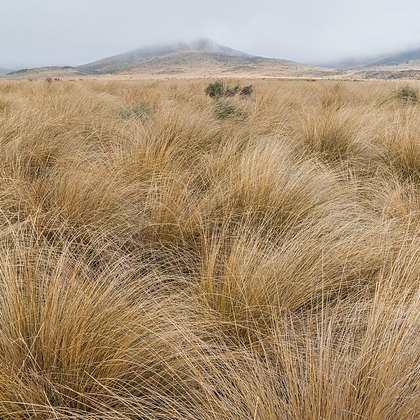

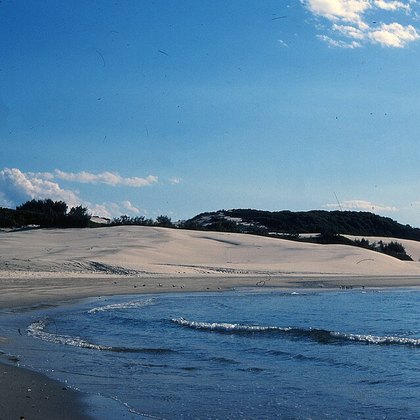
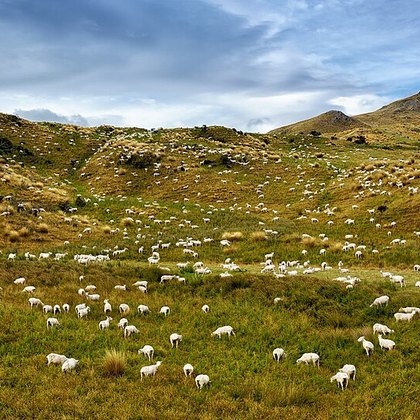

Range and movements
Widespread on the North and South Islands and on many outlying and coastal islands, with distinct forms on the Chathams and the Auckland and Antipodes Islands. Densities are highest where open ground and low human pressure coincide: the shingle rivers and high tussock basins of the South Island, the Northland coast, and islands free of rats and cats. On the closely farmed country of the North Island, by contrast, it has fallen away locally and often survives only along roads and on coastal dunes. Outside New Zealand and its islands the species does not occur under the treatment this guide follows.
- Resident
- dark = core range, pale = thinly spread
Where and when to look
Drive a gravel road slowly past tussock country or a braided river and watch every brown bird that runs ahead of the car instead of flying. If it stops and the tail goes up and down, you have it. If it flies, look at the trailing edge of the wing: white means skylark, no white means pipit. Early in the morning they like to sit on the warm shingle or on a roadside fence post.
Conservation
Least Concern (LC) globally, but within New Zealand the species is treated in the national threat assessment as declining, and that is the figure that counts locally. The causes are the usual two: introduced predators, above all cats, stoats and rats, which fall heavily on a defenceless ground nester, and the closing in of its habitat — conversion of rough grassland to intensive pasture, the choking of shingle rivers and dunes by exotic grasses and lupin, and the loss of open verges. On islands cleared of predators and across the vast South Island tussock basins it holds up well.
Scientific name
Anthus novaeseelandiae | (Gmelin, 1789)
Gmelin described the bird in 1789 as Alauda novae Seelandiae, from material taken at Queen Charlotte Sound on the South Island during Cook's voyages; because the species has moved to another genus, author and year stand in parentheses. Anthus goes back through Latin to Greek anthos, a small grassland bird in Pliny and Aristotle, and novaeseelandiae means 'of New Zealand'. The Maori name pihoihoi is onomatopoeic and renders the thin call. For a long time this name covered one species supposedly spread from Asia through Australia to New Zealand; in the taxonomy this guide follows that composite has been divided and novaeseelandiae now applies to the New Zealand birds alone.