All species › Passerines › Wagtails and pipits › White Wagtail
White Wagtail | Motacilla alba
Witte kwikstaart | Lavandera blanca
The White Wagtail is a crisply black, white and grey, long-tailed bird that runs over bare ground with its tail wagging without pause. In Europe and Asia it is one of the best-known birds of villages, rooftops and riverbanks; in Australia and New Zealand it is a genuine rarity — the odd lost migrant in a year, usually standing on a car park, a river bank or a sewage pond, where everyone comes to look at it.
Voice
The call is a clear disyllabic tsee-lip or chiz-zik, sharp and carrying, almost always given in the undulating flight and often the only clue to a bird passing overhead. It sounds purer and less hoarse than the rasping call of Eastern Yellow Wagtail. The song is a hurried twittering mixture of those same call notes with some scratchy filling, but in the wintering and vagrancy range an observer will virtually never hear it.
No freely licensed recording has been found for this species yet; what to listen for is described below.
Identification
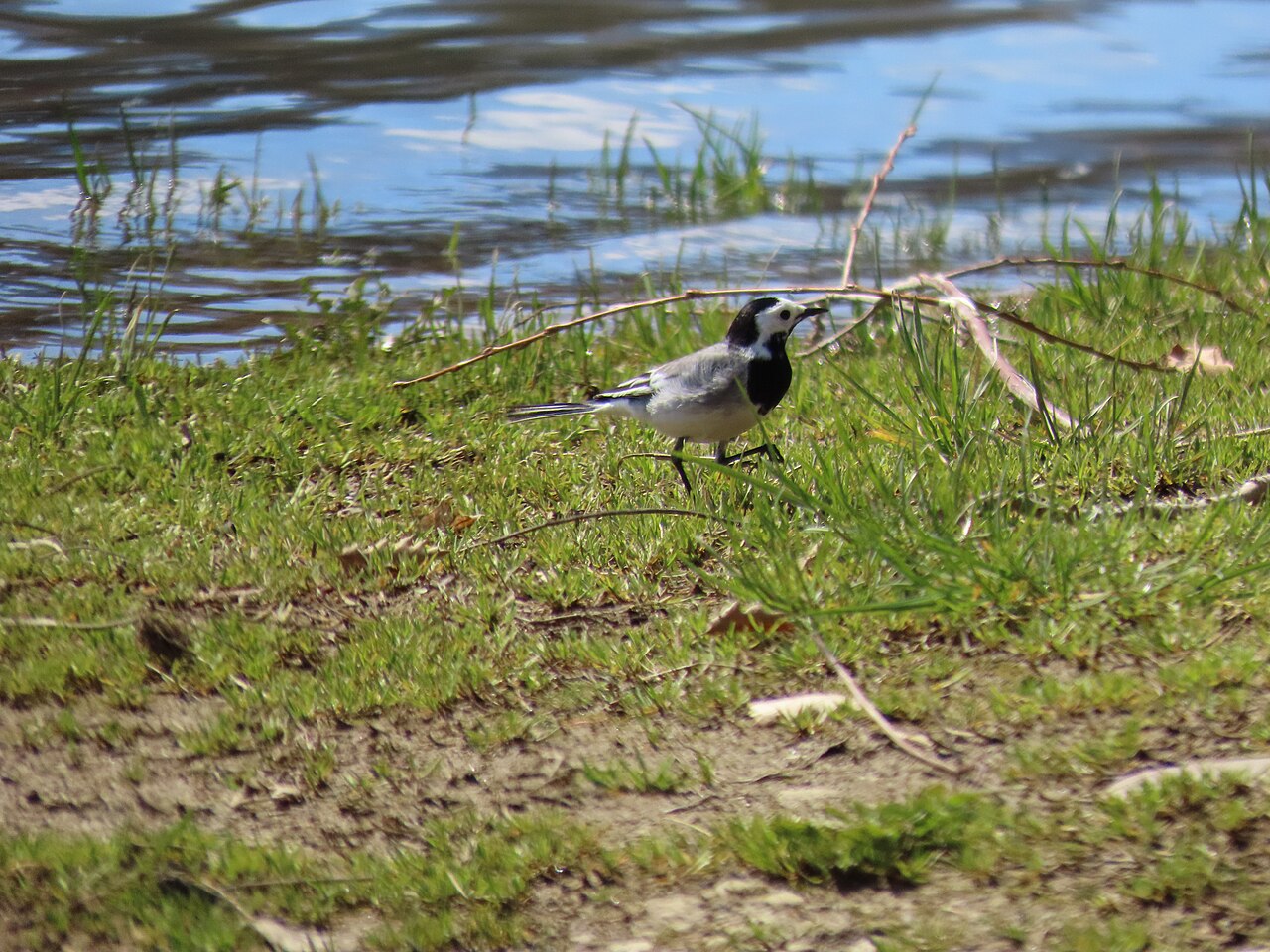
A slim wagtail of sixteen and a half to nineteen centimetres, nearly half of it tail: longer than in the yellow wagtails and moved up and down continually. The adult is grey on the mantle, white on belly and flanks, and black on crown, throat and breast, with a sharply bounded white face and forehead — a pattern that stands out at once in the field and contains no yellow at all. In winter the black of the throat shrinks to a crescent-shaped breast band. The wing is dark with two broad white bars and white fringes, the tail black with white outer feathers, and the legs are black. Young birds are grey-brown with a dirty white throat and a vaguely marked breast band. The flight is deeply undulating, the gait fast and restless, often along the waterline or across tarmac.
Confusion species
Within the genus, confusion in this part of the world is unlikely but not impossible. Grey Wagtail (Motacilla cinerea) has an even longer tail and grey upperparts, but always a vivid yellow undertail and yellow rump, and flesh-coloured legs. Eastern Yellow Wagtail (Motacilla tschutschensis) is olive and yellowish and has no black on throat or breast. Within the species itself there is a real problem: the birds that reach Australia and New Zealand may belong to different Asian subspecies — ocularis with a black eyestripe, leucopsis with an all-white face and black mantle, lugens with a black back — and those differences decide what origin a record is given. Finally the confusion of names with Willie Wagtail (Rhipidura leucophrys): also black and white and also tail-wagging, but a fantail that picks insects from the air off a perch and spreads a broad fanned tail.
Habitat
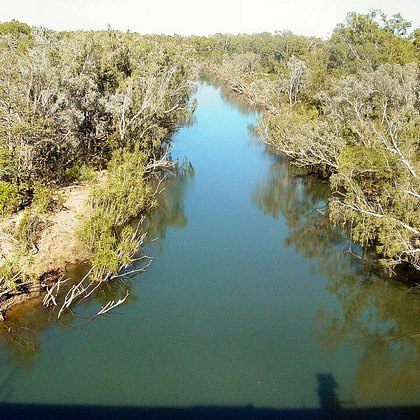
Bare, flat, open ground near water: river banks and shingle bars, mud edges and estuaries, the margins of sewage ponds and water storages, but in the normal range equally rooftops, car parks, farmyards, roads and lawns in the middle of towns. In Australia and New Zealand the few birds are almost always found on just such man-made bare surfaces: a harbour wharf, a sewage pond, a playing field or a remote airstrip.
Where the bird is most often found, arranged by main group and formation.


Range and movements
Breeds across nearly all of Europe, North Africa and Asia to Kamchatka and Alaska, in a series of strikingly different subspecies; the northern and eastern populations migrate to southern Asia and Africa. In Australia it is a rare vagrant, with a small number of accepted records, mainly along the north and west coasts and in the southern summer; in New Zealand likewise a vagrant with a handful of records. The birds that stray this far come from the eastern, Asian populations that normally winter in South-East Asia and overshoot.
- Breeding (summer)
- dark = core range, pale = thinly spread
Where and when to look
Do not count on meeting it by chance — a record in Australia is usually reported and the bird often stays on the same bare patch for days or weeks, so follow the rarity news. Once there, look beyond the black-and-white pattern to the subspecific features: does the bird have a black eyestripe, an all-white face, a grey or a black mantle? That is exactly what the records committee wants to know, and one good photograph will fix it.
Conservation
Least Concern (LC): the species is widespread and numerous across Europe, Asia and North Africa, adapts well to human surroundings and benefits from hard surfaces and from livestock. In Australia and New Zealand there is no population to protect; these are isolated vagrants. The value of such records lies chiefly in what they show about how far northern migrants can overshoot within a single season.
Scientific name
Motacilla alba | Linnaeus, 1758
Linnaeus described the species in 1758 with Sweden as the type country. Motacilla is the Latin word Varro used for this bird, formed on motare, to move to and fro; the ending was later wrongly taken for a diminutive of 'tail', which happens to describe the bird exactly. alba means white. The species has an unusually large number of subspecies differing strongly in head and back pattern, several of which have at times been treated as separate species; the birds reaching Australasia belong to the eastern forms, so that a vagrant here almost always brings a subspecific identification question with it.