All species › Waders, gulls and terns › Buttonquails › Red-chested Buttonquail
Red-chested Buttonquail | Turnix pyrrhothorax
Roodborstvechtkwartel | Torillo pechirrufo
The Red-chested Buttonquail is a small, thickset buttonquail of tall grass on heavier soils in eastern Australia, and the only one in which the rusty orange of the breast runs on across the belly. It is shy, wanders erratically, and in most years is recorded only because somewhere a bird bursts from the grass at someone's feet. As in all buttonquails the female is the larger and the brighter coloured: she calls, she wins the males, and she leaves the incubating and the rearing to them.
Voice
The calling sex is the female, and her voice is a deep, dull booming oom, slower and lower than that of Little Buttonquail, repeated at intervals of a few seconds and with a swelling carry that makes the bird impossible to locate. She calls mainly at dusk and at night, and most strongly in the breeding season after rain. A startled bird gives a short high squeak as it whirrs away; the male is all but silent.
No freely licensed recording has been found for this species yet; what to listen for is described below.
Identification
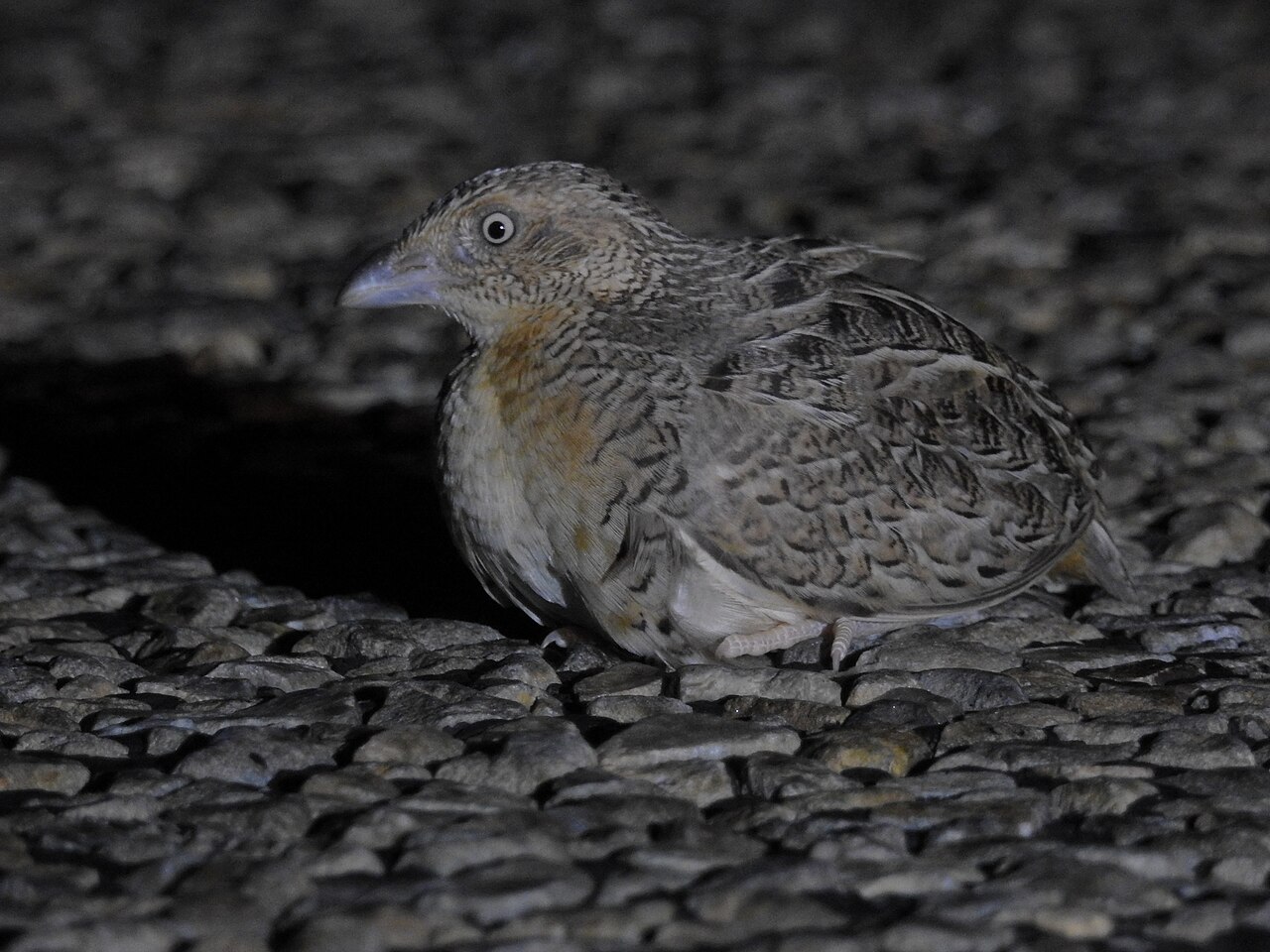
A small, rounded and very short-tailed ground bird of twelve to sixteen centimetres, with three toes: the hind toe is missing, which separates all buttonquails from the true quails. The decisive mark is the underside: face, throat, breast and belly are warm rusty orange to cinnamon-red, with no black spots on the flank and no white flank stripe. The upperparts are grey-brown, finely barred black and with pale scapular lines and white speckling on the wing coverts. Bill and legs are yellowish to pale horn, the eye pale cream-white. The sexual difference runs the other way round: the female is larger and far deeper rufous, the male smaller, paler and more buff — this reversed sexual dimorphism is unique among Australian birds to the buttonquails. In flight it is darker and more compact than Little Buttonquail, low and whirring, with the rufous of the underside showing.
Confusion species
Little Buttonquail (Turnix velox) is the standing confusion and locally shares the same ground: much paler and sandier, with a blue-grey bill and a sharp white flank stripe, and with a breast that is at most dull buff rather than rusty orange. Red-backed Buttonquail (T. maculosus) of the tropical north coast is the closest match, but has the orange confined to the breast, a grey face, clear black spots on the flanks and a bright yellow bill; the ranges barely overlap. Painted Buttonquail (T. varius) is larger, grey, with pearl-white drop spots and an orange-red eye, and sits in litter forest rather than grassland. Chestnut-backed Buttonquail (T. castanotus) carries its chestnut on the back rather than the belly, and occurs only in the tropical north-west. Watch too for Plains-wanderer (Pedionomus torquatus), which shares the same sparse grassland but is longer in leg and neck, has a hind toe, and flushes with dangling legs. Brown Quail (Synoicus ypsilophorus) is a true quail: larger, heavily streaked, with a hind toe and a loud two-note call.
Habitat
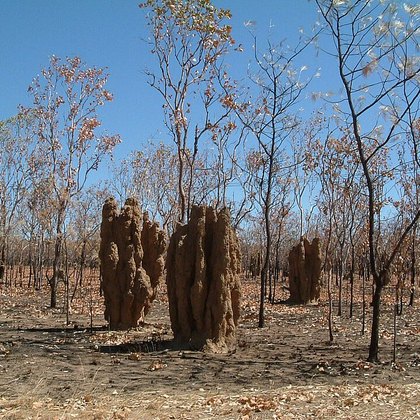
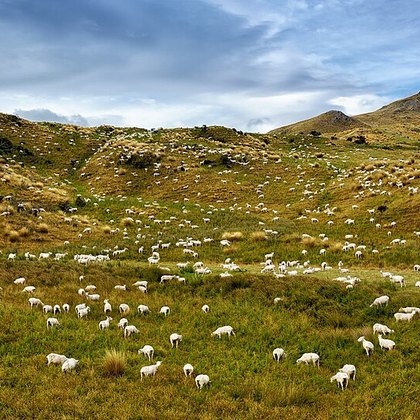
Tall, dense grass and herbage on heavier, somewhat damper soils: Mitchell grass and black-soil plains, grassy eucalypt savanna, the margins of creeks and small swamps, and rank strips along road and railway. It takes readily to cropland — stubble, sorghum, fallow blocks — and to dense pasture, provided the grass is tall enough to disappear into. Bare grazed country and open ground it avoids, and unlike Little Buttonquail it does not push into the driest desert.
Where the bird is most often found, arranged by main group and formation.


Range and movements
Mainly the eastern interior of Australia: from central and southern Queensland through inland New South Wales into northern Victoria, with scattered and irregular records west into the Northern Territory, South Australia and inland Western Australia. It is scarce and very local everywhere, and its occurrence shifts from year to year with the rain and with the growth of dense grass. In the south, particularly in Victoria, it has become distinctly rarer than it was a century ago. It does not reach New Zealand.
- Resident
- dark = core range, pale = thinly spread
Where and when to look
In the summer half-year after good rain, walk slowly through a strip of tall, uncut grass along a creek or a crop edge and be ready for a bird that flushes only at close range. In those few seconds look at the underside: rusty orange running on across the belly is decisive against Little Buttonquail, which shows a white flank stripe there. At a camp, listen at night for the female's low, slow booming, which betrays an inconspicuous species more often than the eye does.
Conservation
Least Concern (LC), on the basis of a large range and no evidence of rapid decline, but the status rests on thin data. The conversion of native grassland to cropping, heavy grazing that removes the tall grass, and too-frequent burning of grasslands all work against it, and in the south-east of its range it has become noticeably scarcer as a result. Feral cats and foxes weigh heavily on a bird that nests on the ground. Because it shows itself almost only by accident, and the female's voice is the one reliable mark at a distance, every trend estimate for this species stands on shaky ground.
Scientific name
Turnix pyrrhothorax | (Gould, 1841)
Gould described the bird in 1841 as Hemipodius pyrrhothorax; because it was later placed in another genus, author and year stand in parentheses. The genus Turnix was introduced by Bonnaterre in 1791 and is a shortening of Latin coturnix, 'quail'. pyrrhothorax is formed from Greek purrhos, 'flame-red', and thorax, 'breast', exactly the mark by which the species is settled in the field. The type locality lies in the interior of New South Wales.