All species › Waders, gulls and terns › Buttonquails › Black-breasted Buttonquail
Black-breasted Buttonquail | Turnix melanogaster
Zwartborstvechtkwartel | Torillo pechinegro
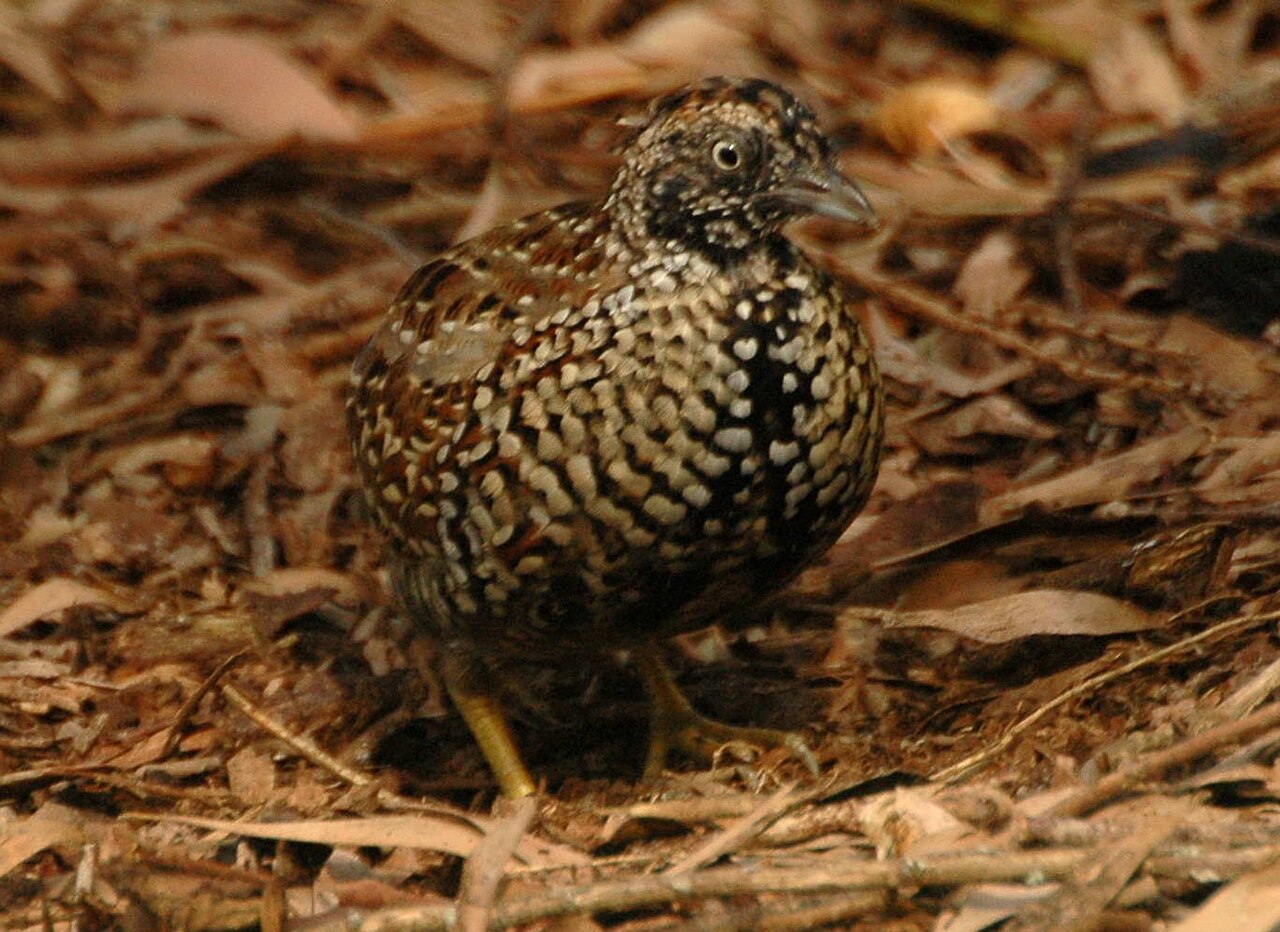
The Black-breasted Buttonquail is the largest and rarest buttonquail in Australia, a bird of dry rainforest and vine thicket in south-eastern Queensland. The female is unmistakable: head, throat and breast jet black with fine white speckling, a rufous back and a striking cream-white eye. Its habitat has been cut back to fragments, and that makes it the only member of its family here on the red list.
Voice
The calling sex is the female, and her voice is a heavy, low, hollow booming oom, deeper than in any other buttonquail, repeated at intervals of a few seconds and swelling slowly through a series; under a closed canopy it seems to come from everywhere. She calls mainly in the early morning and at dusk, and most between September and February. The male is all but silent; a startled bird makes nothing but a loudly whirring, short flight into the scrub.
No freely licensed recording has been found for this species yet; what to listen for is described below.
Identification
The largest Australian buttonquail, seventeen to twenty centimetres, heavily built, with three toes: the hind toe is missing, which separates all buttonquails from the true quails. The female has head, throat and breast deep black, densely strewn with fine white speckles, a warm chestnut mantle with black barring and white spots, a blue-grey bill, yellow-white legs and a bright cream-white eye that catches the light in the gloom of the forest. The male is far duller: head and breast grey-brown with pale spotting instead of black, and browner throughout. This reversed sexual dimorphism — the female larger, heavier and far brighter marked than the male — is unique among Australian birds to the buttonquails, and in this species is the most strongly developed of all: the female weighs about twice as much as the male.
Confusion species
Painted Buttonquail (Turnix varius) overlaps in range and habitat and is the only real confusion: smaller and slimmer, grey-brown instead of black on head and breast, with pearl-white drop spots across back and flanks and with an orange-red rather than cream-white eye. A male Black-breasted is dull enough to be taken for a Painted Buttonquail; eye colour then settles it. Red-chested Buttonquail (T. pyrrhothorax) and Little Buttonquail (T. velox) are both far smaller and belong in open grassland, not in closed litter-floored forest. Spotted Quail-thrush (Cinclosoma punctatum) shares the litter layer but is a songbird with a long tail and a hind toe; Brown Quail (Synoicus ypsilophorus) is a true quail, with a hind toe and without the black breast.
Habitat
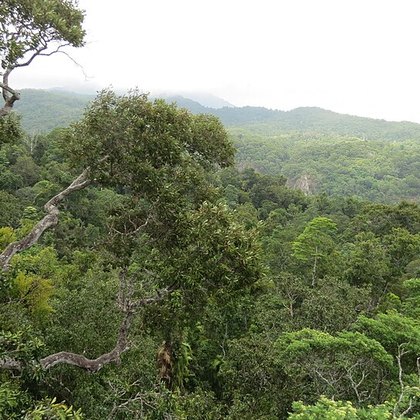
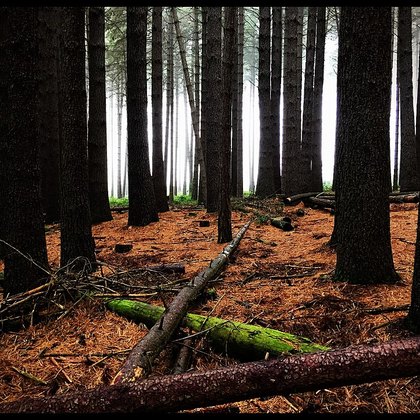
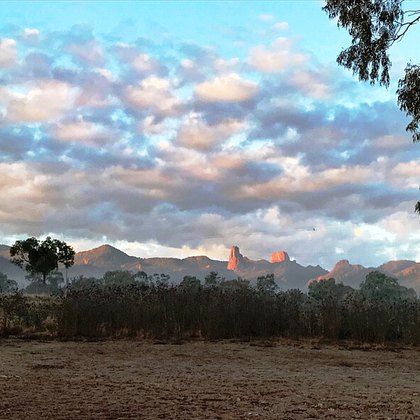
Dry rainforest, vine thicket and vine scrub with a deep, dry litter layer, and the margins where these grade into dry eucalypt forest. Also littoral rainforest on sand, dense lantana thickets and older hoop pine plantations, provided there is leaf litter to work in. What it wants is the litter layer and closed cover: forest without litter, or open, bare grazed forest, it does not use.
Where the bird is most often found, arranged by main group and formation.

Range and movements
A narrow band in south-eastern Queensland, roughly from the country around Byfield and the Great Sandy coast south to the far north-east of New South Wales. The best-known sites are Inskip Point, Cooloola, K'gari and the forests of Bulburin, Yarraman, Barakula and Widgee. Within that band occupancy is broken into separate patches of vine thicket, often of a few tens of hectares, between which the birds move only with difficulty. The species occurs nowhere outside Australia and does not reach New Zealand.
- Resident
- dark = core range, pale = thinly spread
Where and when to look
Here too, do not look for the bird but for its work: the round, bare platelets in the litter of a vine thicket are the best proof that the species is present, and fresh ones under dense scrub pinpoint the spot. Then sit on a fallen log at first light and wait rather than walk, because foraging birds are heard before they are seen. Inskip Point near Rainbow Beach has for decades been the best-known place where the species is seen with any regularity.
Conservation
Vulnerable (VU), and likewise listed as vulnerable under Australian environment law; estimates of the number of mature birds run from a few hundred to a few thousand, with a falling trend. The main cause is the loss of dry rainforest and vine thicket: that forest type stood on the best soils and has been largely cleared since the nineteenth century for cropping and grazing, so that only small, isolated patches remain. What is left suffers from fire pushing into the vine thicket, from cattle and feral pigs turning over and removing the litter layer, and from the grazing out of the understorey. On top of that comes predation by foxes, feral cats and dogs on a bird that does virtually everything at ground level. The counterweight is protection of the core populations at Inskip Point, in the Cooloola country and on K'gari, fire management that keeps the remaining patches unburnt, and the fact that the birds also use dense lantana and older hoop pine plantations, which suggests that replanting can help it.
Scientific name
Turnix melanogaster | (Gould, 1837)
Gould described the bird in 1837 as Hemipodius melanogaster; because it was later placed in another genus, author and year stand in parentheses. The genus Turnix was introduced by Bonnaterre in 1791 and is a shortening of Latin coturnix, 'quail'. melanogaster is formed from Greek melas, 'black', and gaster, 'belly'. The type locality is given as New South Wales, although virtually the whole present range lies in south-eastern Queensland and the species is now confined in New South Wales to the extreme north-eastern corner.