All species › Passerines › Fairywrens, grasswrens and emu-wrens › Superb Fairywren
Superb Fairywren | Malurus cyaneus
Ornaatelfje | Maluro soberbio
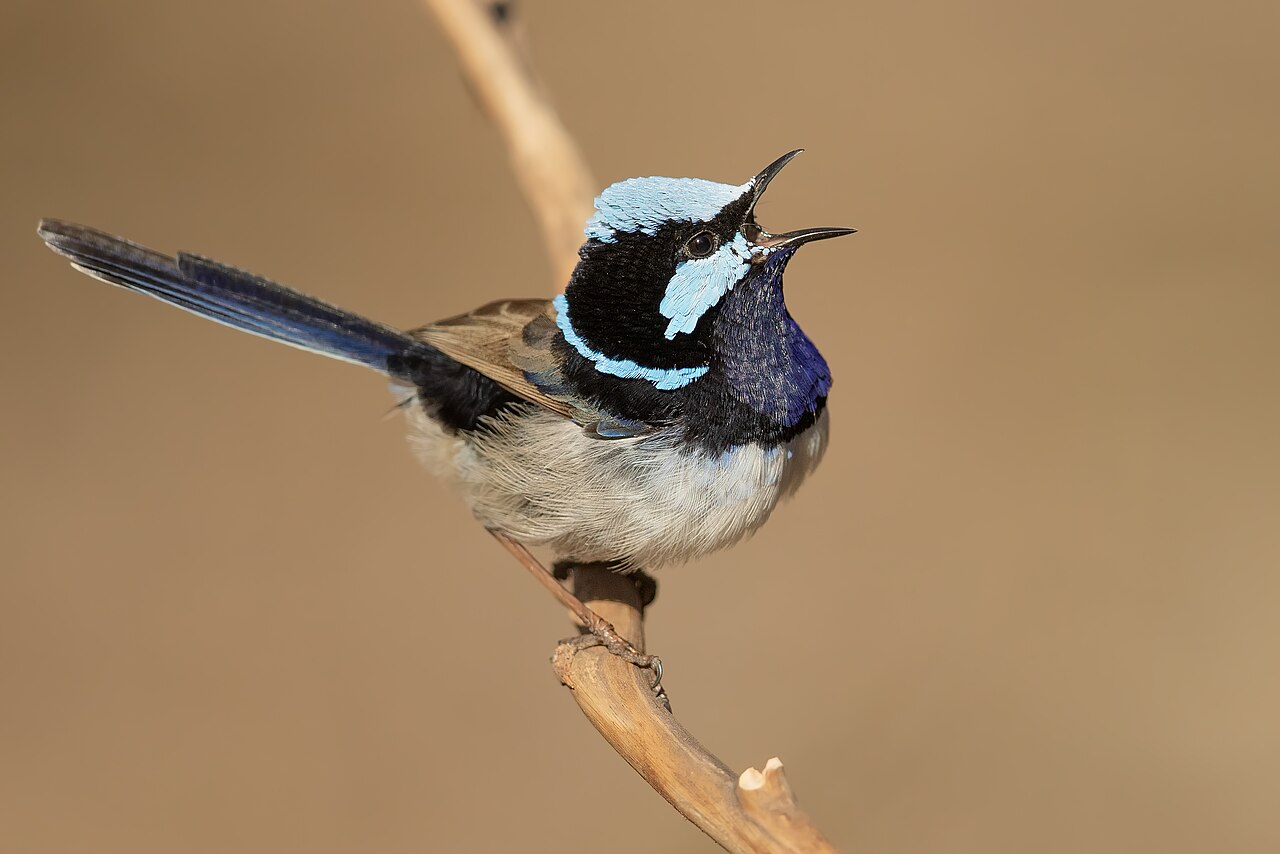
The Superb Fairywren is the best known of the nine fairywrens in this guide: a small, long-tailed bird that works through the lowest metre of cover in fixed groups, the male in cobalt blue and black. It is the easiest of them all to see, because it holds on into town gardens.
Voice
A high, fast trill that begins with sharp chip notes and runs into a sustained, even reeling song; both sexes give it. The contact note is a thin tsit, by which the birds follow one another in cover. In danger comes a fine, very high alarm call that is lost entirely in traffic noise.
No freely licensed recording has been found for this species yet; what to listen for is described below.
Identification
Thirteen to fourteen centimetres, of which nearly half is tail, usually carried cocked. The breeding male has a sky-blue crown, blue ear-tufts and a blue mantle, with black throat, black nape band and grey-white belly. The female is grey-brown above and off-white below, with a red-brown bill, lore and eye-ring. Outside the breeding season the male moults into an eclipse plumage resembling the female, but the bill stays black and the tail blue — this is where it goes wrong in the field.
Confusion species
Splendid Fairywren (Malurus splendens) lacks the grey-white belly: that male is blue underneath as well and has no black nape band. Red-backed Fairywren (Malurus melanocephalus) has a red back and black underparts and occurs further north. Females of all the fairywrens are closely alike and can often only be placed by company and district. A 'female' with a black bill and a blue tail is a male in eclipse.
Habitat
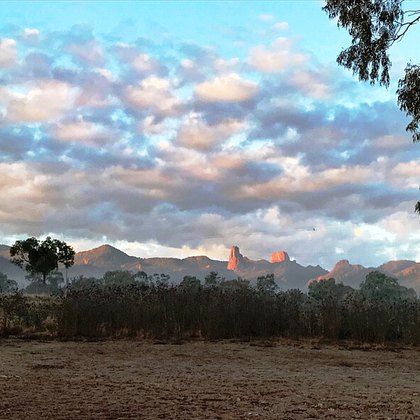
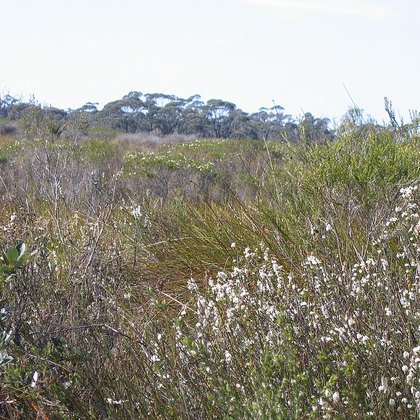
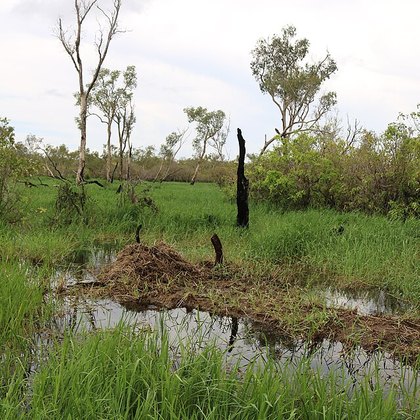
Dry eucalypt woodland with a dense shrub and herb layer, eastern heathland, rank growth along creeks and reed fringes. In towns and cities it holds on as long as there is a continuous low layer: a garden with shrub clumps and a hedge is enough, a lawn with scattered trees is not. It rarely crosses more than a few tens of metres of open ground.
Where the bird is most often found, arranged by main group and formation.



Range and movements
South-eastern Australia south of the Tropic of Capricorn: from south-eastern South Australia through Victoria and New South Wales into south-eastern Queensland, and throughout Tasmania. Resident in the strictest sense: a group defends a territory year-round that is sometimes no larger than half a hectare, and the birds stay there for life. In built-up country it has disappeared where the shrub layer was cleared, and returned where parks have been densely replanted.
- Resident
- dark = core range, pale = thinly spread
Where and when to look
Look low and look for movement: the group works along the lowest metre of a shrub edge and gives itself away by the reeling song and the cocked tails. In spring and summer, from September to January, a displaying male sometimes carries a yellow or purple petal in his bill to offer to a female. In the winter months of June and July, check bill and tail before writing a brown bird down as a female.
Conservation
Not threatened and common over almost all of its range. Cats and the introduced fox take birds out of low cover, and clearing the shrub layer in parks and gardens is the main local cause of disappearance. Where dense planting returns, the species returns with it within a few years.
Scientific name
Malurus cyaneus | (Ellis, 1782)
William Wade Ellis, surgeon's mate on Cook's third voyage, described the bird in 1782 as Motacilla cyanea, among the wagtails; because the species was later moved to another genus, author and year stand in parentheses. Vieillot introduced the genus Malurus in 1816, from Greek malos (soft) and oura (tail). cyaneus is Latin for 'dark blue'. The type locality is Adventure Bay in southern Tasmania, where Cook's ships lay at anchor in 1777.