All species › Passerines › Bowerbirds › Western Bowerbird
Western Bowerbird | Chlamydera guttata
Gevlekte prieelvogel | Pergolero moteado occidental
In the red gorges of central Australia this bowerbird raises its display structure: two walls of upright sticks with a walkway between them, and a collection laid out on either side of bones, snail shells, green fruits, glass and anything that glitters. The bower is not a nest — it is a stage, and the female comes to look and then leaves to nest alone elsewhere.
Voice
A hoarse, grating and hissing repertoire delivered at the bower: rattling hisses, hard clicks and a high grinding squeal. Between these the species is a first-rate mimic, taking off other birds of the gorges with startling accuracy, but also barking dogs, goats and the screams of raptors. The mimicry is loud and given from cover near the bower, so that the bird itself stays out of sight.
No freely licensed recording has been found for this species yet; what to listen for is described below.
Identification
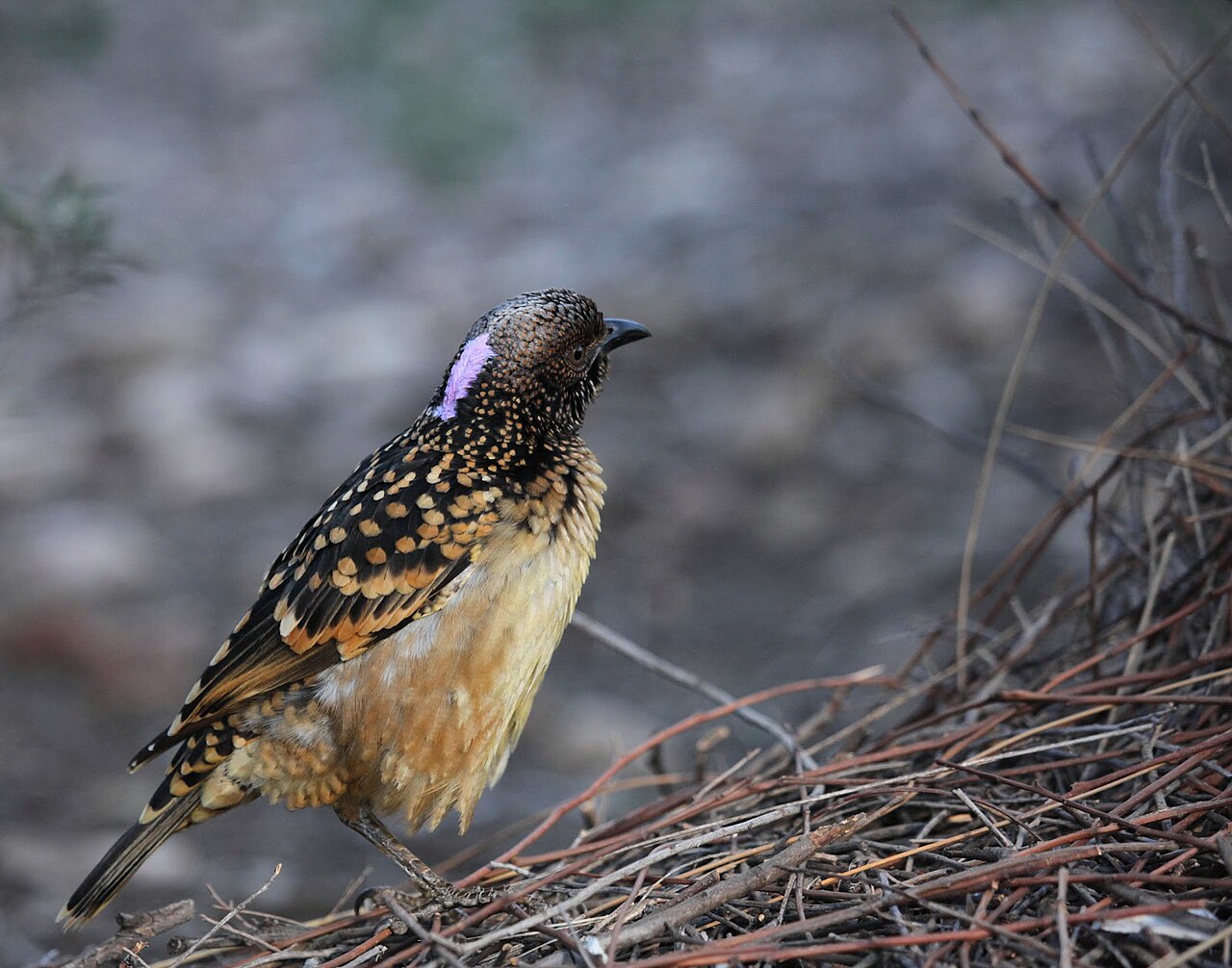
A grey-brown bird of 24 to 28 centimetres, thickly sown over the whole upperside with round, warm rufous to ochre spots that lie across mantle and wing coverts like roof tiles. The underparts are grey-buff with fine dark vermiculation; the crown is dark and spotted. On the nape, chiefly in males, lies a hidden collar of lilac-pink elongated feathers, raised only in display and otherwise lost under the grey. The bill is stout and dark, the tail square-cut. The sexes are closely similar; the female has a smaller nape crest or none.
Confusion species
The Spotted Bowerbird (Chlamydera maculata) is the nearest relative and looks much the same, but is larger and longer-tailed, paler and sandier, with larger and more buff-yellow spots and far less vermiculation below. Range decides it: this species holds the inland and western ranges, the Spotted Bowerbird the eastern interior, with a gap of hundreds of kilometres between them. The Great Bowerbird (Chlamydera nuchalis) of the north is much larger, far plainer grey and barely spotted. Female Satin Bowerbirds (Ptilonorhynchus violaceus) are green and do not occur here.
Habitat
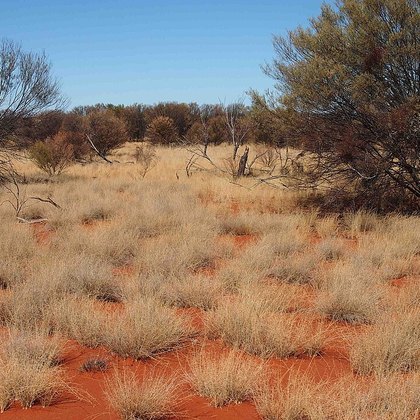
Rocky gorges, scarps and scree slopes with rock figs (Ficus), the core of the habitat, and from there the surrounding acacia shrubland and mulga, and the eucalypt woodland of dry creek beds. Water in a rock hole or permanent pool is nearly always near. In Alice Springs and on remote stations the bird reaches gardens, where it takes fruit from orchards and sets its bower in a windbreak.
Where the bird is most often found, arranged by main group and formation.



Range and movements
Two separate areas in the arid interior. In the centre of the continent the MacDonnell Ranges and the surrounding ranges of the Northern Territory and northern South Australia; and, a good thousand kilometres west, the Pilbara and the Gascoyne hinterland of Western Australia. Sand desert lies in between, where the species is absent. Sedentary: bower sites are fixed and used year after year.
- Resident
- dark = core range, pale = thinly spread
Where and when to look
Look for the bower, not the bird. Walk a gorge with figs and watch the ground beneath dense shrubs: a runway twenty to thirty centimetres long between two stick walls, with a pile of green berries, white bones and glass at the end. Sit down at a distance; the male returns almost every morning to rearrange. A run of odd, out-of-place bird calls one after another from the same bush is nearly always this species sitting and mimicking.
Conservation
Least Concern, but the range is naturally broken into islands: each inland range carries its own population, with unsuitable country in between. That leaves the bird exposed to whatever happens in a given gorge. The heaviest pressure comes from the replacement of the native understorey by buffel grass, which burns hotter than the native grasses and takes out the rock figs and the shrubbery in the gorges. Feral cats on the gorge floors are a second concern.
Scientific name
Chlamydera guttata | Gould, 1862
Gould described the species in 1862, with north-west Australia, probably the upper Fortescue River, as type locality; author and year stand without parentheses, as the genus has not changed since. Chlamydera is built from Greek chlamys, 'cloak', and dere, 'neck', after the collar of elongated nape feathers raised in display. guttata is Latin for 'drop-spotted', after the pattern of the upperparts, which the Dutch name follows; the English name points to the western range.