All species › Passerines › Fairywrens, grasswrens and emu-wrens › White-throated Grasswren
White-throated Grasswren | Amytornis woodwardi
Zwart-witte grassluiper | Maluro gorjiblanco
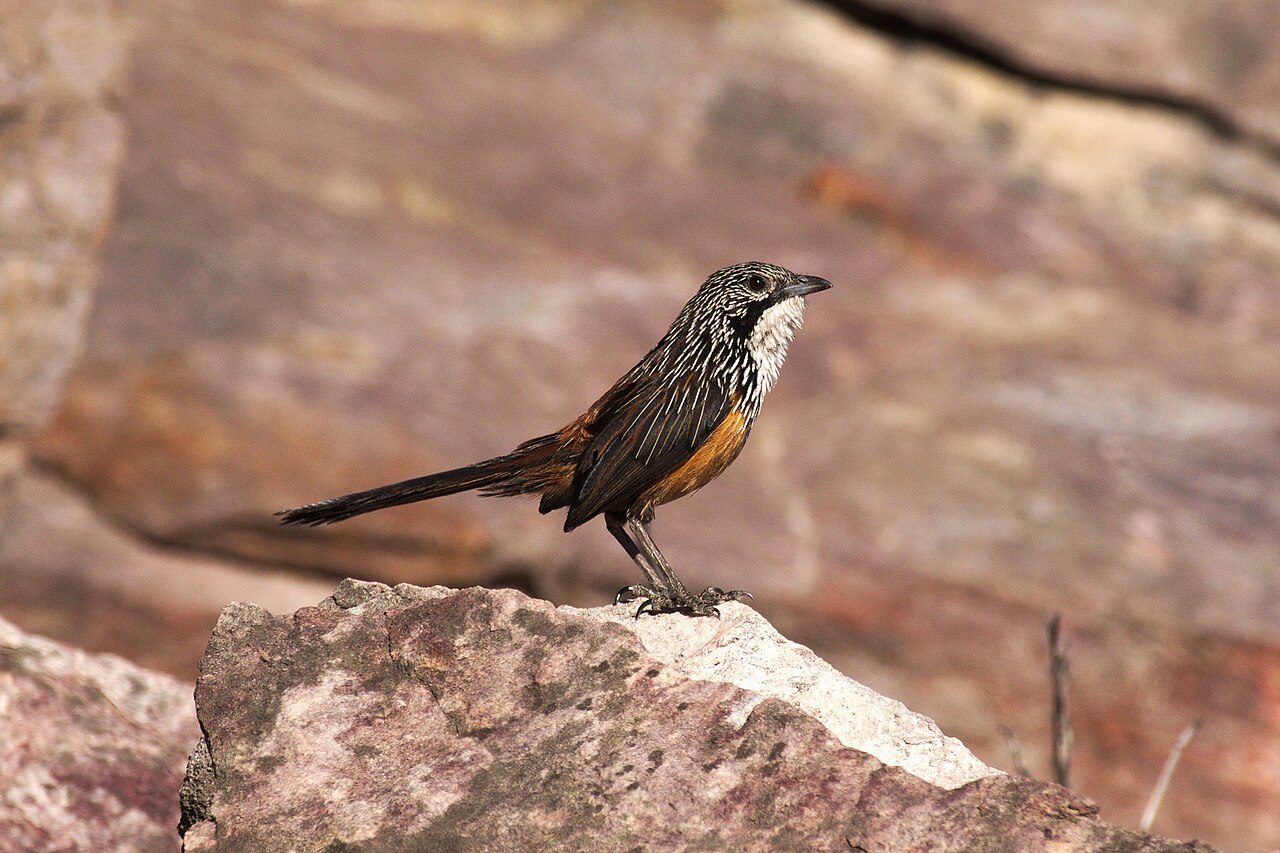
The White-throated Grasswren is the largest and most boldly marked of the grasswrens: a heavy, long-tailed bird with a black face, a snow-white throat and a blackish-brown, white-streaked back, living only on the sandstone plateau of Arnhem Land in the north of the Northern Territory. It is also the grasswren in the most trouble: it is listed as Endangered and has vanished from much of Kakadu.
Voice
Powerful and varied for a grasswren: a high, clear, trilling song that rings off the sandstone blocks and carries across a gorge. There are also sharp, metallic chink notes and a run of dry alarm ticks as the birds run off between the rocks. In the early morning they sing from a boulder or a bare rock ledge.
No freely licensed recording has been found for this species yet; what to listen for is described below.
Identification
Twenty to twenty-two centimetres and some thirty-five grams: bulky, with a very long tail often carried at an angle. The head is black around eye and lores, the throat and upper breast pure white and sharply bordered — the most conspicuous feature at a distance. The upperparts are dark blackish-brown with broad, obvious white shaft streaks, far coarser than in the small spinifex species. Belly and flanks are warm rufous. The legs are long and heavy; the bird hops and runs from block to block and hardly ever flies.
Confusion species
Within its range confusion is impossible: no other grasswren occurs on the Arnhem Land plateau. The nearest relative is the Carpentarian Grasswren (Amytornis dorotheae), a few hundred kilometres east in the sandstone around the Gulf of Carpentaria; it is clearly smaller and lighter, with less black in the face and finer, less contrasting streaking. The Black Grasswren (Amytornis housei) occupies comparable sandstone country but more than a thousand kilometres west, in the Kimberley, and is largely black with no white throat. The small spinifex species, such as the Striated Grasswren (Amytornis striatus), are much smaller, rufous and finely streaked, and do not occur here.
Habitat
Sandstone plateau and escarpment: fields of large loose blocks, scree slopes and gorge walls with old hummocks of spinifex (Triodia) between them. The bird needs both — the blocks for cover and lookout, the hummocks to forage and nest in. Where the spinifex between the blocks has burnt away it disappears, even though the rock is still there.
Where the bird is most often found, arranged by main group and formation.


Range and movements
Endemic to the sandstone plateau of western Arnhem Land, from the escarpment in Kakadu National Park across the Arnhem Land plateau to the country around Nitmiluk. The range is small and fragmented across separate plateaux and gorge systems. Resident, holding fixed territories, with no known migration or nomadism. Recent surveys failed to refind the species at many former sites in Kakadu.
- Winter
- dark = core range, pale = thinly spread
Where and when to look
In the first hour after sunrise, search the edge of a boulder field where the spinifex between the rocks stands tall and closed, and listen for the clear song ringing off the rock. The birds walk over the tops of the blocks and vanish into a crevice at any disturbance; sit down and wait quietly. Ground burnt in the last dry season can be skipped.
Conservation
Endangered. The species has declined steeply in a short time; repeated surveys in Kakadu National Park produced no records at many historical sites. The cause is sought above all in the changed fire regime: the traditional small-scale, cool early-season burning by Aboriginal owners has over much of the plateau been replaced by extensive, hot fires late in the dry season, which remove the old spinifex hummocks between the blocks in one go. Feral cats, which hunt easily in freshly burnt ground, compound the effect. Restoring small-scale early burning, carried out by the traditional owners themselves, is the key measure.
Scientific name
Amytornis woodwardi | Hartert, 1905
Ernst Hartert described the bird in 1905 from a specimen from the South Alligator River in the Northern Territory. The epithet woodwardi honours Bernard Henry Woodward, the first director of the Western Australian Museum. The genus was first called Amytis, after a Persian noblewoman; because that name was already taken, Leonhard Stejneger proposed Amytornis in 1885, adding the Greek ornis (bird). The Dutch name describes the contrast of black face and white throat; the English name mentions only the throat.