All species › Passerines › Old World buntings › Yellowhammer
Yellowhammer | Emberiza citrinella
Geelgors | Escribano cerillo
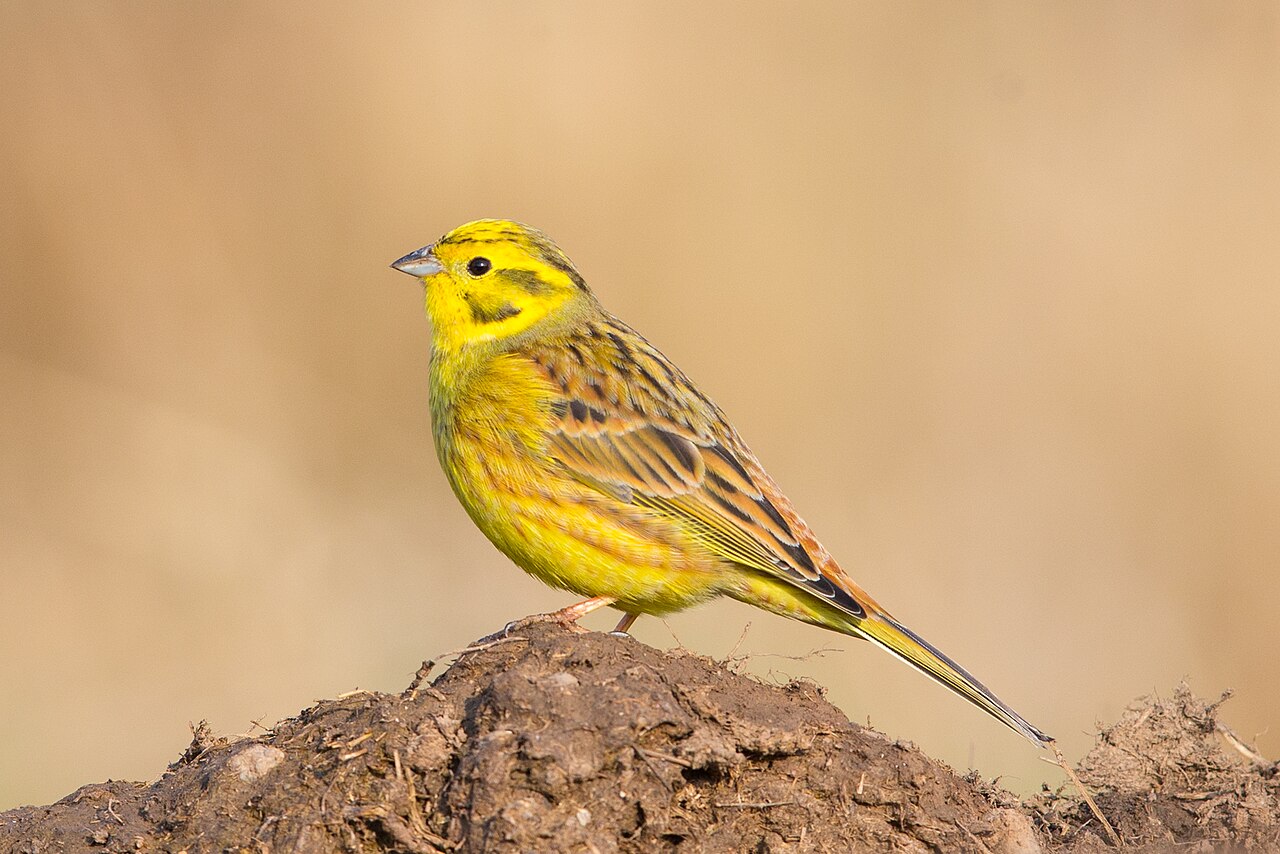
The Yellowhammer is a slim, long-tailed bunting whose male has an almost lemon-yellow head and underparts set against a cinnamon-brown rump. It sings from the top of a hedge or a wire right through the spring, with a thin, persistent little phrase that everyone in Europe knows. In New Zealand it is a nineteenth-century introduction that has done very well on farmland — there the Yellowhammer belongs with the gorse and the broom, not with the native fauna.
Voice
The song is a run of six to eight rapidly repeated thin ticking notes that accelerate and end in one drawn-out note, either higher or lower — the classic English mnemonic is 'a little bit of bread and no cheeeese'. The male sings from a conspicuous perch, often going on late into the summer when most other birds have fallen silent, and on hot afternoons singing alone. The call is a short, sharp, metallic tsik or twick, and in flight a thin brief tsrreep. In New Zealand this is one of the few bird sounds of open farmland that is European in origin.
No freely licensed recording has been found for this species yet; what to listen for is described below.
Identification
A slender bunting of sixteen to seventeen centimetres, a good part of it tail: that tail is long, narrow and notched, and shows white outer feathers as the bird takes off. The breeding male has a bright lemon-yellow head with fine olive streaking over crown and ear coverts, a yellow throat and breast, chestnut streaking on the flanks and a warm, unstreaked cinnamon-brown rump — the last of these shows in every plumage and is the most reliable feature of all. The mantle is rufous-brown with black streaks. Females and winter birds are far duller and more heavily streaked, with only a faint yellow wash on head and belly, but keep the rusty rump. The bill is short, conical and two-toned, with a greyish upper and a paler lower mandible. Outside the breeding season it feeds in flocks on the ground, among stubble and along ditch banks.
Confusion species
Cirl Bunting (Emberiza cirlus), also introduced to New Zealand and locally present there, is the one real trap: the male has a black throat and a black eyestripe that the Yellowhammer lacks and — decisive in every plumage, females and young included — a grey-green rather than cinnamon rump. European Goldfinch (Carduelis carduelis) and European Greenfinch (Chloris chloris), also European introductions, share the farmland but have a much shorter forked tail and an entirely different head pattern; the greenfinch is besides bulky, olive-green and yellow-winged. Female House Sparrow (Passer domesticus) is shorter-tailed, lacks any yellow wash and has a plain brown rump with no rust in it.
Habitat
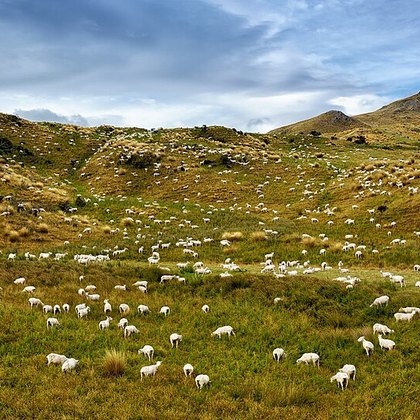
Half-open farmland with upstanding edges: hedges, shelterbelts, ditch banks, gorse and broom scrub, young plantings, field margins and rough grassland with scattered bushes, and in New Zealand also manuka and matagouri scrub along paddocks. It needs two things: seed-rich open ground to feed on and a raised song post. In winter it moves to stubble fields, stock-feed stores and farmyards, joining mixed seed-eating flocks, and then appears in gardens as well.
Where the bird is most often found, arranged by main group and formation.



Range and movements
Originally a bird of nearly all Europe and western Asia into Siberia. In New Zealand it is now widespread and common across both main islands, from the coast into the high country, and also on the Chathams and several outlying islands; it is locally one of the most numerous songbirds of open farmland there. It is not established in Australia — in this guide the species figures only as a New Zealand introduction. Its New Zealand range went on expanding after the first releases until all suitable farmland was occupied.
- Resident
- dark = core range, pale = thinly spread
Where and when to look
Drive a New Zealand farm road with hedges or gorse and work the topmost twig of every bush: the Yellowhammer sings high and in the open and sits for a long time. If you are torn between this species and Cirl Bunting, wait for the bird to fly and look at the rump — warm cinnamon makes it Yellowhammer, grey-green makes it Cirl. This works as well on females and winter birds as on a singing male.
Conservation
Least Concern (LC) globally, but again with opposite trends in the two halves of the range. In north-western Europe, and above all in Britain, the species has declined steeply since the 1980s through the loss of winter stubble and weedy field margins, which collapsed the winter food supply; it is red-listed there among farmland birds. In New Zealand the reverse happened: it is common, unprotected as an introduced species, and in the decades after introduction was actively persecuted as a grain pest. It is not regarded as a serious threat to native New Zealand birds, because it occupies chiefly the man-made farmland.
Scientific name
Emberiza citrinella | Linnaeus, 1758
Linnaeus described the species in 1758, with Sweden as the type country. Emberiza comes from Old High German embritz, a bunting; citrinella is a diminutive of Latin citrinus, lemon-yellow, by way of Italian citrinella. The English name Yellowhammer has nothing to do with a hammer but derives from Old English amore or ammer, which likewise means bunting. In New Zealand the bird was released between about 1862 and 1871 by the acclimatisation societies of Nelson, Canterbury, Otago and others, which imported European songbirds out of homesickness and in the expectation that they would clear caterpillars and other pests. That expectation went wrong: the Yellowhammer proved mainly a seed-eater, was regarded within twenty years as a grain pest, and bounties were even paid on it.