All species › Passerines › Old World buntings › Cirl Bunting
Cirl Bunting | Emberiza cirlus
Cirlgors | Escribano soteño
The Cirl Bunting is the strangest case among New Zealand's released European birds: small numbers arrived from Britain between 1871 and 1880 and have held on ever since — while in that same England the species all but vanished a century later, down to a hundred and eighteen pairs in south Devon by 1989. The dry east of the South Island suited it better than the country it came from.
Voice
The song is a dry, rattling trill on one pitch, two to three seconds long and repeated up to nine times a minute from a wire, a fence post or the top of a matagouri bush. It resembles a section of a Greenfinch's song but is shorter and harder. There is also a high, thin contact note, and in border disputes a loud chattering rattle. In summer, December to February, the male sings all day through the heat, when almost everything else is silent.
Recording: Sonothèque ADVL — CC0 · Cabane Vauban (Carolles), Manche, Normandie, France · xeno-canto
Identification
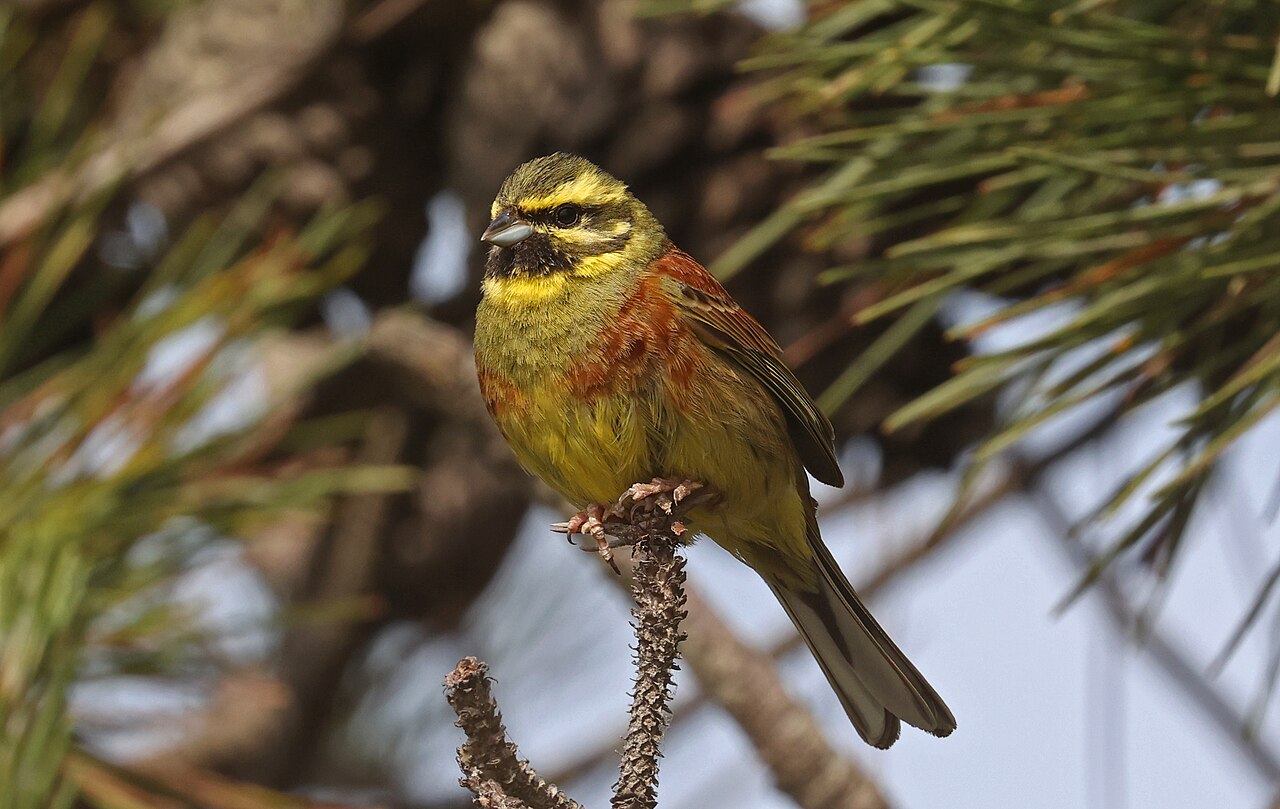
A slim bunting of fifteen to sixteen and a half centimetres, with a long tail and a conical bill. The male has a black eye stripe with a yellow band above and below it, a black throat patch with a yellow band beneath, and below that again an olive-green breast band; the flanks are streaked chestnut. Female and young birds are brown and streaked all year and carry a horseshoe-shaped mark on the ear coverts. In every plumage the rump is olive-green, not rufous.
Confusion species
Yellowhammer (Emberiza citrinella) is the only real confusion and shares the same country: the male is far yellower on head and underparts and lacks the black throat, and in every plumage the rump is warm rufous rather than olive-green — on a departing bird that is the quickest mark. A female Chaffinch (Fringilla coelebs) shows two white wing bars, which no bunting has. A female House Sparrow (Passer domesticus) is shorter-tailed and heavier-billed.
Habitat
Dry, open pastoral country with scattered trees, hedgerows and patches of scrub, where stock keeps the grass short: lower slopes, gullies and river terraces. Matagouri and broom scrub, vineyard and orchard belong to the picture too. It wants seed on the ground, a bush to nest in and a high song post — a combination the Awatere country in Marlborough supplies in abundance.
Where the bird is most often found, arranged by main group and formation.



Range and movements
Almost confined to the low-rainfall districts of the eastern South Island: from the Marlborough Sounds south to Kaikoura, commonest in the Awatere Valley, and scattered through Canterbury, Nelson, North Otago and Central Otago. The estimate runs to two to five thousand birds. On the North Island it is rare, with a breeding population near Wellington since 1991. It does not occur in Australia.
- Resident
- Winter
- dark = core range, pale = thinly spread
Where and when to look
In summer drive a gravel road through grazed hill country in Marlborough or North Canterbury and stop at every wire with a singing bird; the rattling trill carries far in the afternoon heat and is often the only sound going. On any bunting that flies up, look at the rump: olive-green is Cirl, rufous is Yellowhammer. That works on the brown females too.
Conservation
Least Concern (LC) and established in New Zealand as an introduced bird, with a population too small to do economic or ecological damage; no cases are on record. The contrast with home is sharp: in England the species declined from the 1930s to a hundred and eighteen pairs by 1989, all in south Devon, after which targeted management of stubble and hedgerows brought it back to some seven hundred pairs by 2003. The released birds on the other side of the world never needed any of it.
Scientific name
Emberiza cirlus | Linnaeus, 1766
Linnaeus described the species in 1766 as Emberiza cirlus and it has stayed in that genus, so author and year carry no parentheses. Emberiza comes from Old High German Embritz, 'a bunting', and was introduced by Linnaeus in 1758. cirlus goes back to Italian cirlo, a local name for a bunting, from zirlare, 'to chirp' or 'to whistle' — the name is formed after the sound, and both the English cirl and the Dutch cirlgors descend from it.