All species › Passerines › Finches, euphonias and allies › Akiapolaau
Akiapolaau | Hemignathus wilsoni
Akiapolaau | Akiapolaau
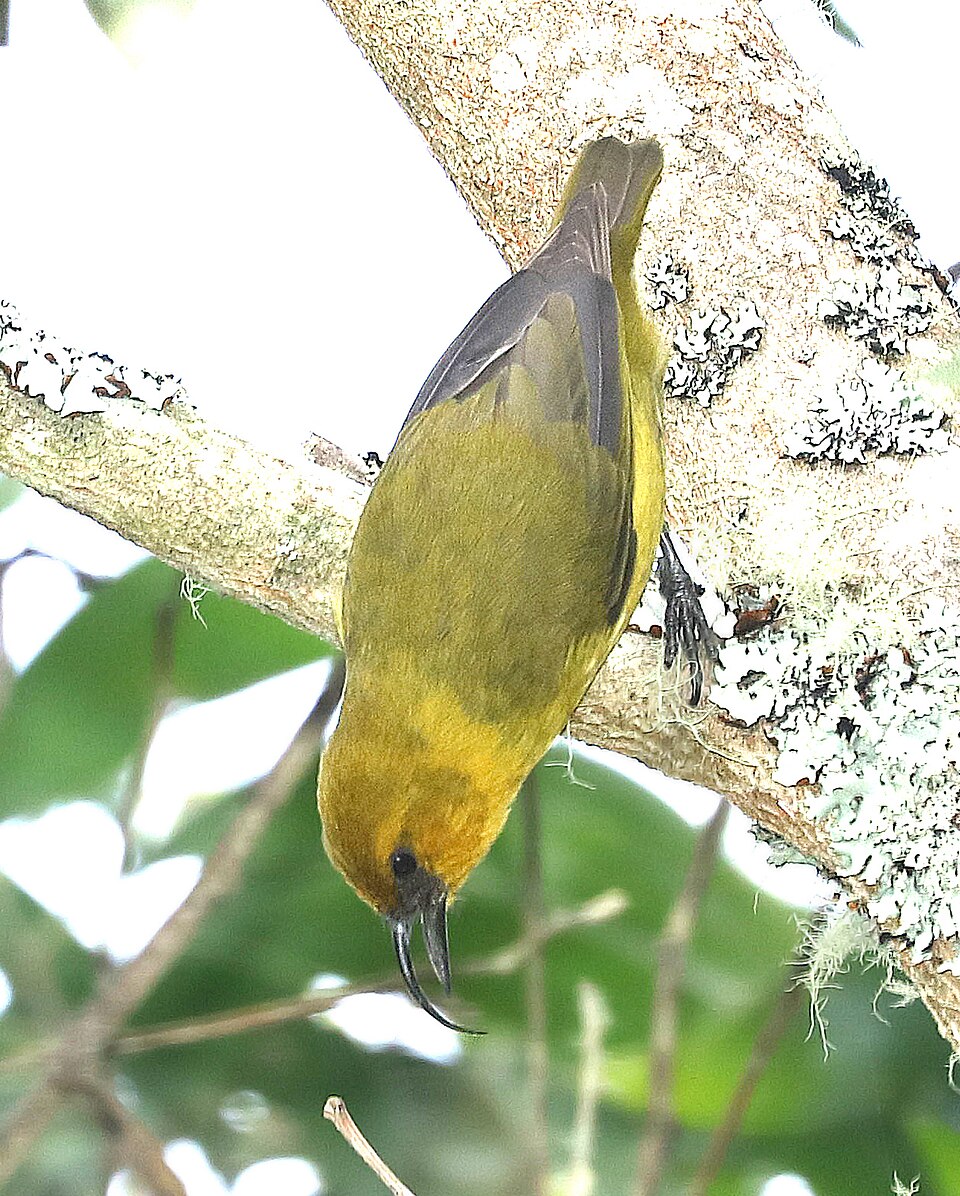
The Akiapolaau has the most unequal bill of any bird: a long, strongly curved upper mandible above a short, straight, chisel-shaped lower one. It hammers holes in the bark with the lower half and picks the larvae out with the upper, a method that fills the role of a woodpecker on Hawaii Island.
Voice
The male sings a loud, short pit-er-ieu or a rapid, rolling warba-warba that carries far through koa forest. There are also an upslurred whistle, a short warble sounding like cheedle-ee and a single clear sweet. Here too the tapping in wood often reveals the bird before the voice does.
No freely licensed recording has been found for this species yet; what to listen for is described below.
Identification
A stocky honeycreeper with an orange-yellow head and breast, a yellow-green back and a pale, dingy white belly and tail; the legs are black. The bill is unmistakable: the upper half is about twice the length of the lower and curves down in an arc, while the lower stays straight and blunt and is set against the bark when hammering. Females and young birds are greener and less orange on the head, with a shorter bill.
Confusion species
The Hawaii Amakihi shares the forest and is yellow-green, but smaller and with a short, evenly curved bill of two equal halves. Hawaii Creeper and Akepa are smaller, plainer and have a straight or slightly curved short bill. The Maui Parrotbill also has unequal mandibles, but a short heavy hooked bill, and occurs only on Maui. The introduced Warbling White-eye has a white eyering.
Habitat
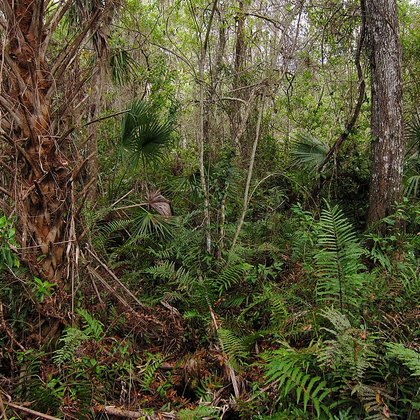
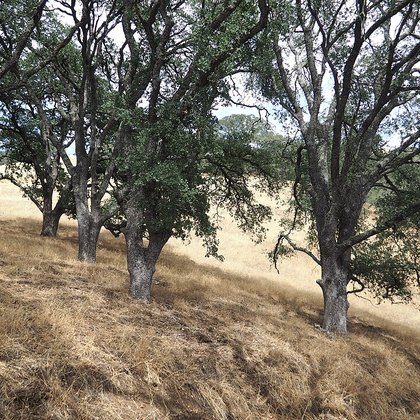
Old, undisturbed mesic and wet montane forest of koa and ohia lehua between roughly 1300 and 2100 metres, where mosquitoes are not yet permanently present. Old koa trees with dead wood supply the food: beetle and moth larvae from trunk, branches and twigs. Planted or young stands without dead wood are avoided; adjoining open koa parkland is used as long as old trees remain.
Where the bird is most often found, arranged by the USNVC — the vegetation classification of the United States and Canada — and CMECS for sea and coast.
Range and movements
Endemic to Hawaii Island, in a few separate remnant populations: the largest in the Hamakua forest and Hakalau Forest National Wildlife Refuge on the eastern flank of Mauna Kea, others in the Kau district on the southern flank of Mauna Loa and in a small area near Kona. The population on the upper slopes of Mauna Kea, in mamane-naio woodland, was lost around 2002. Some of the remaining cores hold only a few dozen birds, against a total of roughly one to two thousand.
- Resident
- Passage
- dark = core range, pale = thinly spread
Where and when to look
The best chance is Hakalau Forest, open only by arrangement or with a guide, and the public section of the Puu Oo Trail off the Saddle Road. Search old koa trees for a bird tapping a dead branch in short bursts and then falling silent; on perched birds the curved upper mandible projects like a thin hook beyond the tip of the lower.
Conservation
The species is listed as Endangered and has been federally protected since 1967. Numbers are falling and the range is fragmented; the low reproductive rate, usually a single chick per brood and a long period of dependence, makes recovery slow. Avian malaria and avian pox are the main pressures and move upslope as the climate warms; old koa forest has also been much reduced by grazing, and introduced rats and cats are predators. Fencing out livestock and replanting koa at Hakalau have brought back forest locally.
Scientific name
Hemignathus wilsoni | (Rothschild, 1893)
Walter Rothschild described the species in 1893 as Heterorhynchus wilsoni; because it was later moved to another genus, author and year stand in parentheses. The genus Hemignathus is from Greek hemi 'half' and gnathos 'jaw', after the unequal mandibles. The species name wilsoni honours Scott Barchard Wilson, the British ornithologist who described the birds of Hawaii. The Hawaiian name akiapolaau contains aki 'to nip, to bite'. The type locality is given as Maui, where the species does not occur; the origin of the type is therefore uncertain.