All species › Passerines › Finches, euphonias and allies › ʻAnianiau
ʻAnianiau | Magumma parva
ʻAnianiau | ʻAnianiau
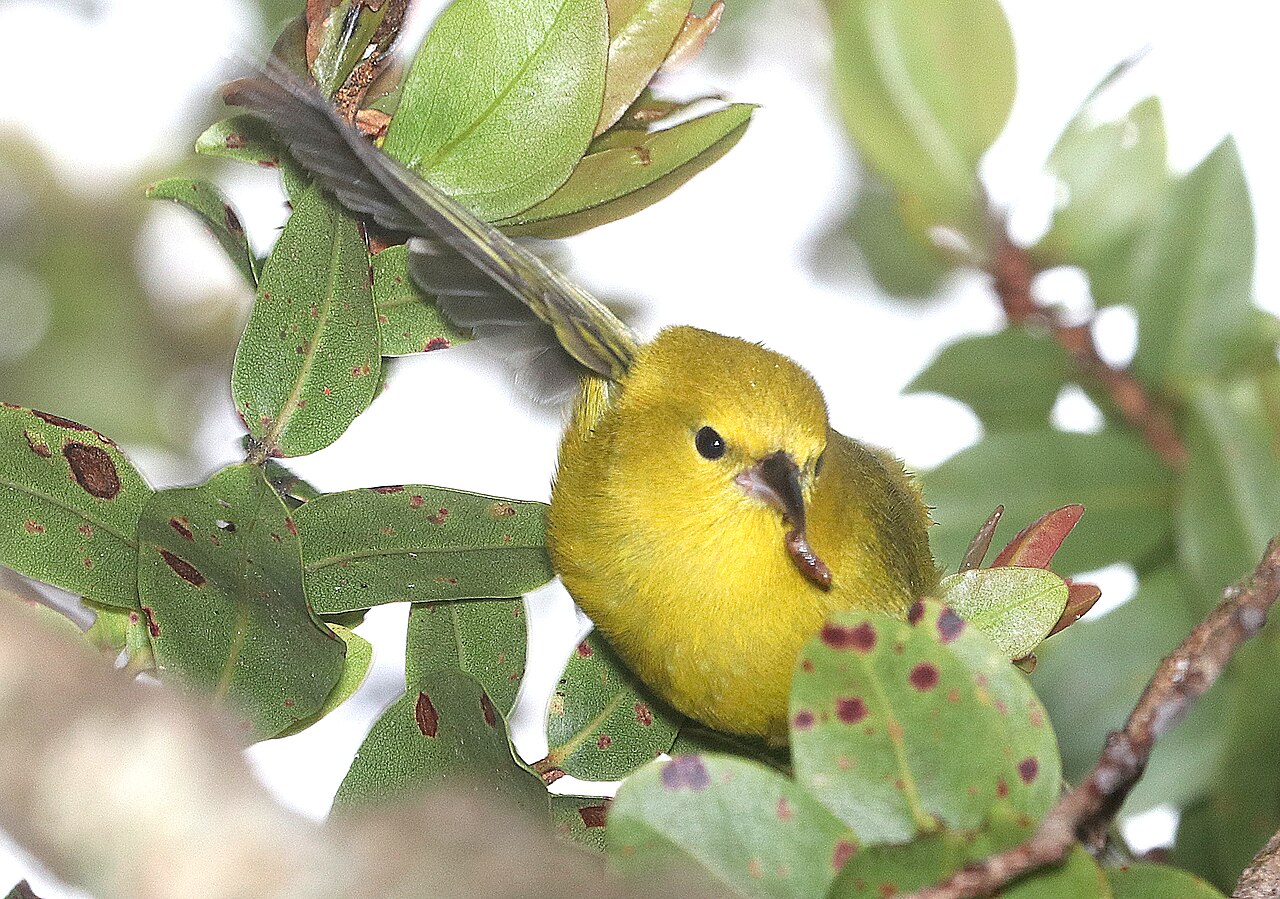
At ten centimetres the ʻAnianiau is the smallest Hawaiian honeycreeper: a lightly built, bright yellow bird of the montane forest of Kauaʻi. It occurs on that island alone and has roughly halved in number within five years.
Voice
The call is a pair of notes sounding like tew-weet. The song is a short trill of repeated couplets, wee-see, wee-see, wee-see, high and thin and without the rasping notes of the ʻApapane. The voice is weak and does not carry far, especially in wind in the forest.
Recording: Daniel Lane — CC BY-NC-SA 3.0 · Alaka'i Swamp trail, Kaua'i, Hawaii , United States · xeno-canto
Identification
A small, round-headed bird with a short, slightly curved bill and a short tail. The male is bright yellow above and below, a little greener on back and wings; the female is duller and more evenly yellow-green. The eyes are dark and there is no eyering or loral stripe. It moves quickly and restlessly through the outer branches and often hangs upside down at flowers.
Confusion species
The Kauaʻi ʻAmakihi shares the forest, is larger, duller yellow-green and has a distinctly longer, more curved bill with a dark loral patch. The ʻAkekeʻe is greyer green with a blue-grey bill whose tips cross. The introduced Warbling White-eye is likewise small and yellow-green, but has a white eyering and a straight, pointed bill. ʻIʻiwi and ʻApapane are red and much larger.
Habitat
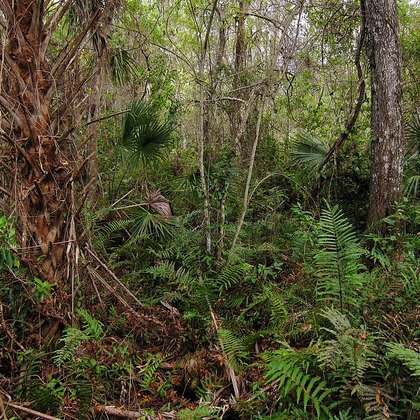
Wet and mesic montane forest above about 600 metres, with the highest densities above 1100 metres, in stands of ohia lehua, koa (Acacia koa, a native Hawaiian tree), olapa and lapalapa. It takes nectar, small insects and spiders and forages in the outer fine twigs and in the herb layer. Lower and degraded forest is no longer occupied.
Where the bird is most often found, arranged by the USNVC — the vegetation classification of the United States and Canada — and CMECS for sea and coast.
Range and movements
Endemic to Kauaʻi, where the range is now virtually confined to the Alakai plateau and the adjoining high forests of Kokee and Waimea Canyon. Historically the species occurred throughout the forested part of the island; the area occupied has shrunk by roughly eighty-five per cent, and contracted again between 2018 and 2023 from about 11,400 to 4,300 hectares. The birds do not migrate but move locally with the flowering.
- Resident
Where and when to look
The Pihea Trail and the Alakai Swamp Trail at Kokee State Park give the best chance, preferably early and in light wind. Search the canopy for a small, plain yellow bird without an eyering, moving faster and more restlessly than the ʻamakihi beside it; against the light the short bill is the most usable feature.
Conservation
The species is listed as Endangered (EN). Surveys on Kauaʻi gave about 7,500 birds in 2018 and about 3,800 in 2023, a halving within five years. The cause is avian malaria: no forest on Kauaʻi now lies high enough to stay mosquito-free, so the last refuge on the Alakai plateau has been lost. Damage to the forest by pigs and invasive plants and predation by rats add to this. If the decline continues unchanged, models put the population below a threshold of thirty birds after 2050. Mosquito suppression using the Wolbachia method is in preparation on Kauaʻi.
Scientific name
Magumma parva | (Stejneger, 1887)
Leonhard Stejneger described the species in 1887 as Himatione parva; because it was later moved to another genus, author and year stand in parentheses. The species name parva is Latin for 'small' and refers to the size, the smallest in the family. The genus Magumma was introduced by Gregory Mathews, who gave no explanation of the name; before that the species was placed in Hemignathus, Himatione and Viridonia. The Hawaiian name ʻanianiau is the traditional name on Kauaʻi. The specimen described came from Kauaʻi.