All species › Waders, gulls and terns › Stilts and avocets › American Avocet
American Avocet | Recurvirostra americana
Amerikaanse kluut | Avoceta americana
The American Avocet can be named at a distance: patterned black and white, on long blue-grey legs, with a thin black bill that curves upward like a sabre. In the breeding season head and neck turn warm rusty orange; in winter nothing of that is left. It breeds by the salt lakes and rain pools of the interior and winters in thousands on the mudflats and salt pans of the coast.

Voice
The call is a loud, nasal wheet with a complaining undertone, repeated every few seconds. Approach the nest and that call grows faster, higher and more insistent, and the neighbours take it up until the same sound hangs over the whole pool. The birds call on the move as well, so that a passing flock is often heard before it is seen. At the nest and during display there are soft, short clicks audible only from close by.
Recording: Jonathon Jongsma — CC BY-SA 3.0 · Palo Alto Baylands, Santa Clara, California, United States · xeno-canto
Identification
A large, slender shorebird with a proportionately long neck, long blue-grey legs and a thin, black, clearly upturned bill. The plumage is sharply black and white: two broad black bands run across the back, the upperwing is black with a large white patch, and the rest of the body is white. In breeding plumage head, neck and breast are warm rusty orange; outside the breeding season these become plain white with a grey wash over crown and nape. The female is known by a shorter bill that curves up more strongly and more abruptly than the male's, which is longer and more evenly curved. In flight the legs project well beyond the tail and the black-and-white wing pattern shows at a great distance.
Confusion species
Black-necked Stilt (Himantopus mexicanus) often stands in the same pool: black above and white below, with a dead straight needle of a bill and preposterously long pink legs. Pied Avocet (Recurvirostra avosetta) of Europe, recorded once or twice as a vagrant on the east coast, has a white neck with a black cap in every plumage and never turns rusty. A flock of Marbled Godwits (Limosa fedoa) can pass for avocets at a distance in winter, but the godwit is warm brown, has a much thicker two-toned bill and lacks the black and white in the wing. If in doubt, wait until the birds take off: no other shorebird of the area has that wing pattern.
Habitat
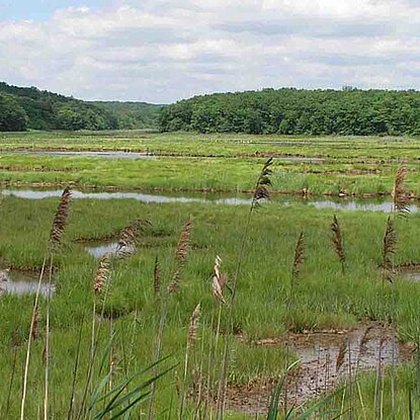
Shallow, often saline or alkaline waters: the margins of salt lakes, temporary rain pools on the prairie, salt flats, diked salt-production ponds and the mudflats of river mouths. At the breeding site it is a matter of open, bare or thinly vegetated shores and islets, without tall growth for a predator to hide in. In winter it also uses rice fields, flooded pasture and the sewage ponds beside towns. Deep water, dense growth and shaded banks it does not use.
Where the bird is most often found, arranged by the USNVC — the vegetation classification of the United States and Canada — and CMECS for sea and coast.




Range and movements
Breeds in the west and centre of the continent, from southern British Columbia, Alberta and Saskatchewan south through the Great Basin and the northern prairies to Texas and northern Mexico. Winters on the coast of California, along the Gulf of Mexico, in Florida and along both coasts of Mexico, and in smaller numbers as far as Guatemala, Honduras and Nicaragua and on Cuba. In the nineteenth century it bred considerably further east, into Wisconsin and Illinois; with the draining of the marshes it disappeared there. On the Atlantic coast, by contrast, it has increased as a winter visitor since the 1970s, with flocks as far as the Carolinas. The Great Salt Lake in Utah is the chief gathering place: tens of thousands of birds are there at once in late summer.
- Resident
- Breeding (summer)
- Winter
- Passage
- dark = core range, pale = thinly spread
Where and when to look
Go to a salt lake or a salt-production pond in August or September and look for a dense, white group in shallow water: avocets feed in line and all move to the same rhythm, which stands out at once from a distance. Then sit down and watch a single bird: the curve of the bill tells you whether it is a male or a female, which few shorebirds allow so easily. In May the same pool shows the rusty orange heads, which are already fading by July.
Conservation
The population is put at about 450,000 birds and has stayed roughly level since the 1960s. The largest loss lies further back, in the draining of the marshes of the midwest, which shrank the breeding range westwards. The present worries are chemical: selenium from irrigation drainage and mercury from coal burning accumulate in the shallow basins where the bird breeds, and deformed embryos are the result. On top of that the salt lakes of the west, the Great Salt Lake foremost among them, are falling hard through water abstraction and drought.
Scientific name
Recurvirostra americana | Gmelin, 1789
Gmelin described the species in 1789 and placed it at once in Recurvirostra, the genus Linnaeus had introduced in 1758; because it has not moved since, author and year stand without parentheses. The generic name is compounded from Latin recurvus 'bent backwards' and rostrum 'bill', and describes exactly what sets the bird apart from other shorebirds. americana means 'American'. Gmelin gave as its origin 'North America and New Holland', that is, Australia; the latter rested on an error, and the type locality was afterwards restricted to North America.