All species › Cranes, rails and allies › Rails, gallinules and coots › Black Rail
Black Rail | Laterallus jamaicensis
Zwarte Dwergral | Polluela Negra
Black Rail is the smallest rail in North America: no bigger than a sparrow, dark slate-grey with white speckling, a chestnut nape and a deep red eye. It lives in the densest, shallowest corner of the marsh and is almost only ever heard, at night. The eastern subspecies has been listed as threatened in the United States since 2020.
Voice
The male's call has three syllables, kic-kic-kerr, the last of them lower and burred; it is repeated for minutes on end with short pauses between. Calling comes mostly between midnight and first light, in spring and early summer, and on a still night a calling bird carries a couple of hundred metres. There is also a long, rattling growl, given by both sexes, whose meaning is not known; anyone who does not know it takes it for a frog or an insect. By day the bird is almost always silent.
Recording: Paul Lenrumé — CC BY-NC-SA 4.0 · Montplaisant savanna, French Guiana · xeno-canto
Identification
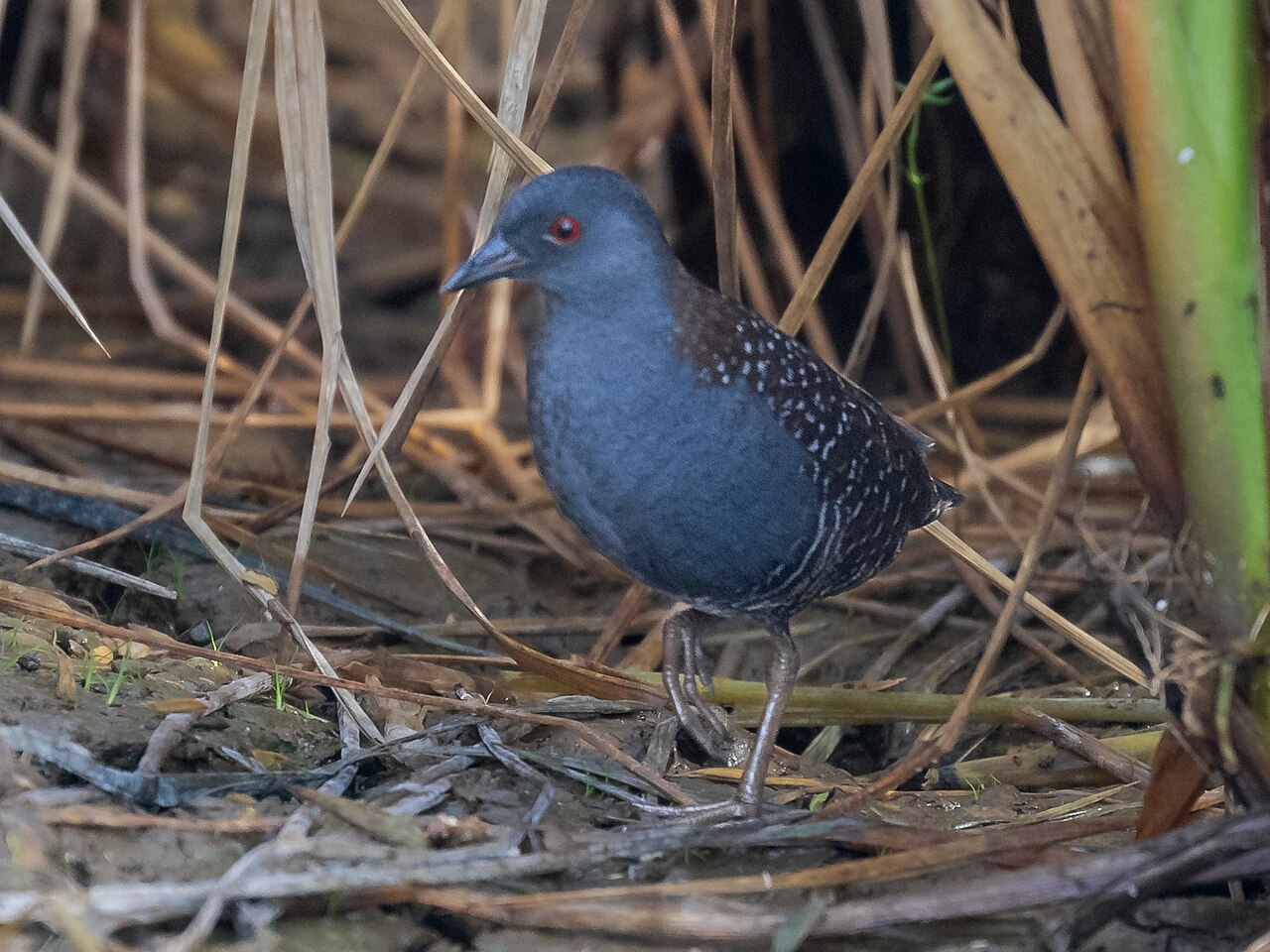
A rail of 10 to 15 cm and about thirty grams, with a short blunt black bill, short wings and heavy legs for its size. The adult is dark slate-grey, blackest on crown and forehead, with a chestnut patch on the nape and upper back and fine white speckling over back, wings and flanks. The eye is deep red and catches attention at once at close range; the legs are dull pink to wine-coloured. The sexes look nearly the same, though the female has a paler grey throat. Young birds resemble the adults but show less white and an amber eye, which turns red only at about three months; downy chicks are entirely black. It hardly ever flies: a short whirring flutter just over the grass, and straight back down.
Confusion species
Nothing else in the marsh is that small and that dark at the same time. Sora is more than twice the size, with a yellow conical bill and a grey face; Yellow Rail is buff-yellow with black lengthwise stripes and a white patch in the wing. The commonest mistake is a downy chick of Clapper Rail, King Rail or Virginia Rail, which is also all black — that has a proportionately larger head, always walks close to a parent, and lacks the white speckling and the chestnut nape. The growling call is confused as well, in that case with a frog.
Habitat
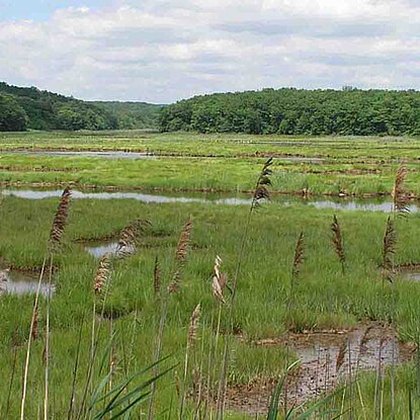
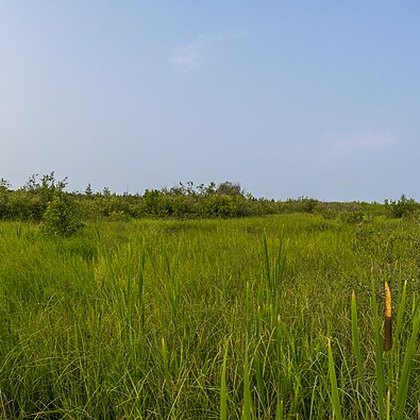
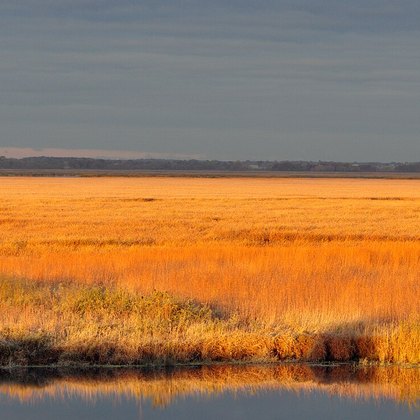
The highest edge of salt marsh, flooded only by the heaviest tides, with dense saltmeadow cordgrass, saltgrass and rushes; inland, wet meadows and shallow freshwater marsh with sedge and grass, often around springs, seeps and leaking irrigation canals. The water there may be no more than a few centimetres deep, and a dense roof of grass must carry right down to the ground. Open water, tall cattail stands and anything that regularly floods deeply are of no use to it. Because it sits so shallow, it is exposed both to ground predators and to any sudden inundation.
Where the bird is most often found, arranged by the USNVC — the vegetation classification of the United States and Canada — and CMECS for sea and coast.

Range and movements
In the east it breeds along the Atlantic coast from New Jersey south to Florida and on along the Gulf Coast into Texas, with Texas and Florida the places where it is most numerous; inland there are small populations in the Arkansas River valley of Colorado, in southern Kansas and patchily in Oklahoma. The northern birds withdraw to the Gulf and southern Atlantic coasts; sites north of Ocean County, New Jersey, have been abandoned, and in North Carolina it has fallen away sharply. In the west a group stays all year in the marshes along the lower Colorado River and the canals of the Imperial Valley, in Arizona and southeastern California, and further in San Francisco Bay and the Sierra Nevada foothills. Between 1989 and 2001 that western group declined steeply.
- Breeding (summer)
- Winter
- Passage
- dark = core range, pale = thinly spread
Where and when to look
Go in May or June after midnight to a dike or a track along the landward side of a salt marsh or a wet meadow and stand still and listen; the three-syllable call carries far over flat ground. Do not walk into the marsh: the nests are on the ground, the birds barely take flight, and for a listed species the use of recordings to draw them out is not permitted. Waiting quietly on a windless night yields more than searching in daylight, because by day the bird does not leave cover.
Conservation
The IUCN lists the species as Endangered (EN); the eastern subspecies Laterallus jamaicensis jamaicensis was listed as threatened under the United States Endangered Species Act in October 2020, after steep declines across nearly the whole of its range. The threats are the loss and fragmentation of marsh, altered water regimes, mowing and burning at the wrong moment, grazing, predators and contaminants; on top of that comes sea-level rise, which takes away precisely the high marsh it lives in. How many birds are left is not well known, because the species can only be counted at night and by ear.
Scientific name
Laterallus jamaicensis | (Gmelin, 1789)
Gmelin described the species in 1789 as Rallus jamaicensis, in the thirteenth edition of Linnaeus's Systema Naturae; because it was later moved to another genus, author and year stand in parentheses. The genus Laterallus was introduced by Gray in 1855 and sets Latin latus ('side, flank') beside the genus name Rallus. jamaicensis means 'of Jamaica', because that is where the described specimen came from. Beside the eastern birds, the western group is separated as Laterallus jamaicensis coturniculus, with a protected status of its own in California.