All species › Cranes, rails and allies › Rails, gallinules and coots › Yellow Rail
Yellow Rail | Coturnicops noveboracensis
Gele Ral | Polluela Amarilla
Yellow Rail is a small, buff-yellow rail of shallow sedge marsh that makes itself heard almost only at night and by day hardly ever steps into the open. To see one you have to flush it, and what stays with you afterwards is the white patch in the wing. Roughly nine tenths of the breeding range lies in Canada.
Voice
The song is a dry, insect-like ticking, close to the sound of two pebbles or two coins struck together: tick-tick, tick-tick-tick, in a fixed measure of two and three, kept up for minutes on end. On a still night it carries several hundred metres. Calling is almost entirely after dark, in May and June, and loudest around midnight; a bird will sometimes answer two coins tapped together at the edge of the marsh. Outside the breeding season it is all but silent.
Recording: Justin Watts — CC BY-SA 4.0 · McGregor Marsh, Aitkin Co., Minnesota, United States · xeno-canto
Identification
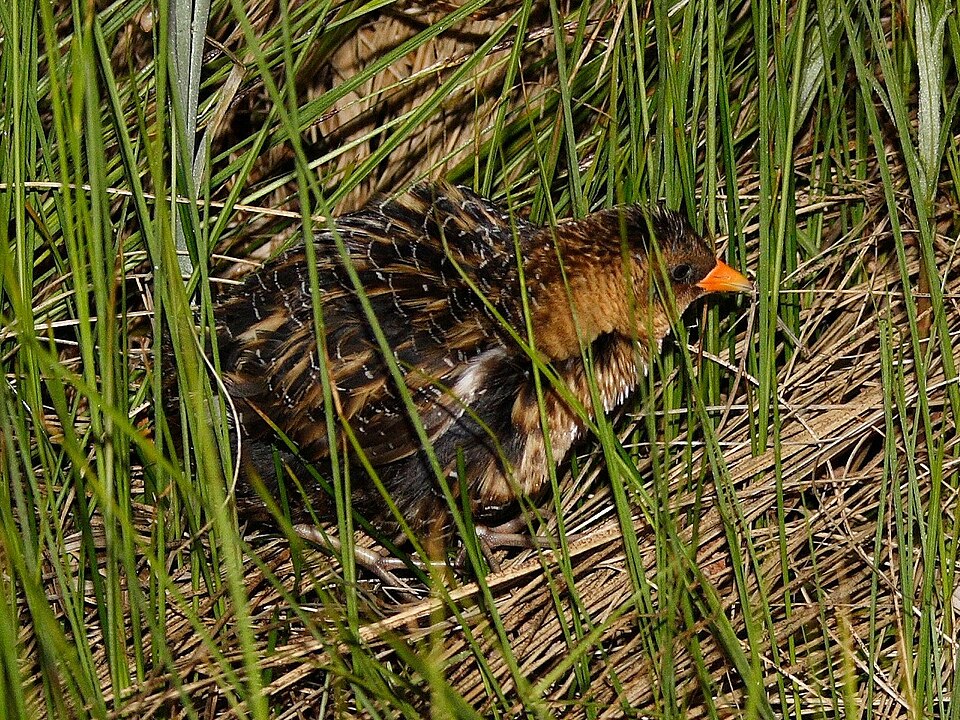
A very small rail of 13 to 18 cm and 40 to 70 grams, with short rounded wings, a short blunt bill and long legs for its size. The upperparts are buff-yellow with broad black lengthwise stripes, crossed by fine white bars, which gives a chequered look at close range. Face and breast are pale yellow, with a dark patch on the cheek; the bill is yellowish in breeding males and otherwise greenish grey. The best mark shows only in flight: a large white patch on the inner primaries and the secondaries, which flares as a bird lifts. It flies seldom, and then briefly, low and with legs dangling, dropping back into the sedge within a few tens of metres. Young birds are duller, with fine barring on nape and flanks.
Confusion species
Sora lives in the same marsh but is nearly twice the size, has a grey breast, a short yellow conical bill and no white in the wing; a young Sora is buff-toned and is the bird most often taken for a Yellow Rail. Black Rail is smaller again and dark slate-grey with white speckling and a chestnut nape, without the yellow ground colour and without the white wing patch. Virginia Rail is larger, rufous on the breast, and has a long, slightly curved red bill. On a bird lifting out of the grass, the white secondary patch settles the matter within a second.
Habitat
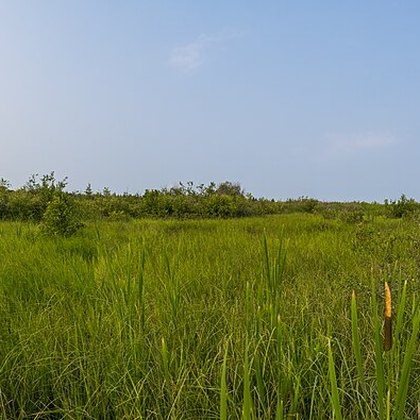
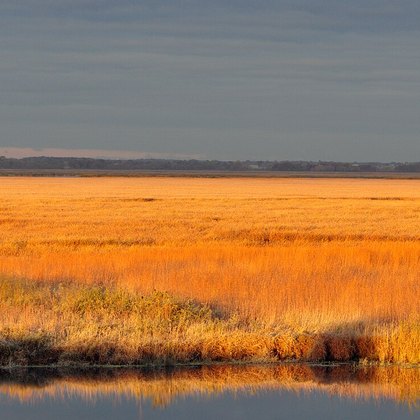
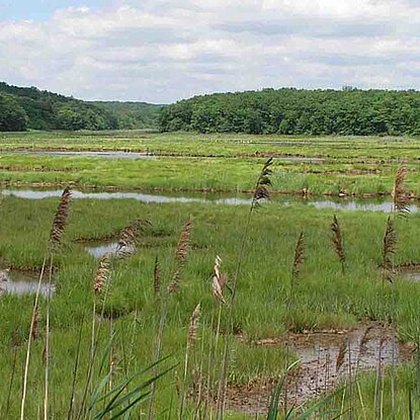
Shallow sedge marsh and wet meadow where the water stands no deeper than a hand's breadth and a layer of last year's dead sedge lies over the ground; that layer serves it as a roof. In the boreal part of the range these are fens and sedge-filled hollows in muskeg country. In winter it sits in the higher, drier parts of salt marsh with cordgrass, in damp meadows just behind the coast, and in rice fields. Deep cattail marsh and open water are of no use to it.
Where the bird is most often found, arranged by the USNVC — the vegetation classification of the United States and Canada — and CMECS for sea and coast.


Range and movements
It breeds from the Northwest Territories and northern British Columbia east through Alberta, Saskatchewan, Manitoba, Ontario and Quebec to New Brunswick, and in the United States in Minnesota, Wisconsin, Michigan, the Dakotas, Montana and very locally in Maine. A separate population holds the wet sedge meadows of the Klamath Basin in southern Oregon, with Klamath Marsh, Sycan Marsh, Summer Lake and the Wood River Valley as regular sites. It winters in a narrow coastal band from the Carolinas through Florida and west along the Gulf to southern Texas. Migration is by night, in September and October and back in April and early May, and it is rarely noticed on the way; now and then a bird ends up in a city park or on a parking lot.
- Breeding (summer)
- Winter
- Passage
- dark = core range, pale = thinly spread
Where and when to look
Go to the edge of a sedge meadow after dark in June and listen: the ticking in twos and threes carries for hundreds of metres and finds the bird where no binocular will. Tapping two coins together sometimes draws one closer, but do not walk into the breeding ground. In winter it can be found in the Gulf coast marshes, where it lifts only when somebody passes within a step; be ready then for the white patch in the wing, because much more than that is not on offer.
Conservation
The Red List has it as not threatened, but the North American population has lost more than half its numbers in fifty years and it stands on the watch list of species at a tipping point. The Canadian population is put at about ten thousand mature birds, with much uncertainty around that figure. The main pressures are the draining and conversion of sedge meadow, altered water levels, shrub and tree encroachment where fire has been withheld, and mowing and grazing during the nesting season. An isolated population in Mexico may be gone.
Scientific name
Coturnicops noveboracensis | (Gmelin, 1789)
Gmelin described the species in 1789 as Fulica noveboracensis, in the thirteenth edition of Linnaeus's Systema Naturae; because it was later moved to another genus, author and year stand in parentheses. The genus Coturnicops was introduced by Gray in 1855; the name sets Latin coturnix ('quail') beside Greek ops ('appearance'), after the compact build and the striped plumage. noveboracensis means 'of New York', after Novum Eboracum, the Latin name of that city. The type locality is accordingly given as New York.